As the Voice of the Employee (VoE) market faces rising pressure from evolving employee expectations, hybrid work environments, and the demand for real-time insights, organizations are moving beyond traditional survey-based feedback tools.
This review blog by QKS Group assesses whether VoE platform vendors are truly innovating to meet these demands or merely making incremental updates.
What Modern VoE Platforms Should Deliver: Today’s platforms must offer more than core surveying features. Critical next-gen capabilities include:
Embedded Listening Triggers: Contextual feedback prompts woven into daily workflows and key lifecycle moments.
AI-Powered Signal Detection: Intelligent systems that surface emerging themes and risks before they escalate.
Multi-Channel Orchestration: Seamless listening across Slack, Teams, mobile apps, and other flow-of-work environments.
Key Findings:
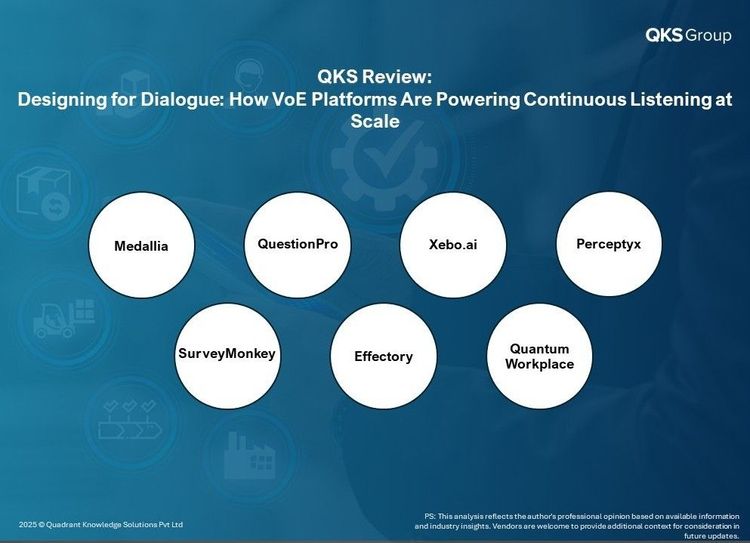
Leading vendors (Xebo.ai, Medallia, QuestionPro) stand out with comprehensive, enterprise-grade solutions architected for continuous listening and intelligent feedback action.
Capable vendors (Perceptyx, SurveyMonkey) show promise in structured programs and ease of use but lack real-time orchestration and embedded design maturity.
Lagging vendors (Effectory, Quantum Workplace) remain focused on cyclical surveys and cultural diagnostics, offering value in specific contexts but falling behind in responsiveness and workflow integration.
Market Landscape
The Voice of the Employee (VoE) landscape is evolving from static snapshots to dynamic, ongoing dialogue. Annual surveys and quarterly check-ins no longer meet the needs of today’s workforce, where engagement can shift week by week, even hour by hour. As employee expectations grow, organizations increasingly need platforms that support continuous listening: systems built to gather feedback in real time, across multiple channels, and seamlessly within daily workflows.
Leading organizations now view listening as more than a pulse survey or sentiment metric; it’s a core system of engagement, intelligence, and action. In this transformation, VoE platforms are redefining how, when, and why feedback is captured, and what’s done with it.
This capability-focused review examines how vendors are approaching continuous employee listening: not just in feature sets, but in the philosophies shaping their platforms. While some vendors have embedded listening deeply into their architecture and workflows, others are extending legacy frameworks with incremental features.
This segmentation reveals which platforms are building for the future and which may need to rethink their listening strategies.
Leading Platforms: Listening as Infrastructure, Not an Add-On
At the forefront of the shift to continuous listening are platforms that treat employee feedback as a living data stream, something to be captured, interpreted, and acted upon in real time. These vendors have embedded listening touchpoints across the employee lifecycle and across tools employees already use, such as Slack, Microsoft Teams, and mobile apps.
Medallia leverages its experience in experience management to deliver robust cross-channel listening capabilities, blending active and passive signals. Through voice, digital, and behavioral data, Medallia creates a holistic listening ecosystem that informs HR, managers, and leadership teams in real time. The platform’s deep analytics and NLP capabilities add layers of insight that few competitors match.
Xebo.ai with intelligence and automation at its core, captures feedback instantly, across channels and formats. Its AI spots issues early by detecting patterns that could lead to churn, while manager dashboards enable quick action. XEBO also delivers robust Voice of Employee (VoE) insights, helping organizations stay connected to what truly matters to their people. Its flexible, modular design supports continuous listening across key moments, from onboarding and development to change readiness, without relying solely on scheduled surveys. XEBO.ai exemplifies this “designed-for-dialogue” approach, making every interaction a meaningful opportunity to listen, learn, and act.
QuestionProhas made significant strides in building scalable listening workflows. It now supports a range of always-on listening options, with alerting and reporting tools accessible to both HR teams and frontline managers. While historically known for its structured survey tools, the platform’s evolution into real-time listening and improved personalization makes it a compelling choice for organizations looking to embed feedback across the flow of work.
[MT1]Catch-Up Players: Expanding Listening, One Layer at a Time
Other platforms are actively enhancing their listening capabilities, though many began with more traditional, campaign-based survey models. These vendors are introducing pulse surveys, conversational feedback tools, and dashboarding enhancements but still face limitations in real-time orchestration or intelligent signal detection.
Perceptyx,known for its enterprise-grade survey customization and reporting depth, is broadening its focus to include more dynamic listening workflows. Its strength remains in structured lifecycle programs and segmentation-based insights. However, the platform still operates largely within scheduled feedback cycles. While its dashboards and manager tools are robust, the underlying feedback architecture has yet to become fully real-time or contextual. Organizations using Perceptyx often implement workarounds or integrate third-party tools to simulate continuous listening. The vendor shows promise, especially with recent innovations around nudging and targeted feedback, but its maturity across embedded triggers and signal automation remains in progress.
SurveyMonkey, retains its ease-of-use and speed advantages. The platform offers pulse templates and quick-deploy listening programs but is more reactive than predictive. While suitable for organizations starting their feedback programs, SurveyMonkey lacks the integration depth and contextual feedback delivery that define modern continuous listening platforms.
Both vendors are investing in smarter feedback, but their current structures still revolve around survey cycles rather than adaptive feedback ecosystems.
Adjacent Players: Listening Through a Culture Lens
Vendors like Effectory and Quantum Workplace offer unique value in the Voice of the Employee (VoE) space, with strong emphasis on engagement and cultural alignment. Both have introduced more frequent listening tools and manager reporting capabilities, though their architectures still lean toward structured feedback intervals.
Effectory’s strength lies in international engagement programs and culture diagnostics, making it a strong partner for organizations operating across borders. QuantumWorkplace stands out for its performance-linked listening tools and manager enablement features, but its continuous listening design is more cyclical than embedded.
These platforms add valuable perspective to the broader VoE landscape; especially for companies seeking to link engagement to broader culture and performance narratives but are not yet fully aligned with the demands of high-frequency, embedded listening.
What’s Next: From Listening to Systemic Responsiveness
As employee voice grows more complex and business cycles become shorter, continuous listening will define which organizations stay connected to their workforce in meaningful, real-time ways.
Vendors that treat listening as infrastructure, not just survey automation are leading this evolution. Platforms like Medallia, Xebo, and QuestionPro are building environments where feedback can surface organically, be analyzed intelligently, and lead to action autonomously.
Catch-up platforms such as Perceptyx and SurveyMonkey, while strong in their legacy strengths, are still retooling to meet the demands of continuous listening in hybrid and fast-evolving work environments. They still serve important use cases, particularly for organizations early in their Voice of the Employee (VoE) journey or focused on tactical feedback. However, as expectations shift toward agility, personalization, and immediacy, platforms without embedded listening architectures may struggle to meet enterprise demands.
The future of feedback is continuous, contextual, and connected; and the platforms shaping that future are already listening.
Disclaimer & Invitation:
This blog is based on independent research and publicly available information. The insights presented reflect the views of QKS Group and are for informational purposes only. While we strive for accuracy, we do not guarantee completeness or absolute correctness. Vendors are welcome to provide clarifications or updates. If any vendor listed in this analysis wishes to provide additional context or clarification, we welcome a briefing call and will consider incorporating relevant updates. This analysis is not intended to disparage any vendor but to provide an informed, balanced perspective. We encourage open and constructive dialogue to foster transparency and a deeper understanding of the industry.