QKS Logo
QKS Library Icon

QKS Library

NewsroomSign In
QKS Logo

Build a business case that stands up to scrutiny

Validate your technology business case against a structured ROI methodology, with assumptions clearly defined and financial outcomes assessed using established value metrics.
Designed for product marketing, sales, value engineering, and commercial teams that need a defensible business case for enterprise buyers.

ROI Benchmark Framework™

A structured QKS Group methodology for evaluating technology value and ROI.

Three-point ranges

Conservative, median, and top-quartile scenarios instead of relying on a single projection.

NPV · IRR · BCR

Financial metrics that help evaluate the potential value of an investment.

Validated, not authored

We assess the assumptions and business case. Your team owns the final commercial message.
The Challenge

A strong product story needs a strong business case

Vendor presents the expected ROI

Buyer challenges the assumptions

Finance asks for supporting evidence

Procurement reviews the economics

The business case becomes harder to defend

The challenge is often not demonstrating value. It is demonstrating value credibly.

Technology vendors often build ROI cases around their own assumptions, projected benefits, and expected outcomes. Enterprise buyers may then ask how those assumptions were calculated, whether they apply to their environment, and how the projected returns compare with realistic alternatives.
Business Case Validation provides an independent review of those assumptions and the underlying financial model before the business case reaches the final stages of the buying process.

Give your buyers a business case they can evaluate

QKS Group assesses your business case using a structured methodology that examines the assumptions, value drivers, costs, and projected financial outcomes.
The objective is not to rewrite your marketing message. It is to test whether the underlying business case is supported by a clear and defensible financial model.

Typical Engagements

When Business Case Validation is useful

01

A new value proposition is being developed

You are building an ROI or business case to support a product launch, positioning change, or new market opportunity.

02

The business case needs additional validation

Sales, finance, or executive stakeholders need greater confidence in the assumptions and financial model behind the proposed value.

03

Pricing or packaging is changing

Repricing or repackaging needs an economic defense buyers can't dismiss as self-serving.

04

ROI evidence is part of your market strategy

You want independently assessed economic evidence that can support conversations with prospects, customers, and internal stakeholders.

The Framework

What we validate

A business case is built from multiple assumptions and inputs. Our validation framework examines the key components that determine whether the proposed economics are supported by the available evidence.

Component 01

Value drivers

Are the proposed benefits clearly defined and relevant to the customer?

We examine the value categories used in the business case and assess whether they reflect outcomes customers can reasonably expect.

Component 02

Assumptions

Are the assumptions behind the model clearly defined and supported?

We review inputs such as adoption rates, baselines, timelines, usage levels, and other assumptions that influence the projected outcome.

Component 03

Cost Model

Does the model account for the full cost of the investment?

We assess whether the business case considers relevant costs such as implementation, migration, integration, operations, and licensing.

Component 01

Return Metrics

Do the financial metrics support the proposed business case?

We review measures such as NPV, IRR, BCR, and payback period where applicable, using the assumptions established in the model.

Component 02

Sensitivity

How does the business case change when key assumptions change?

We identify the assumptions that have the greatest impact on the projected outcome and assess how sensitive the business case is to those changes.

Component 03

Realized-Value Evidence

Is there evidence that supports the expected customer outcomes?

Where relevant, we examine customer evidence, voice-of-customer research, benchmarks, and other available sources that can support the value claims.

The Methodology

How Business Case Validation works

You provide the business case and supporting evidence. QKS Group applies relevant benchmarks, financial analysis, and market evidence to assess the model and produce a structured validation output.

01

Case intake

Review the business case and supporting inputs

We review the proposed value model, key assumptions, supporting evidence, and the intended customer use case.

02

Benchmark Testing

Assess assumptions against relevant benchmarks

Key inputs are compared with applicable market benchmarks, value ranges, cost assumptions, adoption levels, and other relevant reference points.

03

Buyer Evidence Review

Compare the case with available customer evidence

Where relevant, we assess the proposed value drivers against buyer and user perspectives, voice-of-customer research, and other supporting evidence

04

Sensitivity Analysis

Identify the assumptions that influence the outcome

The model is tested across relevant scenarios to understand how changes in key assumptions affect the projected business case.

05

Validated Model

Document the findings and financial outcomes

The validated model presents the relevant scenarios, financial metrics, supporting evidence, and areas where assumptions require further consideration.

06

Analyst Readout

Review the findings with the QKS Group analyst

A working session provides an opportunity to discuss the methodology, assumptions, findings, and implications of the validation.

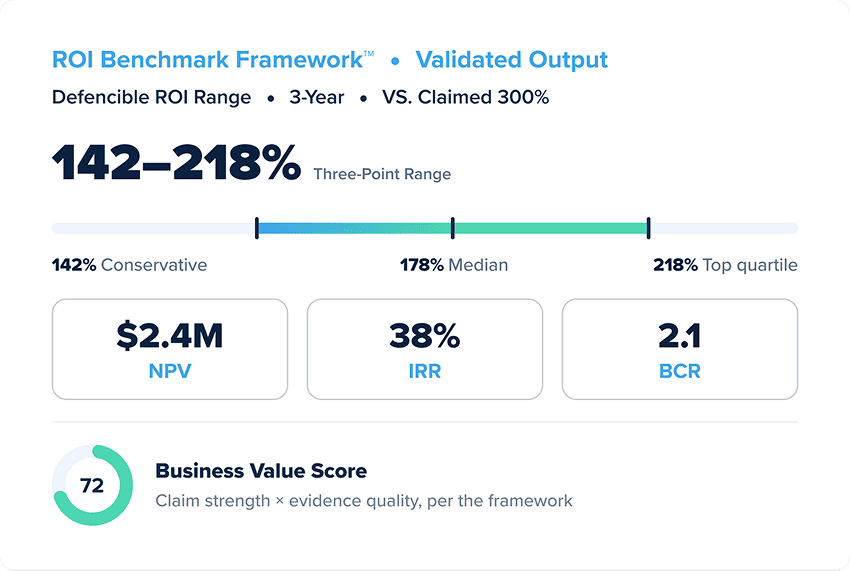
ROI Benchmark Framework validated output

Illustrative output. In this engagement the claimed 300% didn't survive the model — the validated three-point range is what the vendor now leads with, because it speaks the same grammar as the buyer's benchmark.

Business cases often depend on assumptions that can vary by customer, market, and implementation environment. Presenting a range alongside the underlying assumptions helps stakeholders understand both the potential return and the factors that influence it.

Deliverables

What you receive

A Business Case Validation engagement provides a set of outputs that document the assumptions, analysis, findings, and supporting evidence behind the validated business case.

Validated Business Case Report

A detailed assessment of the business case, including the key assumptions, financial model, supporting evidence, and validation findings.

Validated ROI Range

A three-point view of potential returns, including conservative, median, and higher-case scenarios, supported by the underlying assumptions.

Business Value Score

A structured assessment of the strength of the business case based on the methodology and available supporting evidence.

Assumption Risk Register

A summary of the key assumptions that have the greatest influence on the business case, including areas that may require additional evidence or validation.

Validated Model

A working version of the validated financial model that your team can use to review assumptions, scenarios, and outputs.

Citation & Usage Rights

Where applicable, documentation and licensing rights for referencing the validated findings and methodology in approved buyer-facing materials.

The Evidence Behind The Validation

Validation supported by multiple sources of evidence

Business Case Validation combines the submitted business case with relevant QKS Group research, benchmarks, customer evidence, and market context.
This provides a broader evidence base for assessing the assumptions and value drivers behind the proposed business case.

Economic evidence

ROI Benchmark Framework™

Relevant value and cost benchmarks used to assess the financial assumptions within the business case.

Customer evidence

VoC Resonance™

Customer and user evidence that provides context on the outcomes and benefits experienced in relevant technology categories.

Buyer evidence

Enterprise buyer inquiry

Insights into how enterprise buying teams evaluate technology value, business cases, and investment assumptions.

Competitive & market evidence

SPARK Matrix™ Evaluations

Market and competitive research that provides context for the technology category, vendors, and broader market environment.

Frequently Asked Questions

Understand how QKS Group’s Business Case Validation helps technology providers validate ROI assumptions, strengthen financial models, and build credible, evidence-based business cases to support sales opportunities and customer decision-making.

Get the math validated before procurement does.

Tell us the offering and the claims it carries. We'll scope the validation.

Pricing scoped to portfolio breadth · How we keep research independent →