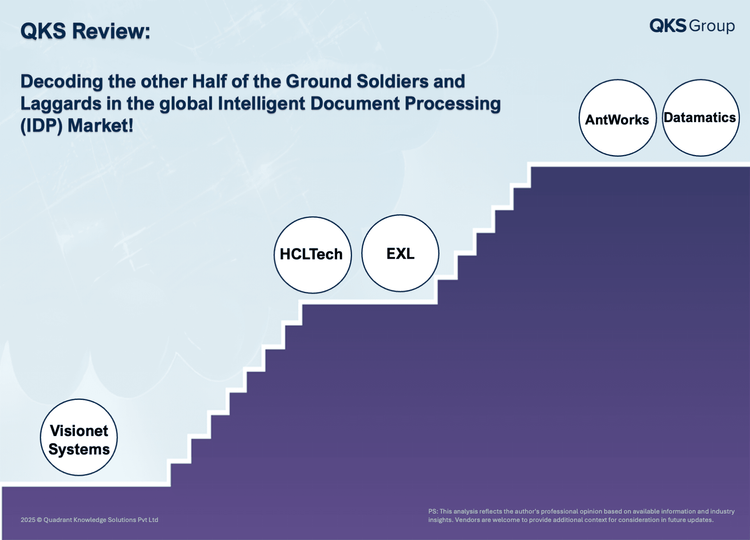
The global Intelligent Document Processing (IDP) landscape is undergoing significant transitions in the recent past. We at the QKS Group have identified the following categories in which majority of the vendor basket is falling into –
- Thinkers (Ideologists/ Conceptualizers)
- Pioneers/ Anchors (Remarkable Achievers)
- Revolutionaries (Leaders/ Activists)
- Executioners (Commanders/ Path Creators)
- Ground Soldiers (Trend Adopters)
- Laggards (Simple Trend Followers)
In this blog, we would be categorically focusing on the other half of the vendors falling under the 5th and the 6th Category of Evolution of the IDP Vendors and try dissecting their offerings, based on the above-mentioned bifurcation (also highlighting their significant aspects) i.e. on –
- Ground Soldiers (Trend Adopters)
- Laggards (Simple Trend Followers)
Datamatics – Steady Scalers
Datamatics’ ‘TruCap+ IDP’ platform is promoted as a ‘unified automation engine’, which blends its intelligent document processing (IDP) with other aspects like RPA, analytics, as well as the data operations. Thus, this reflects a ‘holistic automation mindset’, as against a rather narrowly focused IDP solution. The actual strength of the ‘TruCap+’ primarily lies in its broader functional scope - wherein it supports the extraction from structured, semi-structured, as well as the unstructured content. It further leverages the OCR with prior cognitive skills, and integrates downstream into the ‘document-rich workflows’, including the likes of billing, vendor onboarding, and claims as well. With its global operational delivery and the presence across the plethora of geographies, Datamatics promotes its promise of ‘automate everything’, to the mid-market and enterprise clients alike, thereby emphasising on the ‘cost-efficiency’ and ‘incremental value’ aspects prominently.
Furthermore, Datamatics go-to-market strategy appears to be pragmatic. Case in point, since the ‘TruCap+’ is positioned as a ‘managed service-friendly’ platform, that is supported by the Datamatics’ ‘global service footprint’ and the delivery partners, thereby enabling the customers in adopting the IDP, with minimal to nil technology risk. The solution further offers verticalized accelerators, particularly in the verticals like - finance, banking as well as logistics, which further supports aspects like ‘faster deployment’ an the ‘targeted value realization’. However, despite these robust capabilities, Datamatics still appears to present a persona of a ‘Steady Scaler’, rather than being a ‘market disruptor’. Its IDP narrative seems to emphasise more on the ‘consolidation and expansion’ of capabilities, but somehow, its yet to effectively project a very distinct ‘GenAI Innovation Edge’, or build a robust ecosystem which could rival the other ‘large platform-centric’ competitors. Furthermore, the company’s enterprise-scale reference base, particularly in the context of the ‘highly regulated’ and ‘multinational deployments’, still remains severely limited in its visibility.
In a nutshell, Datamatics does offer a considerably reliable and functionally broadened IDP approach, with commendable operational delivery, coupled with a ‘service-oriented’ model. Stil, until it accelerates its core pace of innovation, dives deeper into its platform differentiation, and successfully undertakes actual large-scale enterprise transformations, it appears to be continuing to operate as a ‘Steady Scaler’ - competent and capable, yet not quite the ‘game-changer’, within the global IDP arena.
HCLTech = Adaptive Transformers
HCLTech positions its EXACTO™ platform as a ‘core enabler’ of the ‘adaptive document intelligence’, by primarily combining the AI, ML, and GenAI-driven automation, within the re-engineered and microservices-based architecture. The platform’s transition from monolithic to modular primarily reflects HCLTech’s strategic shift towards the composable, scalable, as also the cloud-ready IDP. More so, through its continuous innovation, it now ably supports a plethora of use cases and languages, thereby underlining its focus on critical aspects like breadth, flexibility, as well as the enterprise readiness.
Especially, its ‘Ask EXACTO’ capability, that is powered by Generative AI, does enables natural language document querying (NLDQ) as well as the contextual summarization, thereby reinforcing the company’s commitment towards humanized as well as explainable document understanding. The solution’s strength further lies in its ability in managing diverse input types as well as the complex document workflows, right from insurance claims all the way to contract analysis, while also ensuring that aspects like the data consistency as well as security are maintained across the regulated environments.
Backed by a robust technology partner network which includes the likes of AWS, Azure, UiPath, as well as SS&C Blue Prism, amongst others, the platform does maintain high interoperability and integration, within the broader enterprise ecosystems. From an execution standpoint, HCLTech seems to be leveraging its expansive delivery footprint as well as its vertical depth across the plethora of industries like the - BFSI, healthcare, as well as the telecom, for scaling its IDP engagements practically globally. Its innovation cadence, that is marked by its incremental but steady enhancements within aspects like the NLP, zero-shot learning, as well as the real-time model feedback, does position it as a ‘mature transformer’, thereby balancing its reliability with the innovation.
Yet, while HCLTech’s approach appears structurally sound, it does remain quite ‘methodically evolutionary’, as against being ‘radically disruptive’. Its innovation narrative still appears to lean more towards the ‘enterprise stability’, as against its market-shaping agility. For fully capitalizing on its leadership position, the company could actively accelerate the pace of its ‘GenAI operationalization’, along with fostering a deeper ecosystem co-innovation, thereby ensuring that the EXACTO does evolve from a mere reliable document automation tool, into a genuinely ‘agentic intelligence fabric’. Until then, HCLTech does appear as a typical adaptive transformer, a steady and disciplined innovator that is progressing through ‘structured modernization’, and is yet restrained by its cautious and large-enterprise orientation.
EXL – Process-Driven Pragmatists
EXL positions its proprietary ‘XTRAKTO.AI™’ solution as a lean and AI-native global IDP engine, that is aimed towards converting the unstructured content, into properly structured insights, all while coupled with a ‘minimal technical debt’, an a ‘template-agnostic scalability’. Its value proposition specifically emphasizes on aspects like the operational efficiency, domain-embedded NLP, and a thin yet prominent human-in-the-loop layer for driving the end-to-end extraction, as well as the validation workflows. One of the EXL’s key strengths lies within its ‘domain-first’ model design. As an example, one could consider its ‘underwriting & claims’ ontologies, which are developed by its insurance SMEs, and are embedded within its core AI modules, thereby allowing the accelerated onboarding of its vertical use cases.
The platform also steadfastly supports the ingestion of a variety of document types (including but not limited to the - structured, semi-structured, unstructured, as well as the handwritten types), while also integrating with its downstream systems, via the modular connectors. EXL’s broader organizational clout appears to be supporting its global IDP narrative. With entrenched roots in aspects like data analytics, BPO, as well as the digital operations, it appears to be including aspects lie operational scale, global delivery reach, as well as the domain credibility into the sectors like insurance, healthcare, as well as banking. Its more recent geographic expansion, such as the opening an ‘AI lab’ in Dublin, as well as its investment in ‘EXLdata.ai’, as a part of its AI platform stack, definitely underscores its ambition for evolving beyond the traditional services, into an AI-first product-led transformation.
Everything said and done, the story of EXL’s IDP journey appears more of being ‘evolutionary than being revolutionary’. While its ‘XTRAKTO.AI™’ does offer modularity as well as domain accelerators, its adoption beyond its existing domain strongholds does remain slowly incremental. Also, its GenAI narrative as well as the semantic reasoning layers are only now beginning to surface, and as such, its marketplace visibility as a ‘standalone IDP vendor’, still appears quite modest. To further strengthen its position in the market, EXL must now more aggressively externalize the reach of its XTRAKTO, actively expand its third-party ecosystem, as well as consistently punctuate the large-scale and cross-sector reference wins.
In essence, EXL does embodies all the qualities of being a ‘Process-Driven Pragmatist’ - anchored in aspects like the execution excellence, deep domain expertise, as well as the operational stability, thereby steadily advancing toward its goal of ‘intelligent document orchestration’, though still not yet fully defining its cutting edge within the global IDP innovation.
AntWorks - Emerging Specialist
AntWorks continues to redefine its presence within the global Intelligent Document Processing (IDP) space through its proprietary offering of the Cognitive Machine Reading (CMR+) platform, which is purpose-built for handling highly - variable, semi-structured, as well as the unstructured document types, at the enterprise scale. The platform unifies aspects like the low-code configurability, hybrid AI architecture, as well as the ‘GenAI-driven contextual intelligence’ – thereby delivering precision and adaptability, across the regulated and document-intensive industries.
Its ‘hybrid AI’ framework, that combines aspects like - deterministic ML, rules-based parsing, as well as the ‘GenAI-led’ context comprehension, all in all, ensures both explainability as well as accuracy, while minimizing the retraining needs, especially for the unseen document formats. The CMR+ is further strengthened by its ability in interpreting handwriting, images, tables, as well as the signatures, without any particular dependency on templates, thereby enabling resilient and high-volume automation, across the complex business processes.
Furthermore, critical strategic integrations have further reinforced its enterprise applicability, especially noteworthy being its ‘native Pega’ embedding for the seamless workflow orchestration, and its ‘Azure Marketplace’ presence which steadfastly supports scalable and secure cloud deployments. Additionally, the company’s vertical-specific solution – ‘Insurants’, does reflect a strong ‘domain calibration’, within the commercial insurance sector, being pre-trained on the documents, from across hundreds of carriers. These initiatives collectively appear to position the ‘CMR+’ as a technically mature and industry-aligned IDP platform, which appears suited for the ‘high-compliance’ use cases, which includes the likes of - claims, underwriting, as well as the KYC validation.
However, the AntWorks ‘market trajectory’, also continues to reflect the urgent need for a renewed ‘innovation momentum’, and the ‘ecosystem expansion’. While its insurance-oriented maturity appears to be a clear differentiator, other aspects like its broader cross-sector adoption, out and out global brand resonance, and its total partner network appear to remain relatively modest in the current times. Competing global IDP vendors seem to be outpacing the company in its ‘GenAI-enabled orchestration’ and ‘multi-vertical scalability’, thereby creating a possibility of AntWorks being perceived as an ‘innovation follower’, rather than being a ‘pace-setter’.
All in all, AntWorks does come across as an out and out ‘Emerging Specialist’ - a domain-focussed contender, that is steadily evolving from its initial ‘niche expertise’, towards a broader ‘enterprise maturity’ and ecosystem-driven growth, within the global IDP landscape.
Visionet Systems – Directional Drifters
Visionet Systems has steadfastly expanded its global Intelligent Document Processing (IDP) offering, through its ‘DocVu.AI’, a platform which is primarily tailored made for the document-heavy sectors, that includes the likes of - mortgage, insurance, as well as the financial services. Designed around the concept of ‘AI-driven’ extraction, validation, as well as the compliance auditability, the ‘DocVu.AI’ primarily positions itself as an ‘enabler’ of the precision-focused document automation, within the regulated enterprise workflows.
Visionet’s ‘hybrid AI stack, integrates aspects like the computer vision, NLP, as well as the ML, for delivering the contextual and field-level extraction, as well as the adaptive learning, going beyond the mere traditional OCR parsing. Its API-first and microservices-based architecture further supports aspects like the modular deployment, elastic scaling, coupled with the high availability across the hybrid and cloud environments, all of which remains highly critical for the industries that manage the fluctuating document volumes. Also, its embedded ‘AI-based’ anomaly detection and the rules-driven validation engine further reinforces the ‘downstream accuracy’, and the ‘compliance confidence’. Together, these components enable the ‘DocVu.AI’, in coming out as a robust and trustworthy ‘automation layer’, for the ‘high-precision’ document lifecycles.
However, the company’s global IDP trajectory does remain notably ‘directional yet diffused’. Its innovation rhythm doesn’t seem to have kept pace with the rapidly advancing ‘GenAI-native’ competitors, with the feature enhancements remaining largely present, yet slowly incremental. The platform’s scope also appears to be narrowly anchored to the ‘mortgage and insurance’ sectors, thereby limiting its ‘resonance’ across the broader enterprise ecosystems. Additionally, a relatively constrained ‘go-to-market’ execution, that is primarily heavily reliant on the direct ‘client engagements’, seems to have curtailed its ‘brand visibility’, along with its partner depth, and the geographical expansion potential.
While DocVu.AI does surely demonstrate a very credible technical depth and reliability, the company’s ability in evolving beyond its typical ‘comfort domains’, would actually determine its ‘long-term relevant differentiation’. A precisely sharper innovation cadence, much clearer product narrative, and a further strengthened alliance ecosystem – all appear imperative, for the company to actively scale its global IDP impact. All in all, Visionet Systems could be called as a ‘Directional Drifters’ - a technically grounded, and strategically ‘fragmented player’, that appears to move in the right direction, but is totally lacking the acceleration and clarity, which is required to further enhance and establish their position in the broader global IDP landscape.
Last Word –
Ultimately, as the global IDP market appears to advance towards a new era which is getting re-defined by critical aspects like the - agentic intelligence, core composability, as also the genuine contextual automation, vendors henceforth might no longer be able to rely on the mere ‘incremental evolution’. Basically, achieving the ‘actual competitiveness’ might now require a blend of aspects like ‘governance, scalability, as well as the adaptive orchestration’, which would then effectively transform the ‘static document capture’ into the full fledge ‘dynamic decision intelligence’ system. Vendors that are positioned towards the lower half of the ‘ground soldiers’ or ‘laggards’ must now more than ever, on priority undertake activities like - accelerating their innovation cycles, strengthening their core ecosystem depth, as well as ultimately redefining their ‘strategic relevance’. In the absence of which, they could then risk being steadfastly outpaced in an industry which rewards only those who appear capable of real-time as well as continuous learning, scaling, and thereby effectively leading.
This is Part 5 of the Blog Series.
[Click here for - QKS Review: Part 2 - Decoding the Revolutionaries and Executionaries in IDP! ]
[Click here for - QKS Review: Part 1 - Decoding the Thinkers & Pioneers in IDP!]
Disclaimer & Invitation:
This blog is based on independent research and publicly available information. The insights presented reflect the views of QKS Group and are for informational purposes only. While we strive for accuracy, we do not guarantee completeness or absolute correctness. Vendors are welcome to provide clarifications or updates. If any vendor listed in this analysis wishes to provide additional context or clarification, we welcome a briefing call and will consider incorporating relevant updates. This analysis is not intended to disparage any vendor but to provide an informed, balanced perspective. We encourage open and constructive dialogue to foster transparency and a deeper understanding of the industry.
Author:Apoorva Dawalbhakta, Associate Director (Research) at QKS Group