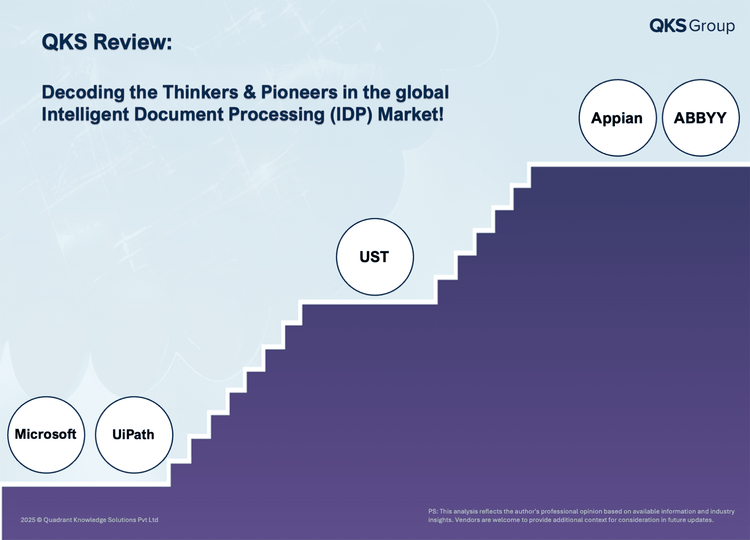
The global Intelligent Document Processing (IDP) landscape is undergoing significant transitions in the recent past. We at the QKS Group have identified the following categories in which majority of the vendor basket is falling into -
- Thinkers (Ideologists/ Conceptualizers)
- Pioneers/ Anchors (Remarkable Achievers)
- Revolutionaries (Leaders/ Activists)
- Executioners (Commanders/ Path Creators)
- Ground Soldiers (Trend Adopters)
- Laggards (Simple Trend Followers)
Let us understand which key vendors are assuming what respective position and role in unfolding this hierarchy of the dynamic global ‘IDP Revolution’. It is crucial to recognize that the global Intelligent Document Processing (IDP) market has been steadily evolving for quite some time now - transitioning from the very basic OCR and rules-based extraction tools, all the way to the present-day AI-native and context-aware ‘Document Intelligence’ platforms. What was once a mundane back-office utility, is now steadfastly becoming the very nerve center of ‘Enterprise Data Orchestration’, thereby powering a plethora of use cases across various verticals, promoting compliance, onboarding, claims, and more. In this blog, we de-code whether the leading global IDP players are aligning or falling short - on this transformative journey!
In this blog, we would be focusing more on the 1st and the 2nd Category of Revolution/ Evolution of the IDP Vendors and try dissecting their offerings, based on the above-mentioned bifurcation (also highlighting their significant aspects) i.e. on –
- Thinkers (Ideologists/ Conceptualizers)
- Pioneers/ Anchors (Remarkable Achievers)
In this critical review, we focus on dissecting the initial apparent vendors of the strategic maturity in the global IDP landscape – particularly the Thinkers, the Conceptualizers, the Anchors, and the Pioneers, all of whom are apparently/ ideally shaping (or may be not so much) the next chapter of global Intelligent Document Automation and Intelligence spectrum. From ABBYY’s genuinely visionary stance as an ‘Absolute Conceptualizer’, to Appian’s niche but equally deep and grounded innovation as a ‘Genuine Thinker’, and UST’s presence as a ‘anchors with emerging momentum’ - each one does bring a unique causality and positioning to the table. Meanwhile, UiPath, once seen as a proper disruptor, now does find itself caught in an absolute paradox of legacy expectations – thereby earning the tag of a ‘Theoretical Ideologist’. And finally, Microsoft – the giant, despite its vast ecosystem an associated strength, continues to play a sufficiently reserved role - thereby fitting the frame of a ‘Passive Pioneer’. Let’s decode what each of these positionings truly represent - grounded in actual capability insights, honest market readiness, and ultimate user realities!
ABBYY = Absolute Conceptualizer
Let’s begin with the ‘Absolute Conceptualizers’ in the global IDP arena i.e. ABBYY! Long before the market was completely fixated on the ‘GenAI-led’ Document Intelligence, the company had already laid the primary groundwork with a genuine focus on aspects like cognitive capture, intelligent classification, and actual document understanding. Its proprietary ‘Vantage Platform’, in particular, seems to have redefined the very modular document processing concept, by the assistance of pre-trained skillsets, reusable cognitive services, and no-code composability, ultimately enabling business users in stitching together diverse document flows, minus the need for in-depth technical expertise. Its observed that ABBYY was also amongst the very early sets of vendors to promote the ‘Document-to-Insight-to-Action’ paradigm, thereby pushing IDP as a concept beyond the mere/ stereotypical ‘Capture’, into the actual decision support.
Notably, the company’s investments in aspects like Computer Vision, NLP, and Task Mining, seem to be paying off, having resulted in robust pipelines for processing unstructured content across verticals typical sectors like the BFSI, logistics, and healthcare, amongst others. What makes ABBYY truly stand out is not just its atypical technology stack, but rather its platform-agnostic strategy – thereby positioning itself perfectly as an ‘Intelligence Layer’ that can surely plug into any automation or analytics ecosystem, rather than pushing for compulsory platform lock-in! While recent entrants in the global IDP market, talk mainly around ‘foundation models’ and ‘Generative AI’, ABBYY’s maturity seems to lie in its ability to stitch intelligence into the actual ‘Operational Fabric’ – in a very methodical, thoughtful, incremental manner, with appropriate precision. For all these reasons, ABBYY is recognised as an 'Absolute Conceptualizer' in the global IDP Market of 2025 - a vendor which hasn’t just followed the IDP curve, but in many ways, has shaped and moulded it as well!
Appian = Genuine Thinkers (Remarkable Niche Achievers)
In the global Intelligent Document Processing (IDP) landscape, Appian stands out as a ‘Genuine Thinker’, which is made possible, not by chasing breadth alone, but by crafting and further honing their precision-focused capabilities within their unified ‘AI Process Platform’! While many global vendors have been treating IDP merely as an ‘isolated toolset’, Appian appears to integrate their proprietary IDP natively into their low-code automation fabric – thereby tightly weaving the ‘Document Intelligence’ into every bit of workflows, business rules, and case management ledgers as well. Its ‘AI Skill Designer’ and built-in ‘Document Extraction’ features greatly empower the users into rapidly configuring the intelligent document workflows, minus the need to writing codes, thereby significantly lowering the relevant barrier for adoption.
What further differentiates Appian from its other leading competitors is its ability to contextualize the document understanding in terms of the broader process orchestration, data fabric, and human-in-the-loop interactions. This makes it especially empowering for high-stakes use cases as in the cases like - financial services, government, and the healthcare sector . Unlike common generic platforms, Appian’s essential strength lies in its unique provisions like - vertical specificity, governance alignment, and ease of deployment, all of which seem to be adding to their often cited positive end-user feedbacks. The company may still have some areas for improvements if compared head-to-head in an absolute sense, with the best-of-breed IDP suites on every single technical parameter yet, and as such, there is definitely some ground for Appian to cover in terms of their IDP offering. Still, the company definitely delivers just the enough amount of ‘Document Intelligence’, as required and expected by its plethora of end users. That required precision where it matters the most, earn them the distinction of being a ‘Genuine Thinker’, quietly but definitely meaningfully reshaping the role of global IDP, within critical enterprise operations!
UST = Anchors with Emerging Momentum
UST’s growing presence in the global automation and digital transformation space is further reinforced by its cohesive and productized Intelligent Document Processing (IDP) strategy, which is anchored in its ‘SmartVision’ platform. As a part of its ‘SmartOps Intelligent Automation’ suite, the SmartVision integrates aspects like - AI, Generative AI, and Agentic AI, for processing - structured, semi-structured, and unstructured documents, at scale. Its capabilities extend across the autonomous workflows, document linking, validations, image enrichment, and other critical components, of the ‘document automation’ cycle.
The platform primarily addresses industry-specific needs, through the pre-built use cases, including those like - contract analytics, healthcare document processing, legal review, and invoice management. Also, its aspects like – the API-first architecture, the low-code workflow engine, and its ‘bring-your-own-model’ flexibility, all in a nutshell enable the customizable deployment, without anywhere compromising on the speed. Furthermore, the recent enhancements in it would include - composable document extraction, advanced preparation techniques, multimodal classification, and a human-in-the-loop interface – for the purposes of validation and continuous improvement. Also, a business process layer supports the downstream tasks like - data transformation and auto-approvals, thereby raising the ‘Straight-Through Processing (STP)’ levels.
Moving along, the platforms’ complementary features such as the - low-code Design Studio, dashboards for the throughput and efficiency, and the SV Connect integration, further seem to expand its enterprise adoption. Additionally, the platform’s GenAI and LLM-powered capabilities further do extend its scope, thereby enabling ‘contextual extraction’ and interactive document analysis, through its ‘SmartGenie Co-Pilot’. The SmartVision’s depth is further reinforced by UST’s ‘intellectual property’ across the multimodal classification, zero-shot extraction, and straight-through processing (STP), alongside the client deployments. This effectively demonstrates measurable impacts, ranging from the steadfast efficiency improvements within large retail operations, all the way to the cost savings and faster turnaround times in the financial services sector.
In addition, UST’s ecosystem strength is further reinforced through critical strategic partnerships with other leading automation players like - ABBYY, UiPath, Automation Anywhere, SS&C Blue Prism and other. These collaborations robustly extend the ‘SmartVision’s’ reach by combining its GenAI and Agentic Orchestration capabilities with the established automation platforms, thereby enabling the enterprises in embedding the document intelligence into other broader digital workflows. Such alliances appear to not only broaden its integration pathways, but also further position UST as a company that is competing more effectively on a larger scale, across the plethora of ecosystem-driven transformation programs.
The company could definitely work around certain aspects like further increasing their current market visibility, and establishing and promoting their differentiation more aggressively in the global market compared to the other leading global IDP peers. However, the underlying technology depth and the ecosystem positioning of UST definitely highlights and proves that they have undertaken meaningful progress for a sustained period of time. With these and upcoming relevant investments in ‘SmartVision’ and ‘SmartGenie’, UST seems to be shifting from a service-heavy execution model to a platform-led innovation approach. If this momentum continues, the company has the potential to move from a ‘supporting anchor’ to a decided ‘recognizable conceptualizer’ in the global IDP market.
UiPath = Theoretical Ideologists
UiPath, once hailed as the key player across the global enterprise automation space, somehow finds itself navigating a very tricky and complex transition in the global IDP space, thereby getting positioned today as a ‘Theoretical Ideologist’ in this market. On paper, the company’s portfolio appears extremely formidable, with aspects like - Document Understanding, which is integrated with the AI Center, support for plethora of pre-trained ML models, dedicated native OCR engines, and curated connectors to third-party platforms (the likes of Azure, Google, and such others). However, despite all these shining capabilities, the actual on ground feedback reveals a different story. Practical orchestration of disparate unstructured data workflows remains a cause of concern due its fragmented and often cost-intensive nature. While UiPath vociferously promotes a vision of a an all-round ‘unified automation offering’ powered by next generation AI, users have still frequently reported massively time consuming learning curves, apart from severed licensing complexities, and associated challenges in the model training and governance, all getting highlighted more when particularly comparing to the other leading IDP providers.
The platform’s strength undoubtedly lies in its ‘Automation-first Foundation’, yet its overall IDP strategy often feels like a typical ‘retrofit’, rather than a ‘curated purpose-built’ one. Many enterprises have often cited its ‘limited end-to-end maturity’ for industry-specific use cases (which includes the likes of – claims processing, user onboarding, or typical compliance checks), along with a lack of ‘out-of-the-box cognitive document skills’ which reduce time-to-value, as the primary adoption deterrents. Moreover, UiPath’s GenAI ambitions, though genuinely promising, do honestly remain at a nascent stage in their actual integration, across different touchpoints of the document lifecycle. Ultimately, until UiPath evolves from being a mere ‘Automation Vendor with Document Capabilities’ to an out and out ‘Document Intelligence Native Platform’, it genuinely risks remaining an ‘Ideologist in Theory’, appearing ‘Vision-Rich in Principal’, but still on the ever long journey towards ‘Practical Leadership’ in the global IDP race!
Microsoft = Passive Pioneers
Microsoft, with its impressive ‘Power Platform’ ecosystem, is identified in the global IDP space as a ‘Passive Pioneer’ – definitely having a strong and powerful presence, yet strategically somewhat underleveraged, compared to other leading IDP players. Microsoft’s IDP offering is increasingly interwoven with its broader ‘Copilot strategy’ across the Microsoft 365 and Azure, thereby enabling the users to interact with documents through their natural language prompts, further automating repetitive extraction tasks, and generating contextual insights from semi-structured data. While these AI-powered integrations do introduce powerful assistive capabilities, more often than not, they function more as enhancements to the main productivity tools, rather than a dedicated, end-to-end IDP framework – thereby blurring the line between steadfast ‘document automation’ and ‘intelligent augmentation’.
With its proprietary tools like the Power Automate, AI Builder, and Microsoft Syntex, amongst others, the company offers robust foundational capabilities for intelligent document processing (IDP), which includes key aspects like - form recognition, document classification, data extraction, and required integration across tools like SharePoint, MS Teams, and Dynamics, amongst others. However, despite this extensive reach, Microsoft’s IDP journey often appears somewhat ‘adjacent’, rather than actually ‘central’ to its ‘broader automation narrative’. In this regard, end users have consistently appreciated the ‘ease of integration’ element within the entire Microsoft environments.
While Microsoft continues to advance its document intelligence capabilities – in particular through offerings like the Syntex, Copilot, and Azure AI, the platform’s IDP journey still might face certain limitations. For instance, its modular toolchain could sometimes result in distinct fragmented user experiences, especially for the enterprises that might seek tightly coupled and end-to-end document workflows. Additionally, while the company does offer strong building blocks for the document AI, undertaking configuration of advanced use cases might often require multi-service orchestration across the Power Automate, SharePoint, and Azure, which might demand deeper IT involvement. Lastly, while Microsoft’s scale and extensibility are surely forces to reckon, possible users who are looking for out-of-the-box verticalized templates and pre-trained models for specific industries, might still find specialized IDP vendors, to be more tailored to their curated needs.
Ultimately, it is observed that Microsoft’s IDP offering seems to be shaped more by its overall ‘ecosystem gravity’. than purely due to focused innovation. Unless there is a diametrical and urgent shift in its approach, from ‘toolchain modularity’ to actual ‘end-to-end document intelligence leadership’, Microsoft would continue to be seen as a true ‘passive enabler’, trusted surely, legacy most definitely, but not being transformative in the evolving global IDP landscape.
Last Word –
The global IDP (Intelligent Document Processing) landscape is surely evolving in genuinely compelling ways - shaped by an interesting mix of legacy automation players, newly emerging disruptors, and typical platform-native thinkers! While several vendors definitely boast of sophisticated AI engines and disruptive automation toolkits, the actual test for these lies beyond their obvious technical supremacy. In an era wherein the unstructured data actually fuels the critical enterprise decisions, the actual global IDP leaders of tomorrow, won’t be defined merely by their model accuracy or conversion speed - but rather by how effectively they operationalize the required intelligence at scale, actually simplify the severe complexities for their end users, and seamlessly adapt to the ever-changing business requirements. The vendors who truly adapt to these dynamic market conditions, work towards reducing friction, and lucidly embed document intelligence across the plethora of enterprise touchpoints, would definitely emerge not just as mere solution providers, but as revolutionary enablers of the actual transformation withing the global IDP space.
Disclaimer & Invitation:
This analysis reflects Analyst’s independent evaluation of vendors in the Intelligent Document Processing (IDP) landscape, offering an objective perspective to stimulate discussion and inform decision-making.
This analysis is not intended to disparage any vendor, but rather to provide an informed, and balanced perspective. Thus, we always encourage open and constructive dialogues!
Author: Apoorva Dawalbhakta, Associate Director (Research) at QKS Group