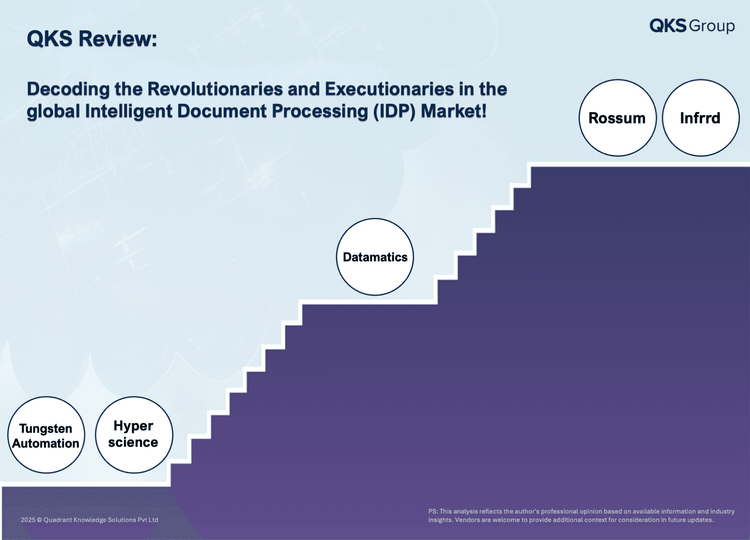
The global Intelligent Document Processing (IDP) landscape is undergoing significant transitions in the recent past. We at the QKS Group have identified the following categories in which majority of the vendor basket is falling into -
- Thinkers (Ideologists/ Conceptualizers)
- Pioneers/ Anchors (Remarkable Achievers)
- Revolutionaries (Leaders/ Activists)
- Executioners (Commanders/ Path Creators)
- Ground Soldiers (Trend Adopters)
- Laggards (Simple Trend Followers)
Let us understand which key vendors are assuming what respective position and role in unfolding this hierarchy of the dynamic global ‘IDP Revolution’. It is crucial to recognize that the global Intelligent Document Processing (IDP) market has been steadily evolving for quite some time now - transitioning from the very basic OCR and rules-based extraction tools, all the way to the present-day AI-native and context-aware ‘Document Intelligence’ platforms. What was once a mundane back-office utility, is now steadfastly becoming the very nerve center of ‘Enterprise Data Orchestration’, thereby powering a plethora of use cases across various verticals, promoting compliance, onboarding, claims, and more. In this blog, we de-code whether the leading global IDP players are aligning or falling short - on this transformative journey!
In this blog, we would be focusing more on the 3rd and the 4th Category of Evolution of the IDP Vendors and try dissecting their offerings, based on the above-mentioned bifurcation (also highlighting their significant aspects) i.e. on –
- Revolutionaries (Leaders/ Activists)
- Executioners (Commanders/ Path Creators)
Infrrd = Genuine Activists
Positioning itself as a ‘Genuine Activist’ in the global Intelligent Document Processing space, Infrrd represents a rare breed of vendors which combines considerable depth towards domain focus, with a consistent pursuit of steadfast innovation. Unlike traditional IDP players which normally retrofit legacy OCR engines, Infrrd has built its platform right from the ground up, making use of ‘AI-native Architecture’, leveraging the trio of - machine learning , NLP, and computer vision, for solving high-variance and document-heavy use cases, which includes - claims, invoices, and mortgage documents, amongst other things. What actually sets them apart from other key IDP players is its ‘document intelligence maturity’, that enables capabilities like - pre-trained ML models, self-learning loops, and an overall strong human-in-the-loop layer – all in all, working towards the goal of providing continuous improvement. Its recently enhanced aspects like – the upgraded user interface, robust API-first designs, and real-time explainability features, are definitely a further reflection of platform not being designed for automation alone, but for establishing and imparting trust and transparency, which particularly hold ground within regulated verticals like BFSI, amongst others.
Despite a genuinely compelling value proposition, Infrrd’s market visibility and global enterprise penetration do remain considerably limited, and as such seem often overshadowed by other global key IDP players. Even then, its strategic clarity of end-user expectations, consistent roadmap execution, and commitment towards solving ‘real document problems’, definitely sets it apart. Infrrd, thus justifiably earns the title of an actual ‘Genuine Activist’, such that they appear to be pushing the boundaries of what current IDP solutions could deliver, by tightly aligning innovation with real-world enterprise challenges.
Rossum = Steadfast Executioners
Amongst the highly dependable ‘Executioners’ in the current global IDP market, Rossum has carved a distinct identity for itself, through its well-structured, AI-native platform which is purpose-built for transactional document automation - particularly directed towards domains like finance, logistics, and supply chain, amongst others. What sets the company apart is its genuine commitment towards promoting aspects like - real-world usability, absolute time-to-value, and industrial-grade scalability. With its core focus on, The platform steadfastly blends deep learning with a flexible schema-less architecture due to its core focus area revolving around automating high-volume, document-heavy use cases like invoices, purchase orders, and bills of lading, thereby ultimately eliminating any need for rigid templates.
Rossum with the provision of robust human-in-the-loop capabilities, precise audit trails, and ability to promote seamless API-first extensibility - allows enterprises in integrating it swiftly across the upstream ERP systems, as well as the downstream workflows. End users have consistently highlighted its ease of configuration, comparatively faster deployment cycles, and continuously evolving AI models, as its key standout strengths. Moreover, the company’s clear roadmap, with a genuine focus around areas which include - automated exception handling, field-level confidence scoring, and end-to-end collaborative data validation – all in all, signals their execution maturity.
Instead of undertaking mere grand claims, Rossum definitely excels in delivering close to what the modern enterprises truly aspire which includes aspects like - operational precision, absolute reliability, and domain-centric and perspective driven document understanding. All in all, it rightfully earns the tag of a ‘Steadfast Executioner’ – i.e. a vendor which thrives in doing comparative heavy lifting - consistently and effectively over time.
Datamatics = Static Commanders
As a ‘Static Commander’ in the global IDP landscape, Datamatics represents itself as a vendor with quite a broad service-led capability, albeit combined with a somewhat limited evolution in terms of its platform depth, and innovation agility. Anchored around its proprietary ‘TruCap+ Platform’, the company offers core IDP functionalities, including the likes of document classification, OCR, and field-level extraction, all strengthened through its rules based automation, along with the AI/ML extensions. Datamatics has begun embedding Generative AI into its IDP offering, particularly within its proprietary ‘TruCap+ platform’, for enhancing its document understanding and data extraction accuracy. Primarily, GenAI is used in interpreting complex, semi-structured, and unstructured documents, for generating contextual summaries, and for assisting in validating extracted fields, through the cross-referencing of contextual cues within the documents. It further supports aspects like auto-suggesting metadata, classification tags, and data normalization patterns – thereby reducing the overall required manual intervention. While still evolving, these capabilities seem directed to improve the overall exception handling, for accelerating template creation, and in the enablement of adaptive learning, thereby making ‘TruCap+’ considerably efficient in processing diverse document types across varying industries.
Despite incremental improvements in its existing offerings, like the integration with proprietary bots in its ‘TruBot’, and BPM focussed ‘TruAI’, the company could still work further on its robust platform composability, cloud-native flexibility, and out-of-the-box cognitive document skills, which are much prevalent in the current lot of relatively more adaptive IDP competitors. Persistent end user feedback has highlighted that its interfaces and configurability do require a sufficient steep learning curve, with limited low-code/no-code accessibility for the primary business users. Moreover, user reviews further suggest areas like scalability, multi-format document adaptability, and rapid retraining of the AI models by Datamatics which could undertake further overall improvements, if compared to other market leading global IDP players. While the company definitely commands loyalty from its existing customer base in the BPO-heavy environments, it has been appearing relatively slow paced in pivoting towards the modern, vertical-specific document intelligence area, and associated customer base.
All in all, in a global IDP market which demands continuous reinvention, Datamatics could risk being perceived as a reliable but ‘rigid executor’, by delivering predictably, but not necessarily an out and out ‘progress driven mindset’ in terms of its offering, hence earning itself the tag of a Static Commander in 2025!
Hyperscience = Isolated ‘Path Creators’
As an Isolated ‘Path Creator’ in the global IDP market, Hyperscience occupies quite a unique market position - leading with a genuine AI-first conviction, yet somehow often trailing in their efforts towards scaling the market penetration. Its core product, the ‘Hypercell’, is architected around a proprietary ML engine, which is designed to process complex and low-structure documents, with minimal manual intervention. Right from ‘intelligent document classification’, all the way to ‘handwriting recognition’ and ‘auto-retraining capabilities’, Hyperscience definitely reflects a bold architectural ambition - one that definitely prioritizes automation depth over breadth.
However, this depth does unfortunately comes with trade-offs. While the company has built a reputation for their ‘technical elegance’ and ‘model explainability’, its offering somehow remain less accessible towards enterprises that seek rapid deployment, broader template based libraries, and low-code usability. Additionally, sustained feedback from users further highlights challenges in regards to onboarding complexity, limited self-service customization options, and a substantial reliance on specialized implementation support.
Unlike other commercially spread out peers, Hyperscience’s moderate to limited marketplace integrations, narrow associated vertical focus, and considerably restrained partner ecosystem – all do reinforce its introspective and product-purist strategy. While this might generally appeal to technically mature organizations, like in the cases of the insurance sector, or the government - it definitely also hinders the broader adoption across prominent/ mainstream enterprise needs. In essence, Hyperscience is definitely creating a distinct impact in the global IDP market, but still seems to risk walking it all alone. Unless the company expands its usability and go-to-market reach, it might remain as a ‘visionary in isolation’, rather than a broadly adopted intelligence platform across the spectrum of end-users.
Tungsten Automation = Passive Revolutionaries
Positioned as a ‘Passive Revolutionary’ in the context of the global Intelligent Document Processing landscape, Tungsten Automation (formerly Kofax) definitely carries the legacy of a pioneering enterprise-grade document capture and process automation solution. Its flagship offering, the ‘TotalAgility’, offers a rich suite of different capabilities, which span across multichannel ingestion, AI-based classification, steadfast business rule automation, and human-in-the-loop decisioning, amongst other things. Tungsten Automation has long supported certain mission-critical use cases within sectors like the BFSI, healthcare, and government domains, wherein aspects like compliance, scalability, and structured processing are absolutely critical.
However, while the company did once set the genuine pace for actual ‘intelligent capture’, it now finds itself considerably lagging in aspects like agility and innovation velocity. Despite being one of the first-movers in the market by introducing ‘cognitive services’ and ‘low-code components’, currently the platform’s monolithic architecture, relatively complex deployment cycles, and considerably limited composability, do continue to frustrate users, especially those that seek rapid configuration or cloud-native flexibility, as their primary requirements. User feedbacks further points to high UI complexity, relatively slower feature modernization, and considerably limited pretrained AI models – as compared to newer IDP players.
Moreover, the company’s execution appears far more reactive than pioneering, since they seem to update their features to stay relevant, rather than themselves reshaping the IDP landscape, by taking charge as a leader. In a market now completely driven by ‘GenAI’, scalable document intelligence, and customized plug-and-play ecosystems – the company does risk bug time of becoming a ‘legacy stronghold’, rather than being a ‘future-ready disruptor’. Thus, despite its storied legacy in the global automation space, Tungsten Automation earns its tag as a ‘Passive Revolutionary’, i.e. a player with absolutely robust foundational strength, but concerningly fading momentum.
Last Word –
The age of cosmetic automation in IDP is drawing to a close. As enterprises demand intelligent, adaptive, and context-aware document processing, the real differentiator lies not in who can extract data—but in who can extract value. True Revolutionaries and Executioners are not merely automating documents; they are reimagining how unstructured content becomes operational intelligence. Yet, as our analysis shows, not all vendors under these labels are living up to that promise. Some blaze new trails with conviction, while others remain anchored in past glory or insular product visions. The IDP battleground ahead will belong to those who pair architectural boldness with scaled execution—who lead not with features, but with foresight. In this fast-maturing space, it’s not enough to process intelligently—vendors must now prove they can think, adapt, and act with enterprise-grade precision. Anything less risks fading into irrelevance.
[This is Part 2 of the Critical Blog Series on the global IDP Market.]
Disclaimer:
This blog is based on independent research and publicly available information. The insights presented reflect the views of QKS Group and are for informational purposes only. While we strive for accuracy, we do not guarantee completeness or absolute correctness. Vendors are welcome to provide clarifications or updates. If any vendor listed in this analysis wishes to provide additional context or clarification, we welcome a briefing call and will consider incorporating relevant updates. This analysis is not intended to disparage any vendor but to provide an informed, balanced perspective. We encourage open and constructive dialogue to foster transparency and a deeper understanding of the industry.
Author: Apoorva Dawalbhakta, Associate Director - Research & Consulting at QKS Group