The manufacturing world is changing fast. With rising pressure to improve uptime, reduce waste, and respond quickly to disruptions, companies need more than just data dashboards. What they really need is a way to simulate, test, and improve operations before problems even occur. That is exactly what Digital Twin technology offers.
A Digital Twin is not just a nice-to-have. It is becoming central to modern MES platforms. It lets you replicate your production line virtually, feed it with live data, and run scenarios to find out what works best. Some vendors are already doing this well. Others are just getting started. And a few are still stuck in the old ways.
Siemens: Leading the Way with a Fully Integrated Digital Twin
Siemens offers one of the most advanced Digital Twin capabilities in the MES space. Its Xcelerator suite, along with Tecnomatix and MindSphere, ties together everything from design to automation and live production. This isn't just a virtual model. It is a live, data-driven system that reflects what is happening on the shop floor in real time.
Manufacturers can use Siemens tools to simulate changes before they go live, test performance virtually, and continuously monitor operations. It allows for faster commissioning, fewer errors, and smarter decisions on the go. Siemens has built a true digital environment that works across both discrete and process industries.
Honeywell: Built for Complex Process Manufacturing
Honeywell has taken a different but equally strong approach. Its Digital Prime and Honeywell Forge platforms focus on process-heavy industries like chemicals, energy, and pharmaceuticals. Here, the Digital Twin does more than track assets. It mirrors entire production environments, including safety systems and energy use.
Honeywell's strength lies in real-time integration. Data flows directly from control systems into the twin, allowing for predictive maintenance, scenario testing, and operator training without touching live systems. It is a full-circle system that helps manufacturers avoid downtime and improve efficiency across large-scale plants.
Dassault Systèmes (DELMIA): Turning Virtual Models into Real Outcomes
DELMIA, part of Dassault Systèmes, brings strong digital twin capabilities from its background in simulation and product design. The DELMIA Apriso MES is tightly linked to virtual factory models, allowing users to plan, test, and validate everything from layout changes to workforce scheduling.
It is especially useful in discrete manufacturing where collaboration across teams is key. By simulating the full production process and syncing it with MES execution, DELMIA helps organizations go live with fewer surprises and smoother rollouts. It’s a blend of planning and execution that works well in complex environments.
Epicor: Starting to Embrace Digital Twin Capabilities
Until recently, Epicor MES (built on the Mattec foundation) focused mostly on production monitoring. But recent updates show that things are changing. Epicor now includes the ABLE Digital Twin application, which lets users visually replay production events and diagnose issues after they happen.
Epicor has also added AI-powered features in its Kinetic ERP platform, such as predictive machine planning and what-if analysis. These are early steps, but they show clear intent to evolve. While not yet at the level of Siemens or Honeywell, Epicor is becoming a relevant option for manufacturers who want basic simulation and capacity planning built into their MES.
Aptean: A Strong Traditional MES, with Room to Grow on Digital Twin Capabilities
Aptean continues to serve many manufacturers well with its proven MES platform, originally developed as Activplant. The solution is well-suited for core use cases such as real-time machine monitoring, performance reporting, and production analytics. For organizations focused on improving visibility and operational control, Aptean remains a dependable choice.
However, as of 2025, the platform does not yet offer native digital twin capabilities. Features like synchronized simulation models, virtual commissioning, or real-time predictive modeling are not currently part of its MES offering. While this may not be a limiting factor for every manufacturer, it’s worth noting for those who are actively pursuing advanced digital transformation or smart factory initiatives.
That said, Aptean has a strong track record of evolving its platforms in response to customer needs. As digital twin adoption continues to grow across the MES landscape, Aptean may well expand in this direction in the future. For now, it remains a robust solution for organizations looking to strengthen their foundational MES capabilities while keeping an eye on what's next.
Final Thoughts: Digital Twin Is Not Optional Anymore
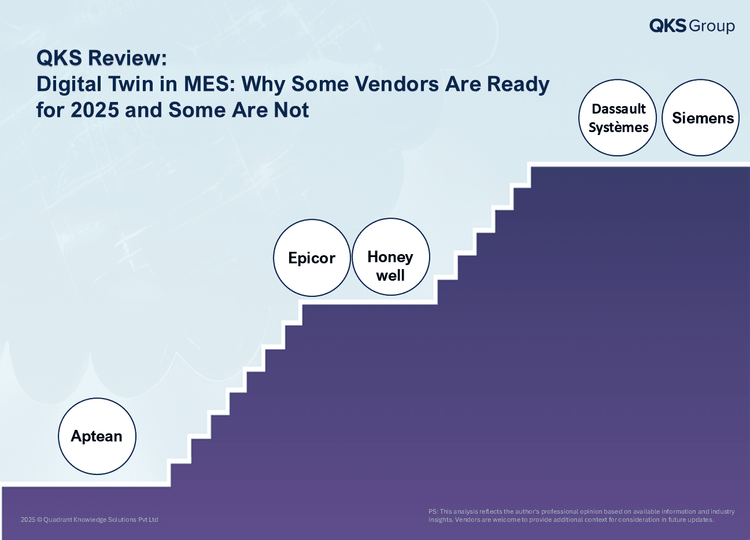
In 2025, the gap between MES vendors is clearer than ever. Some are building full digital ecosystems that help you plan, simulate, and optimize in real time. Others are only now beginning to move in that direction. A few are still behind.
If you are investing in MES today, look beyond monitoring tools. Ask if the system can help you simulate before you act. Ask if it can adapt in real time. And most importantly, ask if it can help you stay ahead, not just keep up.
Siemens, Honeywell, and DELMIA are already there. Epicor is on its way. Aptean still has a long road ahead.
Disclaimer:
This blog is based on independent research and publicly available information. The insights presented reflect the views of QKS Group and are for informational purposes only. While we strive for accuracy, we do not guarantee completeness or absolute correctness. Vendors are welcome to provide clarifications or updates. If any vendor listed in this analysis wishes to provide additional context or clarification, we welcome a briefing call and will consider incorporating relevant updates. This analysis is not intended to disparage any vendor but to provide an informed, balanced perspective. We encourage open and constructive dialogue to foster transparency and a deeper understanding of the industry.
Author: Nithin AK, Analyst - Operational Technology at QKS Group