



Over the last four years, I have spent a significant amount of time working with enterprises on AI transformation, and one pattern has become increasingly clear: the economics of using intelligence are starting to shape how far organizations are prepared to take their transformation agendas. As the cost of applying AI changes, so does the range of business processes that leaders are willing to reconsider.
In the earlier stages of enterprise AI adoption, most organizations concentrated on a relatively small number of high-value use cases. Customer service, employee productivity, coding assistance and knowledge management offered practical starting points because the business case could be established relatively quickly. As these programs moved beyond pilots, however, serving thousands of employees, millions of customer interactions or continuously running AI across business processes introduced a different economic equation. A successful pilot demonstrates potential, while enterprise-wide adoption requires economics that can hold at scale.
When the economics change, the transformation boundary moves
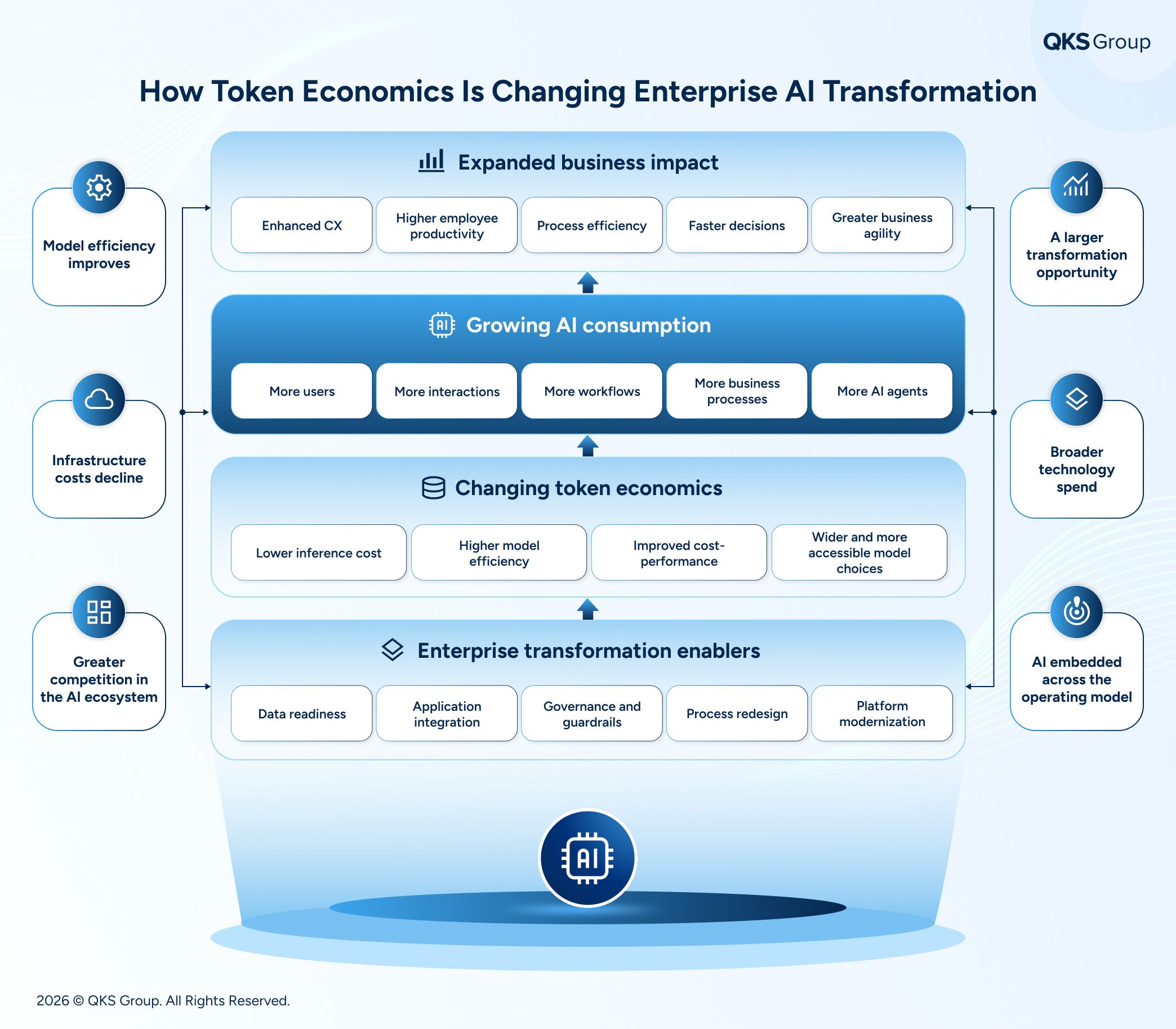
Improving model efficiency, infrastructure economics and competition across the AI ecosystem have made inference more affordable for many workloads. The implications extend beyond reducing the cost of use cases already in production, because they also change which opportunities appear commercially worthwhile in the first place.
I am increasingly seeing organizations discuss AI in areas that would have struggled to reach the transformation roadmap a few years ago. Smaller internal workflows, repetitive knowledge tasks, operational handoffs and decisions that recur throughout the day are gaining attention because the cost of applying intelligence is moving closer to the value those activities can generate.
A large enterprise has thousands of processes that could potentially benefit from this shift. Even a modest reduction in the economic threshold for a single use case can widen the overall opportunity considerably. Transformation can therefore move from a shortlist of flagship initiatives towards a broader portfolio of operational improvements that may be modest individually but significant in aggregate.
Token economics is becoming a demand elasticity question
This is where I find the concept of Jevons paradox particularly relevant. When a resource becomes cheaper or more efficient to consume, demand for it can expand because new applications become economically viable. We have seen similar patterns with computing, storage and bandwidth, where improving unit economics supported entirely new forms of technology consumption.
AI may be following the same economic logic. As inference becomes cheaper, organizations can apply intelligence more frequently across more users, transactions and processes, including activities they previously handled manually or left untouched. A use case that was difficult to justify at one cost level can become reasonable at another, and the cumulative effect across hundreds of enterprise processes can be substantial.
For me, this is why token economics is increasingly a question of demand elasticity: how much additional intelligence an organization chooses to consume as the effective cost falls. Lower token prices may reduce the cost of an individual interaction, but total AI consumption can still grow as new users and workflows come online. The broader transformation opportunity expands alongside that demand.
More viable AI use cases create more transformation work
One consequence I have observed is that making more AI use cases viable also creates more transformation work around them. Once an organization decides that AI can participate more deeply in a process, the conversation quickly moves to the practical conditions required to make that participation reliable.
Data must be accessible and trustworthy, applications need to communicate, and permissions and business rules must be explicit enough for technology to operate within them. Organizations also have to determine where AI can act independently, where human judgment remains necessary and whether the underlying workflow should be redesigned rather than simply automated in its existing form.
This creates a multiplier effect across enterprise technology investment. Each additional AI-enabled process can generate requirements around integration, security, governance, workflow redesign and application modernization. Improving inference economics can therefore expand demand across the broader technology stack, even while the cost of the intelligence layer itself declines.
The enterprise AI conversation is becoming broader
A few years ago, many enterprise AI discussions revolved around identifying a handful of use cases where investment could be justified. Increasingly, the conversations I am involved in are about where intelligence can be embedded across the operating model, which processes should be redesigned first and what capabilities must be in place for those changes to scale.
That shift also changes how organizations need to assess value. Token pricing is an important input, but a lower price per token does not automatically deliver a lower cost per resolved request, completed task or improved decision. Integration, oversight, reliability and the need for human intervention all influence the economics of a finished outcome. Evaluating AI at the workflow level makes it easier to distinguish sustainable transformation opportunities from attractive but incomplete cost comparisons.
After four years of observing enterprise AI transformation, the pattern I am paying closest attention to is the gradual movement of the economic boundary around where intelligence can be applied. Model performance and token prices will continue to evolve, but their wider significance lies in making more processes worth reconsidering and creating new demand for the systems, data and governance needed to support them.
As the cost of applying intelligence declines, the number of processes worth transforming can rise. The organizations that benefit most will be those able to convert that expanding opportunity into reliable, economically sound changes across the business.
Authors

Amandeep Singh Khanuja
AVP – Practice Director & Principal Analyst at QKS Group

Devendra Pagnis
Associate Vice President at QKS Group