


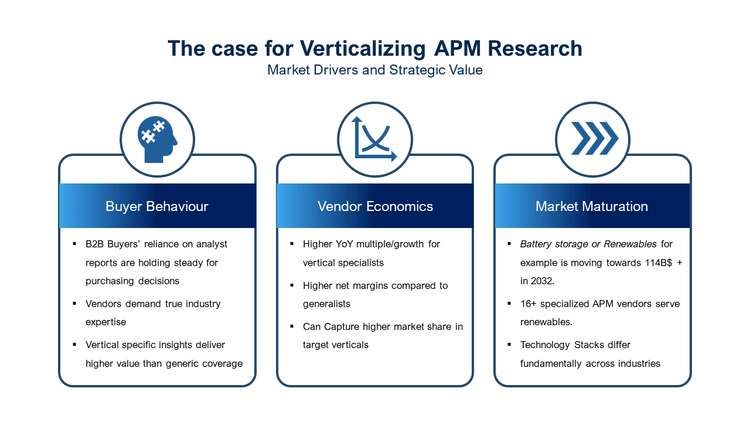

The shift from comprehensive "Asset Performance Management" studies to vertical-specific reports like "APM for Renewables and Battery Storage" reflects three converging market forces that make horizontal research increasingly redundant.
Understanding these drivers including buyer behaviour, vendor economics, and market maturation, reveals why verticalization isn't discretionary but imperative for research firms seeking relevance in fragmented, specialized software markets.
Why This Matters Now
Three years ago, analyst firms published APM studies. Today, the same firms release dedicated research for renewables, battery storage, manufacturing, and other verticals as standalone categories. This isn't repackaging, it's a response to fundamental shifts in how buyers evaluate solutions, how vendors compete, and how markets organize themselves.
The inflection point arrives when three conditions converge: buyers demanding vertical-specific insights, vendors specializing around industry requirements, and markets reaching sufficient size and complexity to justify dedicated research. APM has crossed that threshold.
Buyer Behaviour - The Demand for Industry Expertise
Modern enterprise buyers evaluate software through an industry lens, not a categorical one. When a renewable energy operator assesses APM solutions, their evaluation criteria reflect renewable energy realities: solar panel degradation monitoring, battery storage optimization, weather forecasting integration, regulatory compliance under EU CSRD standards, and integration with renewable energy trading platforms.
This buyer doesn't care about refinery shutdown planning, pharmaceutical batch tracking, or manufacturing process control.
Yet horizontal APM research dedicates equal coverage to these adjacent industries, forcing the renewable energy operator to extract relevant insights from perhaps 20% of a 100-page study.
B2B Buyers' Reliance on Analyst Reports for Purchasing Decisions
B2B buyers have increasingly structured their vendor evaluation process around analyst research. They don't deploy procurement teams to independently assess every vendor's capability across every dimension. Instead, they rely on credible third-party analysis to frame the competitive landscape, identify leading vendors, and validate that vendors understand their specific requirements.
This reliance on analyst guidance creates pressure for research alignment with actual buying criteria. When buyers read horizontal APM research, they face a misalignment: the study's evaluation framework doesn't match their vertical purchasing framework. Features evaluated as important (generic uptime, standard integrations) differ from what the buyer needs (industry-specific compliance automation, vertical-specific analytics).
Vendors Demand True Industry Expertise
Buyers increasingly screen vendors for industry fluency. They ask: Can your sales team discuss our regulatory environment without requiring education? Do your reference customers face similar operational challenges? Does your product roadmap reflect understanding of our industry's evolution?
Generic vendor claims like “we serve all industries equally well” will trigger skepticism. Buyers interpret horizontal positioning as lack of specialization: "We haven't invested deeply in understanding your industry." Vertical positioning signals commitment: "We've built our product, go-to-market strategy, and support infrastructure specifically for your industry."
This buyer behaviour creates downstream research implications. Horizontal research cannot adequately assess whether vendors demonstrate genuine industry expertise versus claiming universal capability. Vertical research can: it evaluates vendor depth within a specific industry's regulatory environment, technology requirements, and competitive dynamics.
Vertical-Specific Insights Deliver Higher Value Than Generic Coverage
The fundamental value proposition of analyst research is reducing buyer uncertainty. Horizontal research reduces uncertainty about generic APM capabilities: feature breadth, architecture maturity, implementation track records. It provides 70-80% confidence that selected vendors can deliver core APM functionality.
Vertical research reduces uncertainty about industry-specific fit: regulatory compliance capabilities, vertical-specific analytics, integration depth with industry ecosystems, reference customers with comparable operational profiles. It provides high confidence that selected vendors will deliver on vertical-specific requirements, the major decision that often determines success or failure in practice.
Vendor Economics - The Business Case for Specialization
Vendor economics have fundamentally shifted toward vertical specialists. This isn't driven by research firm strategy, it's driven by market dynamics that research firms are responding to.
Higher Year-Over-Year Growth Multiple for Vertical Specialists
Vertical specialists consistently demonstrate superior growth profiles compared to horizontal generalists serving the same total addressable market. This reflects several reinforcing dynamics:
Vertical specialists can charge premium pricing for solutions addressing critical vertical-specific requirements. When an APM solution includes solar panel degradation monitoring built specifically for renewable energy operations and not a generic image processing feature adapted for solar use. Renewable energy operators perceive qualitative difference justifying premium valuations.
Vertical specialists achieve faster sales cycles within their target vertical. Sales conversations require less education about industry requirements. Reference customers are directly comparable (operating similar assets, facing similar regulatory requirements, employing similar operational workflows). Deal progression accelerates when buyers see themselves in existing customer success stories.
Vertical specialists capture higher market share within target verticals. Renewables APM vendors competing with horizontal generalists discover that specialized depth attracts buyers willing to pay premiums for purpose-built solutions. Market leadership emerges not through lowest-cost positioning but through deepest vertical specialization.
Higher Net Margins Compared to Generalists
Vertical specialists report consistently higher net profit margins than horizontal generalists, even when both serve the same total addressable market. This reflects the combination of premium pricing, faster sales cycles, and concentrated go-to-market spending.
Horizontal vendors must maintain broad go-to-market operations: sales teams trained across multiple industries, support operations handling diverse use cases, product roadmaps balancing competing vertical requirements. This sprawl increases operational complexity and cost per acquisition.
Vertical specialists concentrate resources: sales teams fluent in specific industries, support operations deep in vertical workflows, product development focused on vertical-specific innovation. Per-customer acquisition costs decrease while margins increase.
Can Capture Higher Market Share in Target Verticals
Market share concentration in vertical software markets demonstrates that specialization yields stronger competitive positions than horizontal coverage. Vertical leaders often capture a chunk of addressable markets within their target verticals, while attempting to serve all verticals simultaneously yields good penetration across the total market but with each vertical undifferentiated.
IBM's acquisition of Prescinto specifically for renewable energy APM capabilities validates this economics. IBM didn't acquire Prescinto to add generic APM features but it acquired focused vertical expertise, customer relationships within renewable energy, and product capabilities built specifically for battery and renewable asset monitoring. The transaction price reflected value of vertical specialization, not horizontal APM commoditization.
Market Maturation - The Structural Shifts Enabling Verticalization
Market maturation creates conditions where verticalization becomes not just economically beneficial but strategically necessary. Three structural shifts signal maturation: regulatory divergence, technology stack differentiation, and vendor ecosystem evolution.
Regulatory Divergence Creates Incomparable Compliance Frameworks
Industries face fundamentally distinct regulatory ecosystems that cannot be meaningfully evaluated in horizontal research frameworks.
Renewables operate under EU CSRD reporting requirements (corporate sustainability reporting standards), carbon accounting protocols, renewable energy certificate tracking, and grid interconnection standards. These compliance requirements embed specific operational workflows and reporting obligations that APM solutions must address.
Manufacturing addresses NIST Cybersecurity Framework requirements, OSHA safety mandates, and industry-specific quality standards embedded in ISO 9001 and sector-specific certifications. These requirements differ fundamentally from renewable energy compliance meaning different regulatory bodies, different compliance mechanisms, different operational implications.
Healthcare navigates HIPAA compliance for patient data protection, FDA quality system regulations for regulated medical devices, and clinical trial protocols. Oil & Gas manages environmental impact assessments, safety integrity levels (IEC 61508/61511), and jurisdictional extraction regulations.
These aren't variations on similar regulatory themes, but they represent entirely distinct regulatory ecosystems. Generic APM research evaluating "compliance capabilities" across all these verticals creates false equivalencies. A vendor's HIPAA compliance expertise says nothing about their EU CSRD capabilities. Vertical research acknowledges this fundamental divergence and evaluates compliance capabilities within specific regulatory contexts.
Technology Stack Differentiation Creates Industry-Specific Requirements
APM solutions must embed technology stacks addressing vertical-specific operational requirements. These don't transfer across industries.
Renewables APM requires:
- Visual recognition algorithms for solar panel micro-crack detection and degradation monitoring
- Battery degradation modeling incorporating charge-discharge cycles, temperature profiles, and cycle count predictions.
- Weather forecasting integration correlating weather patterns with production forecasting.
- Energy trading platform connections enabling demand response participation.
- Integration with renewable energy certificate (REC) tracking systems
Manufacturing APM requires:
- Statistical process control (SPC) integration for quality management systems
- Batch genealogy tracking linking equipment performance to product quality outcomes.
- Production scheduling optimization accounting for equipment capacity constraints
- Integration with manufacturing execution systems (MES) for real-time production data
- OEE (Overall Equipment Effectiveness) analytics specific to manufacturing workflows
Oil & Gas APM requires:
- Safety instrumented system (SIS) integration for critical safety function monitoring
- Shutdown planning and turnaround management optimization.
- Process hazard analysis (PHA) integration linking asset performance to safety integrity levels.
- Reservoir performance modeling connecting equipment optimization to extraction efficiency.
- Regulatory reporting integration for environmental and safety documentation
These technology requirements don't overlap. A vendor's expertise in solar panel degradation monitoring through visual recognition contributes zero capability in manufacturing SPC or oil & gas safety systems. Horizontal research treating all three vendors comparably on generic APM features obscures these fundamental capability gaps.
Vendor Ecosystem Maturation Creates Sufficient Specialization
Market maturation signals emerge when vendor ecosystems consolidate around vertical specialization rather than remaining horizontal and undifferentiated.
IBM's acquisition of Prescinto, specifically and exclusively for renewable energy APM capabilities signals major vendors recognize renewable energy as a distinct vertical market warranting specialized investment. The acquisition wasn't about adding generic APM features; it was about acquiring deep domain expertise, customer relationships within renewable energy, and purpose-built technology for battery and renewable asset monitoring.
Horizontal vendors attempting to serve renewables, manufacturing, oil & gas, and utilities simultaneously face increasing pressure. They compete on generic APM features, claim "we can adapt to your industry," and struggle to articulate vertical differentiation. Vertical specialists demonstrate industry fluency, purpose-built capabilities, and vertical-specific customer references thereby creating competitive positioning horizontal vendors cannot replicate.
This ecosystem maturation validates that renewables APM has crossed the threshold from niche subsegment to established vertical market. Sufficient vendor specialization, buyer sophistication, and market size now support dedicated research.
What This Means for Research Strategy
Buyers have explicitly requested vertical-focused research that evaluates vendors on industry-relevant criteria. Horizontal APM studies increasingly fail to serve their needs as vendor ecosystems specialize and technology stacks differentiate.
Vendors competing in vertical markets seek positioning in research reflecting their specialization. Horizontal research burying vertical specialists among 50 generic competitors obscures their differentiation. Vertical research positions them appropriately: as dedicated specialists competing on industry expertise.
Conclusion: Following Where Markets Lead
The case for verticalizing APM research is fundamentally grounded in market reality, not research firm strategy. Buyers demand vertical expertise. Vendors compete on vertical depth. Markets organize around vertical specialization.
Research firms that maintain exclusively horizontal coverage risk relevance erosion. Buyers will seek vertical-specific intelligence elsewhere, even if they must cobble together insights from multiple sources. Vendors positioned in vertical research gain visibility with qualified prospects and those explicitly seeking specialized solutions.
The question isn't whether to verticalize, but how to structure vertical research that delivers genuine value: sufficiently deep to address industry-specific requirements, sufficiently rigorous to enable confident vendor comparison, and sufficiently comprehensive to capture the competitive landscape within each vertical.
As market maturation accelerates and vendor ecosystems continue consolidating around specialization, verticalization becomes not a research trend but market necessity. Research firms responding to this reality, rather than leading it, position themselves to maintain relevance as software markets continue their inevitable progression toward vertical specialization.
Author : Akaash R ,Principal Analyst – Industrial Operations and Engineering Software At QKS Group