



In the dynamic landscape of enterprise application development, the race is no longer about who can build apps faster, it's about who can build intelligence into them from the start. Organizations are shifting from simply accelerating delivery timelines to embedding predictive and adaptive logic directly into workflows and user experiences. At the center of this evolution are Low-Code Application Development Platforms (LCADPs), which have moved from being rapid prototyping tools to becoming strategic enablers of AI-driven enterprise agility.
Yet, not all low-code platforms are created equal.
Many vendors promise speed, agility, and democratization of development. Some even integrate AI assistants and offer generative capabilities. However, very few deliver the kind of embedded intelligence and contextual automation that today’s enterprise-grade applications demand. That gap between mere visual development and truly intelligent application creation, is being bridged by Artificial Intelligence (AI).
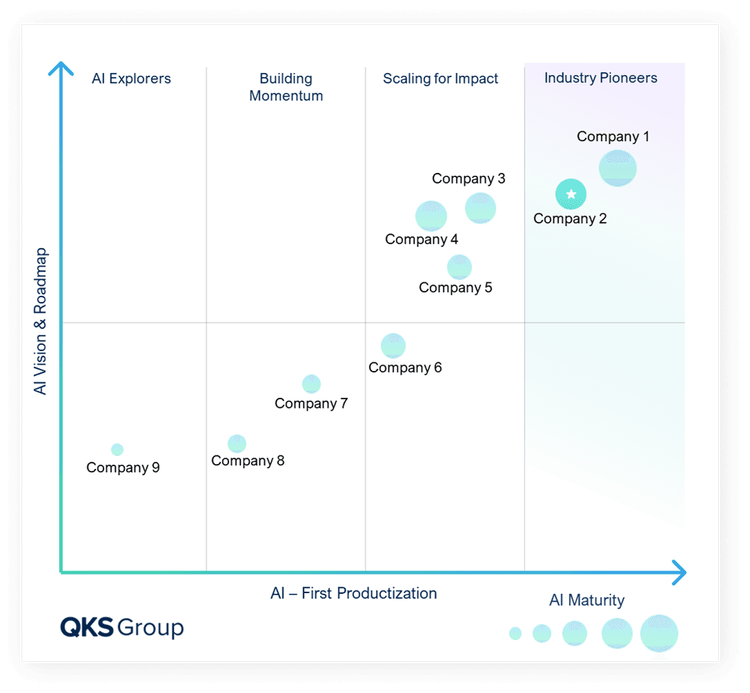
At QKS Group, we believe that AI is not a future enhancement in low-code platforms. It is the foundational enabler that redefines how applications are conceived, built, evolved, and governed. To measure how effectively vendors are progressing along this journey, we’ve created a first-of-its-kind framework: the AI Maturity Matrix for Low-Code Application Development Platforms.
This matrix doesn’t just classify vendors, it signals a fundamental shift in what enterprises expect from application platforms and what vendors must now prove to remain relevant.
Why Low-Code Platforms Needs AI: From Visual Builders to Intelligent Development Environments
The original promise of low-code platforms was simple yet powerful: enable faster and more accessible application development through visual modeling, pre-built components, and minimal hand-coding. This promise helped bridge the gap between business users and IT, accelerating digital initiatives and expanding the developer base.
But in practice, many low-code platforms stopped at accelerating software development. They became efficient builders of business logic but lacked the intelligence to guide design decisions, optimize outcomes, or adapt in real time. In a world shaped by continuous change, hyper-personalization, and automation-first mindsets, speed alone is not enough.
Enter AI.
AI empowers low-code platforms to evolve from rapid delivery tools to intelligent development environments that anticipate needs, reduce errors, and elevate outcomes. With AI deeply integrated, a next-generation low-code platform can:
- Analyze user intent and auto-generate workflows, forms, or logic.
- Learn from application usage patterns to optimize performance and UX.
- Recommend best-fit integrations, security controls, and architecture.
- Detect anomalies and suggest governance improvements proactively.
- Simulate business impact of design choices using predictive models.
In essence, AI turns a low-code platform into an intelligent collaborator, a co-developer that brings foresight, efficiency, and contextual awareness to every stage of the application lifecycle.
The Strategic Impact of AI-Mature Low-Code Development Platforms: A Technology and Market Perspective
As enterprise demands grow more dynamic and application ecosystems more complex, traditional low-code platforms that merely accelerate development are no longer sufficient. Organizations now seek platforms that offer intelligent guidance, contextual automation, and adaptive responsiveness. AI-mature low-code platforms are emerging to meet this need, not simply as minor enhancements, but as strategic accelerators reshaping how enterprises ideate, build, and evolve software.
- Driving Intelligent Application Agility
AI-powered low-code development platforms bring real-time decision support and automation into the development process, enabling organizations to iterate faster, adapt user experiences dynamically, and respond to change without technical bottlenecks. This shift from manual configuration to AI-assisted development is giving early adopters an edge, especially in sectors like BFSI, healthcare, and public services, where regulatory agility, service personalization, and operational efficiency are critical. - Empowering Cross-Functional and Domain-Agnostic Development
AI-mature platforms are no longer confined to IT-led initiatives. Their reach now extends to business developers, operations teams, and data analysts, unifying app development across departments. By leveraging embedded AI to recommend logic patterns, automate integrations, and align with compliance rules, these platforms support diverse use cases from field operations to customer onboarding, across industries and regulatory environments. - Becoming the Application Intelligence Layer of the Enterprise
Today’s low-code platforms are evolving into central intelligence hubs capable of orchestrating not just workflows, but insights and actions across the application lifecycle. AI serves as the cognitive engine in this setup, learning from usage telemetry, adapting experiences in real-time, and surfacing recommendations to optimize outcomes. From enhancing developer journeys to enforcing security policies, AI-mature platforms offer a strategic layer of intelligence for modern enterprise operations. - Shaping the Future of Enterprise Development
Vendors that deeply embed AI into their platform architectures are no longer just keeping pace with development trends; they are setting them. These platforms are now at the heart of strategic IT modernization programs, citizen development governance, and agile delivery centers. Their influence extends from enterprise architecture decisions to innovation task forces. Buyers increasingly view them as transformation enablers not just tools, but platforms that drive strategic alignment and delivery velocity. - Winning the Trust of Transformation Leaders
In enterprise-grade investments, outcomes matter more than features. Low-code platforms that embed AI across the lifecycle, from requirement capture to deployment optimization,are proving to be indispensable. They deliver measurable gains in speed, quality, and innovation readiness. As enterprises progress toward AI-native operating models, vendors with mature AI integration are becoming the go-to choices for CIOs and transformation leaders alike.
The Vendor Perspective: AI Maturity as the New Competitive Currency in Low-Code
In an increasingly saturated low-code market, vendors can no longer differentiate on visual builders or prebuilt components alone. The new competitive frontier is intelligence.
Enterprise buyers are no longer content with platforms that merely accelerate delivery. They want platforms that can anticipate intent, recommend actions, and optimize applications dynamically. Vendors that have invested in foundational AI capabilities are winning high-stakes transformation deals, expanding into cross-functional use cases, and commanding premium positioning in enterprise portfolios.
QKS Group’s ongoing analysis shows a clear and growing divide between platforms that integrate AI as a native, architecture-level capability and those that bolt it on as a UI layer or a marketing message.
High-maturity vendors are:
- Infusing AI into the development lifecycle, from requirement capture to deployment optimization.
- Automating not just code generation, but logic validation, integration mapping, and performance tuning.
- Delivering contextual guidance and predictive recommendations at each stage of application creation.
- Enabling continuous learning from app telemetry to drive intelligent evolution and governance.
Low-maturity vendors, by contrast, often showcase AI through isolated copilots or chat-based UI enhancements that rarely scale. Their users struggle with fragmented experiences, limited reuse, and poor alignment between development output and business goals.
This growing divergence in capabilities is exactly why the QKS Group’s AI Maturity Matrix for Low-Code Platforms is a vital compass for enterprise buyers and a strategic benchmark for platform providers.
Introducing the QKS AI Maturity Matrix for Low Code Application Development Platforms

The QKS Group’s AI Maturity Matrix is a structured, four-stage framework designed to evaluate how deeply AI is embedded into a low-code development platform’s capabilities, architecture, and outcomes.
Stage 1: AI Explorers
Vendors at this stage are in the early phases of AI integration, often experimenting with isolated features such as code suggestions, field autofill, or basic chatbot-based assistance. AI functionality is typically confined to specific UI elements and lacks deep integration with platform-wide development workflows, data layers, or governance frameworks. There is no orchestration linking AI insights to application lifecycle activities, and the impact on delivery speed, quality, or scalability remains anecdotal. These platforms may show conceptual interest in AI but lack the technical and architectural maturity to drive enterprise-level outcomes.
Stage 2: Building Momentum
At this level, vendors begin embedding AI into targeted platform areas such as test automation, workflow recommendations, or prebuilt templates tailored for vertical use cases. AI features may be accessible to both business and professional developers, but they are still confined to specific modules or process flows. Simulation and prescriptive guidance capabilities are emerging, yet not systemically connected across the development lifecycle. Orchestration layers are beginning to form, and some platforms are starting to align AI features with business outcomes. Vendors in this stage are building a credible roadmap toward scalable, value-driven AI integration.
Stage 3: Scaling for Impact
AI is now a foundational element of platform architecture, influencing every phase of application development from requirements gathering and UX design to testing, deployment, and governance. Vendors at this stage support broad enterprise use cases, enabled by real-time telemetry, behavioral learning models, and intent recognition. These platforms drive intelligent collaboration between citizen and pro developers, automate complex logic generation, and deliver quantifiable improvements in time-to-market, quality, and maintainability. AI is operationalized across roles and functions, turning development environments into intelligent ecosystems that actively guide, adapt, and optimize.
Stage 4: Industry Pioneers
This represents the frontier of AI maturity in low-code development platforms. Vendors in this tier have engineered AI into the core of their platforms across data ingestion, model orchestration, development tooling, and runtime environments. Generative AI, reinforcement learning, and adaptive optimization are used not only for code creation but for continuous application evolution. These platforms enable predictive governance, context-aware testing, self-healing logic, and dynamic personalization at scale. AI is no longer an enabler but the engine of platform differentiation. Vendors at this level are setting the direction for next-generation software development where applications are not just built faster, but built smarter by default.
Unlike traditional scoring models, the QKS AI Maturity Matrix emphasizes architectural design, intelligence depth, and measurable user impact, not merely a checklist of features. It is designed to serve as both a credible assessment tool and a strategic guide for enterprise buyers and platform vendors alike.
Why This Matrix Matters: For Buyers and Vendors Alike
For Buyers:
CIOs, CTOs, and transformation leaders need a credible framework to assess low-code development platforms in a market overflowing with AI-labeled offerings. The QKS AI Maturity Matrix cuts through inflated claims and surfaces platforms with true architectural intelligence helping organizations invest in solutions that align with long-term goals around speed, agility, governance, and adaptability.
It also enables strategic vendor selection based on maturity fit. For instance:
- A mid-sized business scaling its citizen development program may prioritize a Stage 2 or Stage 3 platform that balances accessibility with emerging intelligence.
- A large enterprise driving multi-cloud app modernization may seek a Stage 4 platform with deep, embedded AI capable of supporting adaptive, enterprise-wide development governance.
For Vendors:
The matrix acts as a strategic positioning guide. Vendors can:
- Demonstrate the depth and scale of their AI capabilities to prospective buyers.
- Identify architectural or functional gaps to inform R&D and roadmap priorities.
- Leverage QKS recognition (via the MVP Initiative) to establish credibility and trust in a highly competitive market.
More importantly, inclusion on the AI Maturity Matrix allows vendors to shift the conversation from “What features do you offer?” to “What strategic outcomes can you enable?”
Looking Ahead: Why the Future of Low-Code Is Measurable Intelligence
The next wave of enterprise application development won’t be driven by speed alone. It will be powered by low-code development platforms that can understand user intent, simulate outcomes, adapt autonomously, and evolve continuously becoming decision accelerators, not just development tools.
But intelligence must be more than a tagline. It must be evidenced.
The QKS AI Maturity Matrix for Low-Code Development Platforms provides a structured and objective standard to benchmark AI integration and impact. It ensures vendors are evaluated not on claims, but on capabilities and gives buyers the clarity they need to choose intelligently.
At QKS Group, we remain committed to advancing the enterprise technology landscape with precision, insight, and accountability. As AI continues to redefine how software is conceived, built, and evolved, our matrix will serve as a living benchmark, tracking the rise of platforms that are not just low-code, but truly intelligence-first.
Author: Abhishek Anant Garg, Analyst at QKS Group