The Growing Challenge of Third-Party SaaS Connections
The rapid adoption of SaaS applications has expanded enterprise ecosystems far beyond core platforms such as Microsoft 365, Salesforce, and Google Workspace. A growing risk within this landscape is SaaS-to-SaaS integrations, third-party applications connected through OAuth that can bypass traditional security controls. While SaaS Security Posture Management (SSPM) vendors emphasize integration discovery as a key feature, the crucial question is whether these platforms offer actionable control beyond visibility. In this QKS review, we evaluate leading SSPM vendors on their ability to detect, assess, and manage SaaS-to-SaaS integration risks, focusing on depth of coverage, remediation options, and enterprise readiness.
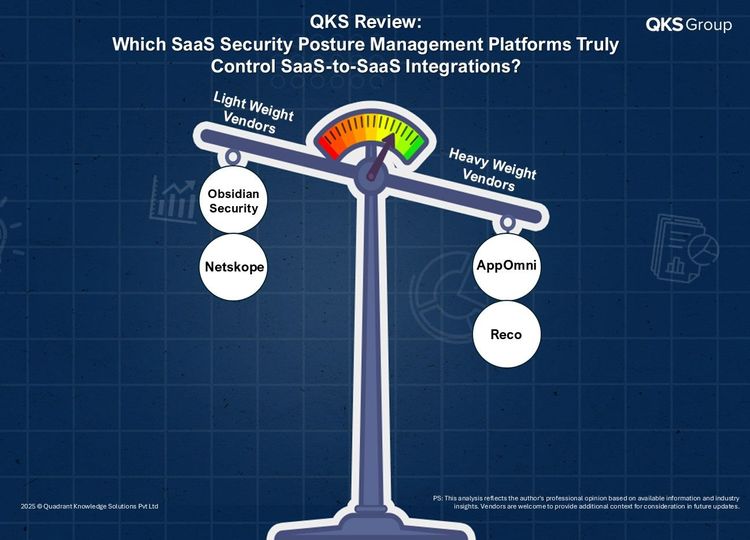
This analysis benchmarks four SSPM vendors based on their handling of SaaS-to-SaaS integrations, grouping them into two categories: Advanced Control Platforms, which provide granular integration visibility, contextual risk scoring, and workflow-driven remediation; and Baseline Control Platforms, which focus on detection and monitoring but offer more limited enforcement capabilities.
Advanced Control Platforms
AppOmni
AppOmni monitors SaaS-to-SaaS integrations across platforms like Microsoft 365, Salesforce, and Google Workspace. It detects OAuth connections and third-party applications linked to user accounts or organizational data. The platform offers workflow guidance to remediate risky integrations, such as revoking excessive permissions or disconnected apps. A notable limitation is that full automation is constrained by the APIs of individual SaaS platforms, which may require some manual intervention. Although AppOmni provides detailed visibility, remediation for niche SaaS apps is less mature than for core applications. Overall, AppOmni emphasizes actionable insights over purely reporting, allowing security teams to prioritize high-risk integrations.
Reco
Reco focuses on identifying shadow SaaS applications and mapping how third-party apps connect across enterprise systems. It shows which user accounts have access to each integration and flags potentially risky configurations. Reco supports automated remediation workflows, including revocation of OAuth permissions or disconnection of unauthorized apps. Its strength lies in contextual risk scoring that highlights integrations posing the greatest potential exposure. Reco can integrate with enterprise IT workflows, but extensive customization may be needed for large-scale environments. The platform also generates audit-ready reports that can be used to track remediation progress and support compliance, although automated enforcement across all SaaS environments is still evolving.
Baseline Control Platforms
Obsidian Security
Obsidian Security primarily monitors identity and account-based risks rather than enforcing full SaaS-to-SaaS integration control. It provides visibility into OAuth connections and third-party SaaS apps, highlighting unusual activity or excessive permissions. Remediation is mostly manual or guided, so the platform is better suited for identifying risks than automatically resolving them. Obsidian emphasizes detection of insider threats, compromised accounts, and permission sprawl, which can indirectly improve SaaS integration security. Integration with SIEM or other monitoring systems allows organizations to include SaaS risk data in broader security workflows. The platform is less focused on automation across multiple SaaS applications, meaning that teams need additional tools or processes to close risky integrations. Obsidian provides alerting and reporting to help track issues over time, but enforcement is limited compared to the advanced platforms.
Netskope
Netskope’s SSPM platform module is part of its broader CASB and security stack. It identifies OAuth applications and third-party SaaS integrations, providing visibility into potentially risky connections. Remediation is guided within the Netskope ecosystem, and fully automated enforcement across all SaaS platforms is limited. The platform emphasizes posture reporting, policy compliance, and workflow-driven action rather than direct control over every integration. Netskope’s approach works well for organizations that already use its CASB solutions, as findings can be integrated into broader security operations. Limitations include potential gaps for niche SaaS applications and reliance on manual steps to enforce policies outside the Netskope environment. The platform provides tracking and audit logs for compliance, but it does not automatically remediate every risk. Security teams can use Netskope insights to prioritize high-risk apps, but operational follow-up is required to implement fixes.
Final Insights
This evaluation of SaaS Security Posture Management (SSPM) platforms highlights a clear differentiation in how vendors handle SaaS-to-SaaS integrations. AppOmni and Reco provide detailed visibility into third-party app connections and offer workflow-driven remediation, enabling security teams to address high-risk integrations efficiently. Both platforms include contextual risk scoring and automated guidance, though remediation for niche SaaS applications may require some manual effort. In contrast, Obsidian Security and Netskope SSPM focus primarily on monitoring identity- and account-based risks, providing visibility into OAuth connections and unusual activity, but rely more on guided or manual remediation for integration issues. Organizations should choose a platform that aligns with their SaaS environment and operational capacity, balancing the need for actionable control with available resources.
Disclaimer:
This blog is based on independent research and publicly available information. The insights presented reflect the views of QKS Group and are for informational purposes only. While we strive for accuracy, we do not guarantee completeness or absolute correctness. Vendors are welcome to provide clarifications or updates. If any vendor listed in this analysis wishes to provide additional context or clarification, we welcome a briefing call and will consider incorporating relevant updates. This analysis is not intended to disparage any vendor but to provide an informed, balanced perspective. We encourage open and constructive dialogue to foster transparency and a deeper understanding of the industry.
Author: Aiyaz Ahmed, Analyst - Cloud Security at QKS Group