

29.07.2025
QKS Review
QKS Review: When Medical Devices Meet Industrial Threats: A Comparative Lens on OT and CMDS Security
Author:
Kunal Kumar


Executive Summary:
As the healthcare cybersecurity market faces rising pressure from the convergence of Connected Medical Devices (CMDS) and Operational Technology (OT) systems, the resulting escalation of cyber‑risks organizations are moving beyond traditional IT-only security tools.
This review blog by QKS Group assesses whether CMDS and OT security vendors are truly innovating to meet these demands or merely making incremental updates.
What Modern CMDS & OT Security Platforms Should Deliver:
Today’s platforms must offer more than core vulnerability scanning and network protection. Critical next‑gen capabilities include:
- Unified visibility and asset discovery across medical devices and OT systems.
- AI‑driven risk contextualization, prioritizing threats based on clinical impact and operational availability.
- Automated remediation workflows (e.g. microsegmentation, device isolation) seamlessly integrated with healthcare systems.
Key Findings:
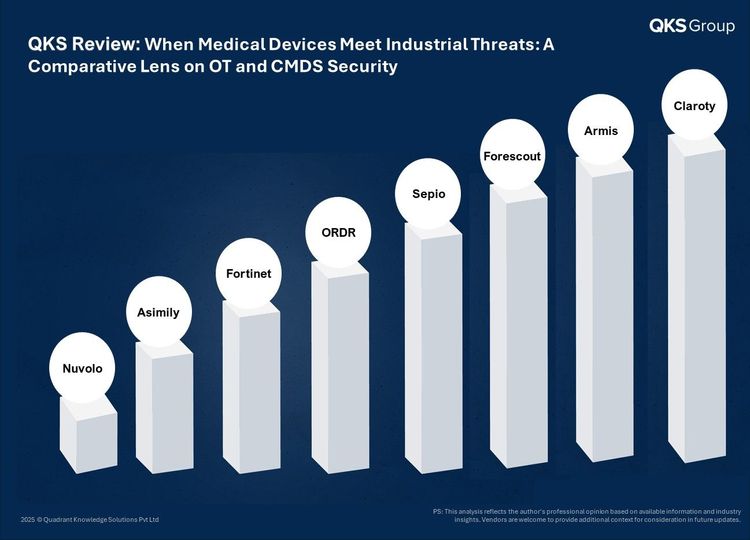
- Leaders (Claroty, Armis, Forescout) stand out with comprehensive, enterprise‑grade solutions combining deep asset intelligence, advanced analytics, unified CMDS / OT coverage, and strong healthcare‑specific compliance support.
- Capable vendors (Sepio, ORDR) show promise in niche domains: Sepio with hardware fingerprinting visibility, and ORDR with solid AI-based asset intelligence and zero‑trust microsegmentation but both lack full platform breadth, refined clinical integration, or strong market visibility.
- Lagging vendors (Fortinet, Asimily, Nuvolo) remain focused on outdated or generic approaches. Their lack of deep healthcare specializations, integration gaps, or reliance on non‑dedicated platforms risks letting them fall behind in a market demanding precision and patient-centric cyber resilience.
Introduction
The healthcare industry is at a crossroads, where the convergence of connected medical devices (CMDS) and operational technology (OT) systems drives innovation but also escalates cyber risks. Devices like IV pumps and systems like building management controls are integral to patient care and hospital operations, yet they are prime targets for cyberattacks. In 2019, 82% of healthcare organizations reported IoT-focused cyberattacks, with 53% of medical devices and 73% of IV pumps harbouring critical vulnerabilities. The stakes are high, cyber incidents can disrupt care, compromise data, and even contribute to tragic outcomes, as evidenced by a 2019 ransomware attack at a medical centre in US that allegedly led to an infant’s death. This blog provides a comparative analysis of CMDS and OT security vendors, offering insights into their strengths, innovations, and gaps to guide healthcare-focused vendors toward cyber resilience.
Understanding the Two Worlds
What is CMDS Security?
Connected Medical Device Security (CMDS) focuses on protecting network-connected medical devices, such as ECG monitors, infusion pumps, and wearable biosensors, which form the Internet of Medical Things (IoMT). These devices enable real-time monitoring and data-driven care but are vulnerable to attacks that can jeopardize patient safety and data privacy. CMDS security ensures device integrity, secure data transmission, and protection against unauthorized access while maintaining clinical functionality. The challenge lies in the diversity of devices, many running outdated software or lacking robust security features.
What is OT Security in Healthcare Environments?
OT Security in healthcare safeguards hardware and software controlling physical processes, such as building management systems (BMS), HVAC, and medical fluid systems. These systems ensure operational continuity, supporting critical functions like power supply and environmental control. Unlike IT security, which prioritizes data protection, OT security emphasizes device availability and reliability to prevent disruptions impacting patient care. The convergence of IT and OT systems, driven by the Industrial Internet of Things (IIoT), increases vulnerabilities, particularly in legacy systems with outdated software.
The Security Imperatives: Shared Goals, Diverging Challenges
Both CMDS and OT security aim to protect critical healthcare systems, but their priorities and challenges differ:
- Risk Surface Differences: CMDS manages a diverse array of medical devices with unique operating systems, creating a complex attack surface. OT security handles broader industrial systems, often with proprietary protocols and long-lifecycle legacy equipment, making them challenging to secure.
- Regulatory Landscape Split: Connected Medical Devices (CMDS) aligns with healthcare-specific regulations like HIPAA and FDA guidelines, emphasizing patient data and device safety. OT security adheres to standards like IEC 62443, focusing on industrial control systems, requiring vendors to navigate a dual regulatory framework.
Vendor Positioning Snapshot
- Leaders: Claroty, Armis, and Forescout lead with comprehensive platforms integrating CMDS and OT security, leveraging advanced analytics and extensive integrations.
- Capable Player: Sepio appeared as an innovator by differentiating with hardware fingerprinting for rogue device detection. While ORDR offers strong technical capabilities but struggles with market presence and integration depth.
- Slow Movers: Fortinet, Asimily, and Nuvolo lag in healthcare-specific focus, market visibility, or advanced cybersecurity features.
Vendor Deep-Dive: Strengths, Innovations, and Gaps
Leaders
Claroty
Claroty’s xDome platform excels in cyber-physical systems (CPS) protection, covering both CMDS and OT environments. It offers asset inventory, exposure management, network protection, secure access, and threat detection, backed by extensive research across hundreds of device types. Claroty simplifies compliance with HIPAA, FDA, and NHS standards. Its integration with clinical engineering and IT systems addresses legacy device challenges, though its broad focus may slightly dilute healthcare-specific optimizations.
Armis
Armis Centrix™ for Medical Device Security provides real-time asset inventory, vulnerability management, and AI-driven threat detection tailored for healthcare. It categorizes devices by clinical usage, prioritizing high-risk areas like ICUs. Armis predicts emerging threats and provides deep clinical context differentiating them from healthcare-specific competitors.
Forescout
Forescout 4D Platform™ offers continuous discovery, classification, risk assessment, and control for connected devices. Its cloud-powered intelligence and FDA recall database integration enhance effectiveness. Forescout excels in hybrid environments but may require complex setup for smaller organizations.
Capable Player
Sepio
Sepio disrupts with its Asset Risk Management (ARM) platform, using hardware fingerprinting to detect rogue devices. This approach provides unmatched visibility into unmanaged assets, critical for healthcare’s complex networks. However, Sepio’s focus on hardware visibility limits its capabilities in advanced threat detection compared to leaders.
ORDR
ORDR’s AI Protect platform delivers robust asset intelligence and automated zero trust for IT, IoT, OT, and IoMT devices. It excels in device discovery, classification, and microsegmentation, minimizing disruptions to medical operations. ORDR’s integrations with systems like Cisco ISE and Fortinet enhance its ecosystem. However, ORDR struggles to keep pace with industry leaders due to a muddled go-to-market strategy and limited market visibility. Its integration ecosystem, while growing, lacks the depth and healthcare-specific tailoring of competitors like Claroty, particularly in clinical workflow integration. Customer feedback highlights occasional challenges with ease of use and support responsiveness, critical for resource-constrained healthcare IT teams. ORDR’s technical prowess is undeniable, but its failure to clearly articulate its value proposition and compete with the polished marketing of leader’s risks relegating it to the sidelines in a market that demands both innovation and clarity.
Slow Movers
Fortinet
Fortinet’s Security Fabric offers broad cybersecurity solutions, including next-generation firewalls, endpoint protection, and network access control, but it falls short in healthcare specialization. While effective for general network security, Fortinet lacks the nuanced features required for CMDS and OT security, such as clinical risk scoring or deep integration with medical device management systems. Its one-size-fits-all approach leaves healthcare organizations vulnerable to targeted attacks that exploit the unique vulnerabilities of medical devices and OT systems. In a sector where precision is paramount, Fortinet’s generic solutions are a risky bet, failing to address the specific regulatory and operational needs of healthcare environments.
Asimily
Asimily provides a solid IoT security platform with features like automated visibility, vulnerability prioritization, and risk mitigation. It supports healthcare-specific needs, such as FDA recall monitoring and device utilization insights. However, its general-purpose approach lacks the deep clinical context and healthcare-specific integrations offered by leaders. Asimily’s limited market visibility and failure to differentiate in a crowded field put it at a disadvantage. In the high-stakes world of healthcare cybersecurity, Asimily’s jack-of-all-trades strategy is a liability, leaving critical gaps in protection for organizations that need specialized solutions tailored to patient care workflows.
Nuvolo
Nuvolo’s Connected Workplace for Healthcare, built on ServiceNow, integrates asset management with OT security, offering a single platform for managing clinical devices and facilities. Its out-of-the-box integrations with security monitoring tools streamline workflows, but its primary focus on asset management overshadows its cybersecurity capabilities. Nuvolo’s reliance on ServiceNow limits its appeal to organizations not using the platform or seeking standalone security solutions. Compared to dedicated security vendors, Nuvolo’s cybersecurity features lack the depth and sophistication needed to combat advanced threats. In a market demanding cutting-edge security, Nuvolo’s asset-centric approach feels like a half-measure, leaving healthcare organizations exposed to sophisticated cyberattacks.
Emerging Themes and Market Directions
Cross-Domain Platform Convergence
Vendors are increasingly offering unified platforms that bridge CMDS and OT security, reducing silos and enhancing visibility. Claroty, Armis, and Forescout lead this trend, providing seamless integration across clinical and operational environments.
Device Identity & Risk Contextualization
AI and machine learning are enabling contextual risk scoring, prioritizing threats based on clinical usage and patient proximity. Armis and ORDR excel here, using AI to predict and prioritize risks, though leaders offer more refined healthcare-specific analytics.
The Shift Toward Remediation & Risk Reduction
The industry is moving toward proactive remediation, with automated workflows for isolating threats and segmenting networks. Forescout and Claroty are at the forefront, offering closed-loop remediation integrated with existing security tools.
Conclusion: Strategic Takeaways for Vendors
- No One-Size-Fits-All: CMDS vendors excel in clinical context, while OT vendors bring infrastructure resilience. Both are essential for a secure healthcare continuum, requiring vendors to balance specialization with broad applicability.
- Leaders Set the Standard: Claroty, Armis, and Forescout dominate with comprehensive platforms, advanced analytics, and healthcare-specific integrations, setting a high bar for competitors.
- Innovators Must Scale: Sepio’s hardware-based approach is disruptive but needs broader threat detection capabilities to compete with platform leaders.
- Capable Players Need Focus: ORDR’s technical depth is promising, but its weak market presence and integration gaps hinder its ability to challenge the leaders. Sharpening its go-to-market strategy is critical.
- Slow Movers Risk Obsolescence: Fortinet, Asimily, and Nuvolo must overcome their lack of healthcare specialization and visibility. Without significant investment in tailored solutions, they risk being sidelined in a market that demands precision.
- Collaboration Over Competition: The future lies in unified platforms and cross-domain intelligence. Vendors must partner or consolidate to address the accelerating pace of healthcare digitalization and ensure comprehensive cyber resilience.
As healthcare digitalization accelerates, vendors must bridge the gap between Connected Medical Devices (CMDS) and OT security through collaboration and innovation. By learning from each other’s strengths CMDS vendors from OT’s infrastructure focus and vice versa the industry can build a unified, patient-centric cybersecurity ecosystem.
Disclaimer:
This blog is based on independent research and publicly available information. The insights presented reflect the views of QKS Group and are for informational purposes only. While we strive for accuracy, we do not guarantee completeness or absolute correctness. Vendors are welcome to provide clarifications or updates. If any vendor listed in this analysis wishes to provide additional context or clarification, we welcome a briefing call and will consider incorporating relevant updates. This analysis is not intended to disparage any vendor but to provide an informed, balanced perspective. We encourage open and constructive dialogue to foster transparency and a deeper understanding of the industry.
Author: Kunal Kumar, Senior Analyst - Cyber Physical Security (CPS) at QKS Group