

30.09.2025
QKS Insight
QKS Review: Weaving the Identity Fabric Who’s Driving, Who’s Fraying?
Author:
Sanket Kadam


Introduction
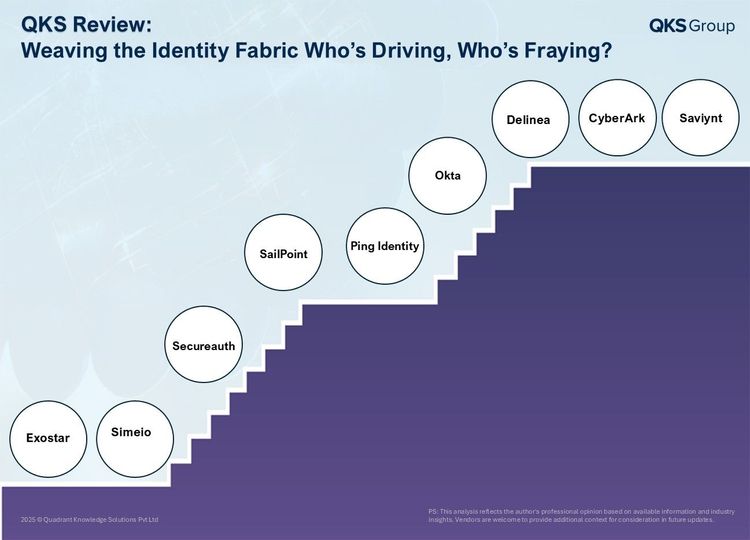
Identity Fabric isn’t a single product it’s the architecture that connects IAM, PAM, IGA, CIAM, and threat intelligence into a unified mesh. In a landscape of credential abuse, lateral movement, and cloud sprawl, vendors are racing to prove they can deliver a fabric that’s strong enough to support Zero Trust ambitions. The winners are those that don’t just stitch tools together but embed intelligence, automation, and scalability across the weave. Today, we evaluate the contenders: the leaders setting the pace, the challengers stretching but not quite converging, and the laggards still patching holes.
Leaders: Owning the Fabric
Delinea
Delinea has taken its PAM heritage and expanded into identity security with CIEM, IGA-lite, and ITDR. Its graph-based identity discovery and Iris AI layer bring visibility and automation into the center of the fabric. Unlike point-solution players, Delinea’s promise lies in its ability to unify privileged and workforce identities, making it a fabric rooted in control and compliance.
What Shines: AI-driven visibility across human and machine identities, stitched directly into PAM workflows.
Saviynt
Saviynt is arguably the most fabric-native player, with its cloud-first Identity Governance and Administration fused tightly with access management and privileged workflows. Its orchestration engine and risk analytics make it a cornerstone for enterprises wanting IGA as the thread tying multiple fabrics together.
What Shines: Policy-driven governance with extensibility across cloud, apps, and privileged entitlements.
CyberArk
CyberArk commands a leadership position in the Identity Fabric market by unifying privileged access management, workforce IAM, and identity threat detection into a coherent architecture that extends across hybrid and multi-cloud environments. Its deep security heritage, strong integration ecosystem, and consistent innovation in automation and analytics make it a trusted choice for enterprises facing complex identity risks. The company’s ability to blend compliance rigor with adaptive, AI-driven identity protection further sets it apart from many of its peers.
What Shines: CyberArk’s Identity Fabric is its prevention-first approach that seamlessly bridges privileged and workforce identities under a single security model.
Challengers: Stretching the Fabric
Ping Identity
Ping Identity still offers robust federation and adaptive access, but its vision of fabric often looks like stitching federation to MFA rather than weaving a unified identity plane. While it excels in flexibility, the lack of deeper governance or threat-centric identity detection keeps it from true fabric leadership.
What Shines: Contextual authentication across diverse ecosystems with strong federation heritage.
Okta
Okta remains the poster child for developer-friendly identity, yet its breaches and platform reliability issues have raised questions about fabric durability. Okta integrates broadly but still struggles to position itself as the fabric rather than just the access gateway.
What Shines: Simple developer-first integration across SaaS and APIs.
SailPoint
SailPoint, traditionally the IGA powerhouse, has made strides toward an identity fabric through AI-driven governance and identity graph initiatives. But without stronger PAM and access enforcement, its fabric risks being governance-heavy but operationally thin.
What Shines: Cloud-native identity governance infused with AI analytics.
Capable Adopters: Fraying at the Edges
SecureAuth
SecureAuth innovates with passwordless and continuous authentication but struggles to scale its orchestration into a full fabric. Its deployments often remain at the adaptive authentication layer, leaving enterprises to look elsewhere for governance and privilege management.
Challenge: Limited scalability and weak presence in APAC hinder global competitiveness.
Simeio
Simeio operates as a managed identity services player rather than a fabric innovator. While it provides managed integrations, it doesn’t control enough of the stack to dictate fabric evolution. Enterprises relying on Simeio risk outsourcing fabric control without securing true architectural strength.
Challenge: Dependency on third-party technologies dilutes fabric ownership.
Exostar
Exostar maintains relevance in highly regulated supply chains like aerospace and defense but lacks the breadth and modern fabric integration to serve as an enterprise-wide architecture. Its focus remains narrow, and its limited extensibility curtails adoption outside its niche.
Challenge: Niche focus prevents it from competing as a universal fabric solution.
Final Verdict
The Identity Fabric race is no longer about stitching together disparate IAM tools; it’s about building a resilient weave that stretches across privilege, governance, access, and threat intelligence. Delinea, Saviynt, and Palo Alto Networks are proving that leadership requires convergence and intelligence at the core. Ping Identity, Okta, and SailPoint remain strong but need to address structural gaps to move beyond challenger status. SecureAuth, Simeio, and Exostar risk being relegated to the margins unless they reinvent their approach.
Disclaimer:
This blog is based on independent research and publicly available information. The insights presented reflect the views of QKS Group and are for informational purposes only. While we strive for accuracy, we do not guarantee completeness or absolute correctness. Vendors are welcome to provide clarifications or updates. If any vendor listed in this analysis wishes to provide additional context or clarification, we welcome a briefing call and will consider incorporating relevant updates. This analysis is not intended to disparage any vendor but to provide an informed, balanced perspective. We encourage open and constructive dialogue to foster transparency and a deeper understanding of the industry.
Author: Sanket Kadam, Analyst - Identity and Access Management (IAM) at QKS Group
Vendors: