

31.07.2025
QKS Review
QKS Review: Unified Fraud and Financial Crime Management: How AI-led FRAML is Transforming Financial Crime Defence
Author:
Siddharth Arya


Executive Summary:
As the financial crime and compliance technology market faces rising pressure from converging fraud and AML threats, stricter regulatory scrutiny, and increasingly sophisticated financial crime tactics, organizations are moving beyond traditional, siloed fraud detection and AML monitoring tools.
This review blog by QKS Group assesses whether unified FRAML (Fraud + AML) platform vendors are truly innovating to meet these demands, or merely making incremental updates.
What Modern FRAML Platforms Should Deliver:
Today’s platforms must offer more than core features. Critical next-gen capabilities include:
• Agentic AI to automate investigative workflows and reduce analyst burden
• Unified risk scoring engines integrating fraud, AML, and behavioral data
• Real-time orchestration with explainable, adaptive decisioning frameworks
Key Findings:
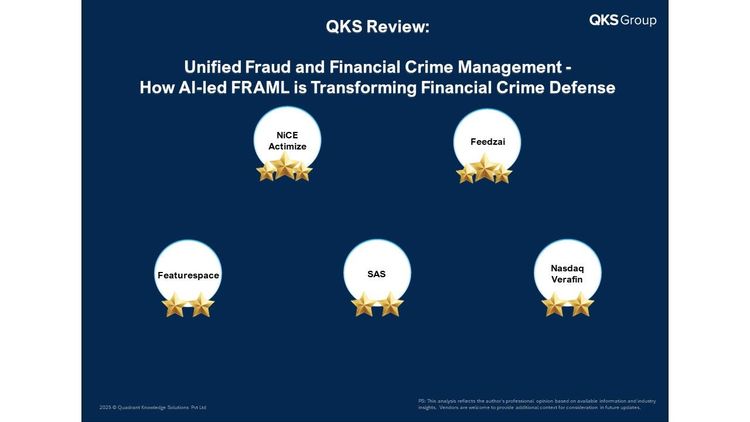
• Leading vendors (NiCE Actimize, Feedzai) stand out with comprehensive, enterprise-grade solutions.
• Capable vendors (SAS, Featurespace, Nasdaq Verafin) show promise in niche areas but lack full-stack AI convergence or global unification.
Introduction
In today’s increasingly digitized and interconnected financial ecosystem, financial institutions face an unprecedented wave of evolving threats. Fraudulent activities have become more sophisticated, money laundering networks more elusive, and regulatory mandates more stringent. Additionally, financial criminals rarely limit themselves to just fraud or money laundering, often exploiting both simultaneously, and at scale. Also, the threats that fraud prevention and anti-money laundering (AML) solutions aim to mitigate are becoming increasingly interconnected. Fraud often generates illicit proceeds that must be laundered, making fraud a common predicate offense for subsequent money laundering.
As a result, financial institutions are increasingly turning to unified intelligence, integrated systems, and AI-powered decisioning to combat complex financial crimes. Moreover, the increasing overlap in threat vectors and regulatory demands for comprehensive risk oversight are pushing institutions to adopt unified platforms that combine fraud detection and AML monitoring into a cohesive, intelligence-led strategy.
A unified FRAML framework, leveraging advanced AI and machine learning, empowers institutions to build dynamic customer risk profiles. This integration streamlines decision-making processes and delivers real-time risk intelligence, which is crucial for combating the threats posed by today's interconnected risks, rapid transaction speeds, vast data volumes, and dynamic regulatory landscape. Essentially, FRAML represents more than just a convergence of tools; it signifies a powerful convergence of strategy, defence, and insight against financial crime.
The imperative for a converged and intelligent approach to financial crime is undeniable. In this dynamic environment, the capabilities offered by technology vendors becomes a critical differentiator. Some leading technology providers in this space are accelerating in this direction, defining the next generation of financial crime defence.
While some vendors such as NiCE Actimize and Feedzai are at the forefront of delivering AI-powered FRAML solutions other advanced players too are making significant strides bringing unique strengths defining the next generation of unified financial crime defence.
Top Players: Leading and Forging New Avenues in FRAML
NiCE Actimize's Xceed AI FRAML platform provides a unified and intelligent solution for financial crime protection, specifically designed for small to mid-sized financial institutions, including credit unions and community banks. This platform seamlessly integrates fraud prevention and Anti-Money Laundering (AML) compliance into a single, intuitive system, offering a truly holistic risk management capability that spans customer onboarding, ongoing risk monitoring, unified case management, and simplified regulatory filings. Its deep embedding of Agentic AI throughout the entire financial crime lifecycle optimizes every stage.
Xceed AI FRAML’s core strength lies in its specialized AI Agents, which significantly enhance accuracy, efficiency, and compliance effectiveness by reducing manual workloads and cutting false positives. These AI Agents proactively learn and adapt, collaborating with the team to continually refine strategies and automate repetitive tasks. Its Fraud Alert Optimizer cuts alert triage time significantly and eliminates false positives, while the Case Summarization & SAR Narrative agent drastically reduces analysts' time with automated writing and generation of Suspicious Activity Reports. The platform also features a Transaction Monitoring Optimizer to reduce false positives in monitoring alerts, and Smart Segmentation capabilities for dynamic transaction grouping to refine AML tuning.
Beyond these agents, Xceed AI FRAML offers comprehensive coverage for fraud and AML. For fraud prevention, it provides real-time capabilities for instant payments, Account Takeover (ATO) protection with advanced behavioral profiling, check fraud detection with image analysis, and robust prevention for ACH and wire fraud. On the AML side, it includes comprehensive KYC and Customer Due Diligence (CDD) with AI-driven automation, real-time screening against watchlists, including PEPs, negative news, and sanctions, and intelligent transaction monitoring for various typologies like money laundering and terrorist financing.
The solution is further bolstered by its unified case management, ActOne, allowing a true convergence of fraud and AML investigations within one cohesive platform for consistent, efficient workflows and significant false positive reduction. By leveraging Agentic AI to learn from analyst feedback and automate repetitive tasks, Xceed AI FRAML ensures fewer manual processes, faster insights, and a continuously evolving financial crime program that enables quick risk detection, leading to higher efficiency, better compliance, and reduced overall financial crime risk. This proactive and continuously adaptive approach firmly positions NiCE Actimize as a leader, offering not just detection, but an intelligent operational partner.
Feedzaioffers a fully integrated FRAML platform, leveraging an AI-native RiskOps architecture that unifies fraud prevention, AML compliance, KYC, and case management across the entire customer lifecycle. Its risk scoring engine, Pulse Risk Engine, performs real-time risk scoring by evaluating transactions, device signals, behavioral biometrics, and external watchlists quickly within milliseconds. This platform collects identity, transaction, and behavioral data streams across channels—spanning login, account opening, payments, and watchlist screening—and integrates them into a single AI decisioning workflow, with a centralized case manager supporting collaborative investigations and audit trails.
Feedzai's AI-driven intelligence combines human-centered AI, whitebox explainability, and Responsible AI governance, ensuring a high degree of transparency and fairness for each AI-driven decision. Machine learning effectively reduces false positives to prioritize high-risk cases. The platform's “Genome” module for graph analytics further enhances detection by reconstructing relationship networks to uncover money mule rings and complex fraud schemes. Recent strategic enhancements include ScamPrevent for proactive mitigation of scams by analyzing pre-transaction behavior and expanded coverage into crypto-related AML through integration with Mastercard’s Ciphertrace.
The solution employs privacy-preserving federated learning via Feedzai IQ™, a capability that leverages anonymized insights from participating institutions to generate collective intelligence. This yields significant improvements in fraud detection and reduces alert volumes by up to four-fold while cutting alert volumes nearly in half, demonstrating a unique ability to harness broader threat intelligence while preserving data privacy. The platform emphasizes rapid deployment with out-of-the-box ML models, no-code deployment, and automated retraining, allowing swift updates to detection logic in days instead of months, providing critical agility against rapidly evolving criminal tactics. Processing high transaction volumes, Feedzai’s platform supports unbiased, explainable decision-making with robust model governance and continuous monitoring, positioning it as a frontrunner in AI-powered FRAML for a future-ready, scalable defense. Its AI-native architecture and focus on collective, explainable intelligence provide a foundational strength for proactive and comprehensive risk management.
Other Notable Players in the FRAML Landscape
SAS, a long-standing provider in analytics and business intelligence, leverages its expertise in hybrid analytics with embedded AI and machine learning to address the FRAML challenges. SAS solutions are architected on a common AI/ML-driven decisioning framework, offering financial institutions both flexibility for modular deployment and the option for integrated, end-to-end platforms.
With its Viya-based Financial Crimes Analytics solution, SAS offers sophisticated capabilities like predictive modeling, hybrid ML models, entity resolution, and advanced network analytics empowering institutions to detect complex typologies, from virtual currency laundering to human trafficking and trade-based money laundering, in real time. SAS Viya platform provides tools for perpetual KYC/CDD, dynamic threshold tuning, and intuitive visual investigator workflows. Venturing into next-gen AI, SAS also integrates generative AI through acquisitions like Hazy, enabling innovative synthetic-data-based model development and decision summarization.
SAS's strength lies in combining automated business rules with advanced predictive modeling, text mining, exception reporting, and sophisticated network link analysis, enabling institutions to spot more suspicious activity with greater accuracy, while reducing false positives. Additionally, its capabilities in data management and simplified data integration through extensive APIs, ensures comprehensive data ingestion. SAS offers orchestration capabilities, intelligently prioritizing alerts and rapidly adapting to new threats.
However, while SAS offers the flexibility to be deployed in an end-to-end FRAML format, its fraud and AML modules are still implemented as distinct components, and true agentic AI is not yet seamlessly embedded across the entire financial crime lifecycle. The company excels in providing flexible tools and strong governance, but its approach remains more modular in practice compared to the intrinsically unified, AI-native competitors at the forefront.
Featurespace, with its proprietary ARIC™ Risk Hub powered by Adaptive Behavioral Analytics, models dynamic behavioural profiles and predicts individual behavior for fraud prevention and AML compliance in real-time. The platform supports instant detection of subtle deviations in user behaviour, indicative of evolving fraud and/ or money laundering schemes. Its models adeptly span payments, account behavior, and transaction routing.
A recent strategic development is the launch of TallierLTM™ (Large Transaction Model), which uses generative AI to analyze large volumes of transactions and identify hidden patterns, showing significant improvements in fraud value detection. This innovation underscores their commitment to pushing the boundaries of real-time behavioral understanding across fraud and the financial crime landscape.
Featurespace is a strong proponent of cross-functional financial crime teams, offering a unified alert-to-SAR interface that effectively integrates fraud and AML workflows for shared analyst visibility. While the platform delivers strong real-time decisioning and false positive reduction, its broader FRAML modules, such as integrated KYC/CDD orchestration and typology driven AML capabilities are currently less mature.
Verafin Nasdaq offers a cloud-native, consolidated Financial Crime Management platform that leverages its powerful consortium data, typology-driven analytics and AI-driven cross-institutional, and multi-channel analysis. The platform combines big data intelligence, consolidated dashboarding and reporting, and collaborative investigation capabilities.
Verafin Nasdaq's platform ingests and analyzes vast amounts of information from numerous sources, including core banking systems, open-source data, and its consortium data. This enables the application of sophisticated cross-institutional analysis to pinpoint truly unusual activity and generate a single, comprehensive alert, significantly streamlining the investigation process and reducing false positives.
Nasdaq Verafin offers rich insights through innovative visualization tools, such as dynamic relationship graphs and geographic maps. Their emphasis on Information Sharing capabilities in accordance with Section 314(b) in the U.S., actively facilitates collaborative investigations among institutions to construct a more comprehensive and actionable networks of financial crime networks.
Furthermore, Nasdaq Verafin has recently introduced an innovative Agentic AI Workforce, featuring digital workers such as the Digital Sanctions Analyst and Digital EDD Analyst. Furthermore, their Entity Research Copilot uses generative AI to assist investigations by gathering relevant external information, streamlining the analyst's workflow. While Verafin offers unified alerts and visuals across both fraud and AML, however, Verafin's AI application is largely typology-based and focused on AML-first workflows. While fraud detection exists, including for wires and checks, true AI convergence across fraud and AML remains incomplete. Fraud detection and AML operate as tightly integrated, but not unified systems.
Conclusion: The Future of FRAML
Looking ahead, the deep integration of Fraud Detection and AML compliance is poised to become the established norm across global banking and fintech sectors, fundamentally transforming how financial crimes are detected and prevented.
- Market Leaders like NiCE Actimize and Feedzai are actively charting new pathways with AI-first architectures, unified risk views, and scalable infrastructure purpose-built for modern threats and enterprise-wide efficiency.
- Established players such as SAS, Featurespace, and Nasdaq Verafin continue to fortify their offerings, providing robust, specialized capabilities that contribute significantly to the broader FRAML ecosystem, but the depth of AI convergence, real-time orchestration, and detection maturity vary significantly
The ultimate objective emerging on the horizon is a real-time, 360-degree view of customer risk, where dynamic behavioral factors are continually assessed alongside traditional static data to update risk scores in real-time. This evolution signifies a shift from a fragmented, reactive stance to an integrated, proactive, and intelligence-led approach.
Financial institutions that embrace this transformation will be able to respond swiftly to emerging threats, comply with regulatory demands for comprehensive risk oversight, and protect themselves and their customers with unprecedented effectiveness. FRAML is here to stay, and as it matures, it promises a safer financial system where advanced technology and human expertise work hand in hand to outpace financial criminals.
Disclaimer:
This blog is based on independent research and publicly available information. The insights presented reflect the views of QKS Group and are for informational purposes only. While we strive for accuracy, we do not guarantee completeness or absolute correctness. Vendors are welcome to provide clarifications or updates. If any vendor listed in this analysis wishes to provide additional context or clarification, we welcome a briefing call and will consider incorporating relevant updates. This analysis is not intended to disparage any vendor but to provide an informed, balanced perspective. We encourage open and constructive dialogue to foster transparency and a deeper understanding of the industry.
Author - Siddharth Arya, Senior Analyst at QKS Group
Co-Author - Divya Baranawal, Vice President & Principal Analyst at QKS Group
Vendors: