

19.06.2025
QKS Review
QKS Review: Transforming Supply Chain Control Towers with Event Management and Intelligent Exception Handling
Author:
Avinash Singh


Executive Summary:
Executive Summary:
In an era of constant supply chain disruption, traditional dashboards are no longer enough. QKS Group's research highlights that the most effective Control Tower solutions combine real-time event monitoring with intelligent exception handling to proactively detect, diagnose, and resolve issues before they escalate. Success now depends on automated workflows, AI-powered prioritization, and deep integration with execution systems. The future of supply chain resilience lies not in watching events, but in orchestrating rapid, business-aligned responses.
In today's hyper-connected supply chain ecosystem, the difference between thriving and merely surviving often comes down to one critical question: How quickly can your organization detect, understand, and resolve supply chain disruptions before they cascade into customer-impacting crises? According to QKS Group's ongoing research into Supply Chain Control Tower (SCCT) solutions, the answer lies in sophisticated Event Management and Intelligent Exception Handling capabilities that go far beyond traditional monitoring approaches.
The stakes have never been higher. Modern supply chains span continents, involve hundreds of partners, and operate in real-time-yet many organizations still rely on reactive approaches that leave them scrambling to understand what went wrong after the damage is done. Are you equipped with the intelligent automation needed to stay ahead of disruptions, or will outdated event management leave your customers questioning your reliability?
Six Traits of a Truly Intelligent Control Tower
1. Real-Time Event Monitoring: No More Noise, Just Signals
Forget basic threshold alerts. Leading SCCTs cut through the static with context-rich monitoring powered by pattern recognition, anomaly detection, and smart filtering. You don’t just know something happened — you know why it matters.
2. AI-Powered Root Cause Analysis: Beyond Guesswork
Causal AI separates signal from noise, pinpointing the actual reasons behind disruptions not just correlations. It’s the difference between swatting symptoms and fixing the system.
3. Intelligent Alert Prioritization: Action Where It Matters
Top platforms automatically triage alerts based on business impact and urgency. Routine glitches are auto-resolved. Critical threats go straight to the top, fast.
4. Workflow-Orchestrated Exception Handling: From Ping to Resolution
This is where legacy platforms falter. Intelligent control towers digitize exception workflows, coordinating humans and systems across the ecosystem from suppliers to last-mile logistics with full visibility and accountability.
5. Predictive Disruption Detection: Solve Tomorrow’s Problems Today
Machine learning models in advanced SCCTs flag risks before they erupt. Early warnings mean you’re acting ahead of time, not scrambling to clean up a mess.
6. Integrated Execution Loop: Events Don’t End with Alerts
Best-in-class SCCTs are tightly integrated with execution platforms (OMS, TMS, ERP). That means your insights lead directly to action — and your actions refine future insights.
Who’s Leading the Event Intelligence Revolution?
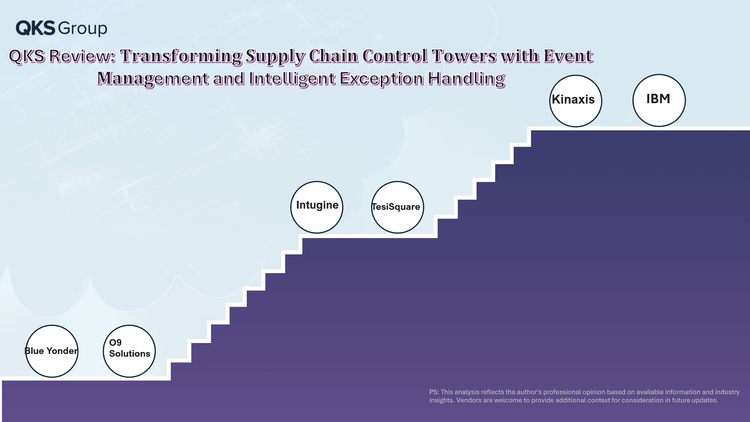
Front-Runners: Turning Data into Decisions
IBM: IBM’s Supply Chain Control Tower is a beacon of innovation, leveraging AI to deliver real-time visibility and proactive disruption management. Its strength lies in correlating internal and external data, think weather reports, supplier updates, and IoT signals, to provide smart alerts and digital playbooks that guide resolution. With seamless integration into OMS, TMS, and ERP systems, IBM empowers businesses to act swiftly, making it a top choice for complex, multi-tiered supply chains. Can your SCCT predict a delay five days out and reroute inventory before it impacts customers? IBM can.
Kinaxis:Kinaxis’s Maestro platform is a master of orchestration, blending predictive analytics with real-time event management. Its AI-driven scenario planning and automated workflows ensure exceptions are resolved with precision across stakeholders. Kinaxis’s Command & Control Center offers instant visibility into key metrics like service levels and margins, enabling rapid, confident decisions. If a supplier falters, Kinaxis doesn’t just flag it, it simulates solutions to keep your supply chain humming. Isn’t that the agility you need?
Building Momentum: Solid Foundations with Room for Growth
TESISquare’sTESI Control Tower offers strong real-time monitoring and alert prioritization, supported by intuitive dashboards and natural language search. Its ability to integrate with external systems and big data sources enhances visibility and supports proactive notifications. While it provides anomaly detection and alerting, its AI capabilities for advanced root cause analysis such as machine learning-driven correlation across multi-source events and predictive detection using time-series forecasting or contextualized pattern recognition are still limited compared to more mature platforms. For organizations seeking dependable visibility and a moderate level of automation, TESISquare presents a solid option, though unlocking more advanced features may require additional configuration?
Intugine demonstrates competence in workflow-based exception resolution and shows promise in predictive capabilities. The platform's modular approach allows for customization of event management processes, though achieving seamless integration with complex execution system landscapes may require more extensive implementation effort than initially anticipated.
The Innovation Imperative: Addressing Critical Gaps
o9 Solutions: o9’s Supply Chain Control Tower shines in real-time visibility and AI-powered scenario analysis, leveraging its digital twin technology to ingest diverse data. However, its workflows for exception resolution can be rigid, requiring customization to handle dynamic disruptions. Integration with execution systems is strong, but real-time orchestration could be more agile. If you’re looking for planning prowess, o9 delivers, but can it keep pace with rapid-fire disruptions?
Blue Yonder’s control tower offers end-to-end visibility and AI-driven insights, with strong orchestration capabilities. Yet, its workflow automation and predictive analytics need refinement to match the seamless automation of leading providers. Integration with execution systems is solid, but consistency in complex, multi-partner scenarios can falter. Blue Yonder is a contender, but are you willing to wait for it to close the gap?
From Crisis to Catalyst: The SCCT Moment of Truth
The shift is clear: today’s supply chain leaders aren’t waiting for issues to arise, they’re intercepting them. Intelligent Event Management isn’t a nice-to-have; it’s a competitive mandate.
Platforms like IBM and Kinaxis are showing what’s possible, transforming supply chain volatility into opportunities for resilience and responsiveness. Meanwhile, others risk falling behind, stuck in reactive loops that erode customer trust and operational agility.
The question isn’t whether disruptions will happen.
It’s whether your control tower will own the outcome or be blindsided by it.
If your SCCT isn’t built for intelligent exception handling, it’s not a control tower. It’s just a dashboard with delusions of grandeur.
Will your next disruption be a catastrophe or a competitive edge?
Disclaimer:
This blog is based on independent research and publicly available information. The insights presented reflect the views of QKS Group and are for informational purposes only. While we strive for accuracy, we do not guarantee completeness or absolute correctness. Vendors are welcome to provide clarifications or updates. If any vendor listed in this analysis wishes to provide additional context or clarification, we welcome a briefing call and will consider incorporating relevant updates. This analysis is not intended to disparage any vendor but to provide an informed, balanced perspective. We encourage open and constructive dialogue to foster transparency and a deeper understanding of the industry.
Author: Avinash Singh, Analyst - Supply Chain Execution (SCE) at QKS Group
Co-Author: Kumar Anand, Associate Director & Principal Industry Analyst at QKS Group
Vendors: