Introduction:
Communications Platform as a Service (CPaaS) has become a facilitator of digital interaction across industries, with various APIs for integrating voice, messaging, video, and authentication capabilities into user applications. For regulated industries like Banking, Financial Services, and Insurance (BFSI) and healthcare where transaction integrity and user identity are crucial, CPaaS has seen its applications far beyond customer communication to become an essential infrastructure layer for security. As the landscape becomes more dependent on digital first experiences, protection against identity fraud, phishing, account takeovers, and evolving threats such as Artificially Inflated Traffic (AIT) has become more critical. AIT, which manipulates communications channels to create fake or non-human interactions, presents increasing financial and reputational risk for financial institutions. CPaaS providers are responding by embedding advanced verification, authentication, and fraud mitigation tools into their offerings allowing users to adopt modern security solutions without restructuring their core systems. This blog presents an analyst’s review of five CPaaS vendors that are innovating in fraud prevention specifically for the critical sectors, with a focus on their technology offerings rather than compliance certifications, audit standards, or encryption protocols.
Security Imperatives for CPaaS in critical sectors
Secure identity verification and authentication processes act as pillars for user’s security infrastructure. Mult factor authentication (MFA) and two factor authentication (2FA), enhances account security by requiring multiple types of credentials, reducing dependence on single points of failure. Newer methods like silent mobile authentication authenticate users based on contextual mobile data checked silently in the background, reducing user friction while retaining integrity. In tandem, SIM swap monitoring is now crucial considering that such exploits can be used to bypass SMS based authentication by routing verification messages to scammers or fraudsters. Such abilities ensure secure prevention against unauthorized access and prevent identity compromise over digital banking channels.
Anti-fraud or fraud prevention tools are essential in identifying and reacting to suspicious activity in real time. They use behavioral analysis, usage profiling, and pattern detection to recognize anomalies that could signal fraudulent activities. In addition to detection, preventive capabilities like number masking and consent management granularity are used to minimize the exposure of personally identifiable information during communication exchanges. Additionally, features like Do Not Disturb (DND) enable users to respect customer preferences while simultaneously limiting avenues that could be exploited for fraudulent outreach. Together, these mechanisms support both regulatory alignment and user protection in increasingly complex threat environments.
Many CPaaS providers are embedding sophisticated security frameworks like biometric authentication, which authenticates identity based on intrinsic personal traits like facial features or fingerprint patterns. This technology lowers the reliance on memorized or shared credentials and provide continuous identity assurance. Additional technologies like number lookup enable institutions to verify the source and authenticity of contact information prior to establishing communication. Single Sign On (SSO) solutions also simplify access control by allowing centralized identity authentication across systems. Artificial Intelligence (AI) improves these layers by allowing ongoing adaptation to changing threat patterns, fraud detection to be more responsive and context sensitive.
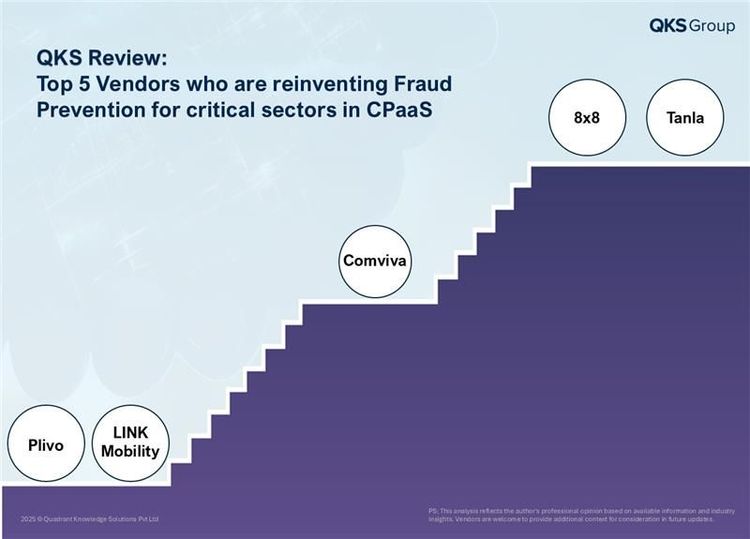
Tanla and 8x8 as leaders:
Tanla is distinguished by its multi-level and sophisticated strategy towards preventing fraud, specifically by its Wisely ATP (Anti-Phishing Technology Platform) and Trubloq solutions. Trubloq utilizes blockchain and machine learning to stop unsolicited communications, while Wisely ATP is for anti-phishing and fraud scenarios with real time intelligence. Its consent management framework, also built on blockchain, adds transparency and control to user data sharing. Although biometric authentication and number lookup are not part of the current stack, the presence of AI-driven traffic monitoring, advanced OTP flows, and integration with Truecaller Messaging positions Tanla as one of the leading players with sector specific relevance, especially for markets grappling with consent, identity integrity, and scam and spam related risks.
8x8 showcases an integrated identity management and fraud prevention strategy, blending its communications platform with sophisticated customer identity and authentication management (CIAM) features through Descope. Its MFA, silent authentication, password-less login, and passkey-based login support offer users with a high level of flexibility in protecting customer sessions. OmniShield module also provides real time protection against artificially inflated traffic (AIT) as well as SMS fraud, number masking and consent management being within its CIAM framework. Incorporation of support for biometric and number lookup makes it a better fit for BFSI and other regulated verticals. Significantly, 8x8 has also restructured its website go to market strategy by highlighting its authentication and anti-fraud offerings within its CPaaS story, signaling a tactical shift towards trust and security focused use cases.
Comviva as market adopter:
Comviva demonstrates strong progress in aligning its CPaaS capabilities with evolving user security requirements, most notably through its robust Messaging Gateway and Firewall platform. Its authentication suite supports MFA and is enhanced by a messaging firewall that enables anomaly detection, content filtering, and AIT protection. Privacy support includes capabilities such as consent capture, number masking, and DND alignment, reflecting a strong compliance framework. Primary identity factors such as SSO and silent authentication are available through flexible integration options. Comviva is steadily advancing toward a more AI-driven and secure CPaaS posture, with its current capabilities reflecting a solid foundation and ongoing evolution.
LINK Mobility and Plivo as laggards:
LINK Mobility offers critical authentication and fraud detection capabilities, but its capabilities are narrow in scope and depth for the regulated space. Although 2FA and anomaly detection using real time monitoring exist, more sophisticated methods like silent authentication, SIM swap detection, or dynamic fraud scoring don't exist. Its privacy stack is limited, with number masking being the only feature, and biometric or AI driven security capabilities aren't enabled. Number validation extends to address lookups but does not serve broader anti spoofing or traffic integrity needs. As threats become more sophisticated, LINK Mobility’s current portfolio lacks the advanced tools financial institutions increasingly require.
Plivo offers core components such as OTP based verification, number masking, and basic anti-fraud protection through its Fraud Shield (an embedded framework in its verify API). Whereas these might suffice for common usage scenarios, they do not suffice for sophisticated risk scenarios in regulated sectors. No biometric authentication support, AI driven traffic analysis, or consent orchestration exists. Number lookup and SSO is supported by the platform, but both these features stand alone and not as part of an overall security strategy. Therefore, Plivo's role in fraud prevention is also limited, with serious loopholes in keeping pace with changing threats for users.
Conclusion:
As regulated sectors face an increasing wave of cyber threats, CPaaS providers are playing a pivotal role to the way security is implemented at the infrastructure level. In industries where authentication, verification, fraud detection, and privacy protection are important, seamless integration with security offerings isn’t optional anymore. While all five vendors provide some level of fraud mitigation support, few are creating sophisticated security stacks that combine real time intelligence with adaptable deployment. Tanla and 8x8 are at the forefront of this, not only by integrating advanced tools but also by focusing their strategic efforts around security use cases applicable to regulated industries.
The landscape, though varied, players like Comviva demonstrate a steady momentum with core capabilities in hand and incremental advancements toward broader integration. At the opposite end of the spectrum, LINK Mobility and Plivo provide baseline functionalities that can suffice, for less sophisticated use cases but is lacking in covering adaptive fraud scenarios typical in regulated sectors. As fraudsters and scammers keep capitalizing on communication ecosystems, users operating in these sensitive verticals will more and more look for CPaaS partners that provide not only functional depth, but integrated, intelligence-based security solutions.
Disclaimer:
This blog is based on independent research and publicly available information. The insights presented reflect the views of QKS Group and are for informational purposes only. While we strive for accuracy, we do not guarantee completeness or absolute correctness. Vendors are welcome to provide clarifications or updates. If any vendor listed in this analysis wishes to provide additional context or clarification, we welcome a briefing call and will consider incorporating relevant updates. This analysis is not intended to disparage any vendor but to provide an informed, balanced perspective. We encourage open and constructive dialogue to foster transparency and a deeper understanding of the industry.
Author: Abhishek Ghosh, Analyst at QKS Group
Amandeep Singh, Associate Director & Principal Analyst at QKS Group