Market Landscape
The Digital Experience Monitoring (DEM) market is maturing rapidly, driven by the enterprise's need to measure not just system uptime but user experience itself. With users accessing applications from diverse networks, devices, and geographies, infrastructure monitoring alone is no longer sufficient. DEM platforms now combine two core methodologies: Synthetic Transaction Monitoring (STM) and Real User Monitoring (RUM), each revealing a distinct dimension of the user experience.
Yet, most vendors and many enterprises still struggle to integrate both approaches effectively. Some vendors focus heavily on proactive synthetic tests, while others emphasize passive user session capture. Without a unified strategy, organizations risk either over-monitoring infrastructure or under-measuring user reality.
Two Monitoring Techniques, One Experience Problem
Synthetic monitoring is about precision. It uses scripted test agents to simulate critical user actions like logging in, performing a search, or checking out. These tests are conducted across regions, browsers, and time intervals. Because synthetic tests are controlled, they are ideal for proactive detection of latency issues, application downtime, or SLA breaches, often before users even notice a problem.
RUM, on the other hand, is about truth. It collects real-time behavioral data from live users, capturing actual load times, device and browser configurations, session errors, and drop-offs. RUM reflects how people experience the application, including the variances that cannot be simulated such as slow mobile connections, obscure browsers, or niche user flows.
The two methods are not interchangeable. STM provides visibility into application health even when no users are online, such as in the early hours of the morning. RUM shows how experiences differ based on geography, device, or network conditions. A mature Digital Experience Monitoring approach does not pick one over the other. It combines both for complete coverage.
Mapping the Vendor Landscape: Who Leads with STM, RUM, or Both?
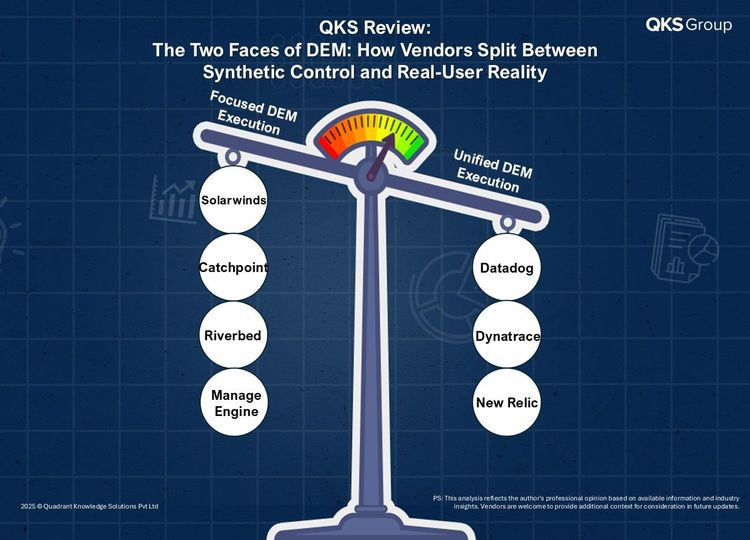
While most vendors claim support for both synthetic and real-user monitoring, their execution varies widely. We categorize them into three clusters to reflect how they align with enterprise needs.
1. Unified Experience Intelligent Platforms
Vendors that offer mature and integrated STM + RUM + Experience Correlation
Datadog
Datadog offers a unified Digital Experience Monitoring platform where synthetic monitoring, RUM, product analytics, and backend traces are all integrated. Its native support for mobile platforms such as iOS, tvOS, and Android TV, along with real-device synthetic testing, makes it strong in mobile-first environments. The platform emphasizes full-stack correlation, making it one of the most complete end-to-end DEM offerings.
Dynatrace
Dynatrace takes a similarly integrated approach. It embeds both synthetic and RUM within its observability platform and enhances them with Davis AI, which connects experience issues with backend telemetry. The platform is particularly strong in predictive analytics and customer-centric diagnostics.
New Relic
New Relic incorporates synthetic tests and RUM into a broader observability suite. While it has introduced natural language interfaces to simplify configuration due to some user challenges with NRQL, it stands out for intuitive dashboards and an extensive plugin ecosystem. However, synthetic test quotas are tied to licensing tiers, which may limit flexibility in large-scale test environments.
2. Synthetic Focused Monitoring Specialists
Vendors with a strong STM focus but relatively weaker RUM
Catchpoint
Catchpoint leads in the synthetic space. With one of the largest global networks of probes and capabilities such as BGP monitoring and Internet Sonar, it provides extensive Internet Performance Monitoring. However, the platform lacks session replay and journey mapping, making it less suited for in-depth behavioral analysis unless complemented with other tools.
SolarWinds
SolarWinds Pingdom supports synthetic monitoring well, particularly for uptime and URI performance testing. It offers RUM for basic session visibility but does not yet support mobile app monitoring. While it is known for fast onboarding and ease of use, limitations in integration and advanced UX diagnostics can restrict its utility in enterprise-wide DEM strategies.
3. Partially Unified DEM Platforms
Vendors offering both STM and RUM but with limitations in scale or advanced capabilities
ManageEngine
ManageEngine (Site24x7) provides synthetic path testing across global locations, along with browser-based RUM that includes device segmentation, session replay, and journey heatmaps. While the platform supports large-scale deployments and is adopted by enterprise accounts, its customer base remains concentrated among small and mid-size enterprises. However, some users report limitations in scaling configurations and correlating telemetry across teams, suggesting room for deeper integration in more complex environments.
Riverbed (Aternity)
Riverbed's Aternity combines Digital Experience Monitoring and Digital Employee Experience (DEX). Its RUM capabilities span endpoints and applications, while synthetic features include mobile app synthetics. However, session intelligence depends partly on OEM technology, and the absence of native session replay limits the platform's ability to conduct deeper diagnostics.
Why Unification Still Lags Behind
Despite nearly every vendor offering both STM and RUM, most still struggle to truly integrate them. Pricing models differ, deployment paths vary, and dashboards often treat synthetic and real-user data as separate silos. In practice, this means IT teams may rely on synthetic alerts while product or digital teams explore RUM dashboards without shared context.
This fragmentation impacts everything from SLA management to UX optimization. Enterprises either miss critical issues because RUM was not enabled, or chase phantom ones triggered by synthetic alerts that are not correlated with actual user impact. The vendors that stand out are those investing in unified telemetry layers, AI-driven correlation, and dashboards that merge both perspectives.
The Future of DEM is Dual-Lens
As Digital Experience Monitoring continues to evolve into a central pillar of observability and performance management, the need to unify synthetic and real-user data becomes more urgent. Synthetic tests provide controlled performance benchmarks. RUM surfaces true user friction. Without both, enterprises are left with only part of the story.
In the years ahead, DEM will become more than a monitoring capability. It will serve as a critical convergence point across user experience, operational intelligence, and digital product performance. The vendors that lead this evolution will not be those who specialize in one approach, but those who make synthetic and real-user data indispensable, integrated, and inseparable.
Disclaimer:
This blog is based on independent research and publicly available information. The insights presented reflect the views of QKS Group and are for informational purposes only. While we strive for accuracy, we do not guarantee completeness or absolute correctness. Vendors are welcome to provide clarifications or updates. If any vendor listed in this analysis wishes to provide additional context or clarification, we welcome a briefing call and will consider incorporating relevant updates. This analysis is not intended to disparage any vendor but to provide an informed, balanced perspective. We encourage open and constructive dialogue to foster transparency and a deeper understanding of the industry.
Author: Manish Chand Thakur, Senior Analyst - Digital Workplace at QKS Group
Amandeep S. Khanuja, Associate Director & Principal Analyst at QKS Group