Over the past few weeks, we’ve explored critical weaknesses in the way vulnerability and exposure management has traditionally been handled-flawed prioritization logic, reactive remediation pipelines, blind spots across IT-OT-Cloud environments, and inconsistent adoption across industries. While some vendors offer patches of excellence, many continue to operate in silos, struggling to deliver actionable, lifecycle-first solutions.
But we’re now at a tipping point.
As attack surfaces expand and adversaries adopt automation, the biggest limiting factor isn’t visibility or integration. It’s human scalability. Security teams can no longer afford to rely on manual triage, static CVSS scores, or quarterly patch cycles to drive decisions. The next evolution of cyber defense will not be driven by more dashboards but by embedded intelligence.
The Cracks in the Old Model
The traditional Exposure Management playbook starts with asset discovery, moves into scanning, prioritization, and then, ideally, remediation. But in practice, here’s where it often breaks down:
- Prioritization Lacks Context: CVSS scores alone can’t distinguish what’s dangerous from what’s just visible. The difference between a dormant vulnerability and an actively exploited one? Not reflected in most tools.
- Remediation Remains Manual: Teams still close tickets manually. There’s no assurance the fix was applied properly, or that the vulnerability can’t be re-exploited through chained paths.
- Visibility is Fragmented: IoT, OT, cloud, and SaaS are often managed by separate tools, creating silos that attackers can exploit.
- Risk Isn’t Quantified: Most platforms can't convert technical findings into board-level decisions. CISOs struggle to justify remediation timelines or investments.
So, what is the alternative?
Enter the Intelligence Layer
The evolution from traditional vulnerability management to AI-powered exposure management is not just about better tools-it’s about smarter workflows. Intelligence becomes the thread that ties together detection, prioritization, remediation, and validation.
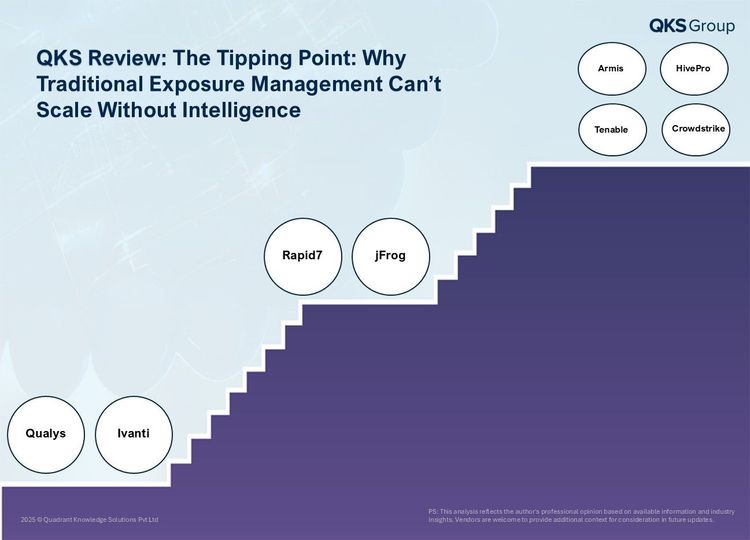
Think of today’s exposure management market as a high-stakes marathon. At the front, we have the runners-platforms sprinting ahead with embedded intelligence that cuts through noise and accelerates decision-making. Right behind them, the challengers are pushing forward with promising tools but still lack full-spectrum coverage. And far behind, the stragglers continue to stumble with outdated architectures, slow innovation, and fragmented workflows.
Among the runners, platforms like Tenable One, CrowdStrike Falcon Exposure, Hive Pro, and Armis Centrix are setting the pace. These vendors have moved beyond conventional scanning to deliver a layered intelligence stack. Tenable One fuses predictive prioritization with attack path modeling, while CrowdStrike brings real-time threat actor correlation through its Threat Graph. Hive Pro sharpens prioritization with SLA-based workflows and predictive vulnerability insights. Armis redefines visibility in unmanaged environments with behavioral analysis that maps device actions to business-critical impact.
The challengers, such as Rapid7 and JFrog Xray, show ambition but have yet to scale their intelligence capabilities across the exposure management lifecycle. Rapid7’s modules perform well in isolation but struggle to translate analytics into actionable prioritization or validation. Frog's strengths in software supply chain risk are valuable but remain focused on a narrower spectrum of threats.
Then we have stragglers, notably Qualys and Ivanti. These vendors still operate within the paradigms of legacy vulnerability management. Qualys retains extensive scanning depth but is hampered by a lack of real-time prioritization or contextual analytics. Ivanti remains limited to endpoint patching automation, offering little intelligence beyond device-centric workflows. In an age where exposure is dynamic and adversaries are automated; these models no longer suffice.
Why Manual Won’t Work Anymore
Attackers aren’t manually scanning networks anymore. They’re using automation, machine learning, and reconnaissance bots. Defending spreadsheets and static workflows is like bringing a whiteboard to a drone war.
AI offers more than efficiency. It delivers agility:
- Spot threats before they materialize
- Filter the signal from the noise
- Act faster than the attacker can pivot
Without intelligence at the core, exposure management becomes a backlog, not a shield.
The Shift Already Underway
We’re already seeing early adopters reap the rewards:
- A healthcare provider using Armis reduced their unknown asset count by 70% in three weeks.
- A major bank using Hive Pro cut its patch backlog by 90% while improving SLA adherence.
- An industrial manufacturer using CrowdStrike's threat graph avoided a costly ransomware breach by detecting lateral movement patterns invisible to traditional tools.
What’s Next?
The exposure management market is splitting into two camps:
- Legacy VM+ vendors are still selling scan-based tools with some cosmetic upgrades.
- AI-first vendors build full-spectrum platforms with intelligence at the core.
Disclaimer:
This blog is based on independent research and publicly available information. The insights presented reflect the views of QKS Group and are for informational purposes only. While we strive for accuracy, we do not guarantee completeness or absolute correctness. Vendors are welcome to provide clarifications or updates. If any vendor listed in this analysis wishes to provide additional context or clarification, we welcome a briefing call and will consider incorporating relevant updates. This analysis is not intended to disparage any vendor but to provide an informed, balanced perspective. We encourage open and constructive dialogue to foster transparency and a deeper understanding of the industry.
Author: Sujit Dubal, Analyst - Network Security at QKS Group