Corporate climate action has matured beyond the basics. Most large enterprises now track their direct (Scope 1) and purchased energy (Scope 2) emissions with relative ease. Yet the real battleground of 2025 is Scope 3 — the indirect emissions spread across sprawling supplier networks, customer use of products, and end-of-life waste. For many industries, Scope 3 accounts for 70–80% of total carbon impact, dwarfing Scopes 1 and 2 combined. Regulators from the EU’s CSRD to the U.S. SEC are tightening disclosure mandates, while investors and customers demand transparency on value-chain emissions. The problem: most companies barely know their tier-1 suppliers, let alone nth-party vendors buried deep in the chain.
Traditional third-party risk management (TPRM) systems weren’t designed for this level of climate visibility. Into this vacuum, IT service providers have rushed with promises to map supplier networks, model Scope 3 emissions, and even drive reductions. Some claim game-changing tools; others deliver little more than dashboards. And while Scope 4, avoided emissions, is emerging as a forward-looking concept, the real credibility test for both companies and their service partners is still Scope 3.
The Data and Accountability Dilemma
The Scope 3 challenge begins and ends with data. Supplier self-reporting is notoriously unreliable, with companies often submitting partial, inconsistent, or estimated figures. Many disclosures lean on industry averages and proxy factors, leaving auditors skeptical. The absence of real-time traceability makes it impossible to separate progress from posturing. Vendors are experimenting with fixes: IoT sensors in logistics to capture actual fuel and energy use, blockchain-led provenance tracking for supply chains, and data-exchange consortia to standardize inputs. But in 2025, these remain patchy. Blockchain pilots rarely scale, IoT deployments cover only narrow segments, and suppliers resist sharing commercially sensitive data. The accountability gap persists: enterprises can claim Scope 3 reductions without a verifiable evidence trail, undermining trust.
Service Provider Strategies
Leaders - Strategy Meets Execution
Accenture
Accenture has made Scope 3 visibility central to its sustainability practice. Its approach combines consulting depth with digital execution: mapping supplier networks, building Scope 3 emissions inventories, and aligning them with disclosure frameworks like CSRD and SBTi. Unlike many competitors, Accenture emphasizes end-to-end programs, from double materiality assessments to supplier engagement roadmaps. The firm markets its ability to integrate carbon data directly into procurement and ERP systems, enabling Scope 3 to become a managed business metric rather than an abstract reporting figure.
In practice, Accenture has supported high-tech and manufacturing clients with large-scale supply chain transformations, not just compliance reports. Its projects often involve supplier scorecards, logistics optimization, and training programs that push sustainability obligations downstream. Where Accenture distinguishes itself is in scale: it can mobilize global delivery to re-engineer sourcing and operations, something few IT service providers can replicate. The criticism, however, is that such programs remain expensive and complex, often viable only for large enterprises with deep pockets.
Capgemini
Capgemini positions itself as a partner for Scope 3 visibility and transformation, leveraging its consulting heritage and digital platforms to help enterprises tackle value-chain emissions. The firm emphasizes building strong data foundations: normalizing supplier inputs, integrating carbon data into procurement systems, and aligning disclosures with CSRD, ISSB, and SBTi frameworks. Its research highlights how most European firms address less than half of their Scope 3 exposure, underscoring Capgemini’s narrative that real progress depends on systemic supply-chain interventions. With validated net-zero targets and a 90% reduction goal across its own value chain, Capgemini presents itself as both practitioner and advisor.
For clients, Capgemini delivers Scope 3 programs that combine digital tools, AI-driven analytics, and supplier engagement strategies. Examples include decarbonization roadmaps for financial institutions, AI-enabled sustainable value chain solutions in manufacturing, and initiatives to cut waste and optimize energy use in telecoms and retail supply chains. Its ecosystem partnerships (e.g., with Thales, Sweep) extend its reach in data integration and supplier collaboration. Where Capgemini adds real value is in connecting sustainability strategy with digital execution — from modeling Scope 3 exposures to helping clients act through circular economy solutions, food waste reduction, and low-carbon supply chain redesign. The challenge: like many peers, its track record of verified emissions reductions is still thinner than its extensive advisory portfolio.
Capable - Strong Foundations, Mixed Outcomes
IBM
IBM’s Envizi platform is marketed as a Scope 3 powerhouse, offering emissions modeling, financed emissions tracking, supplier surveys, and AI-assisted factor management. Its consulting arm integrates this into operational roadmaps, aligning Scope 3 disclosures with frameworks like ISSB and CSRD. IBM also experiments with blockchain pilots for supply chain provenance, aiming to solve the traceability challenge that plagues Scope 3 data.
Client work illustrates IBM’s dual strength: robust analytics plus industry tailoring. In sectors like manufacturing and retail, Envizi helps identify Scope 3 hotspots, while IBM Consulting designs interventions. However, most client references still lean on improved reporting rather than verified reductions. IBM’s strength is technology and integration; its weakness is proving that clients actually use this data to cut emissions rather than just disclose them.
Hitachi Digital Services
Hitachi Digital Services brings an industrial perspective few IT peers can match. Through Lumada IoT and its heavy-industry units in rail, energy, and manufacturing, Hitachi Digital Services integrates operational technology with digital monitoring to capture Scope 3 impacts. Its sustainability services include decarbonization roadmaps for manufacturing, logistics optimization, and downstream energy-use reduction for client products.
Case studies highlight projects such as sustainable manufacturing redesign, data-driven logistics optimization, and energy management for suppliers. Hitachi Digital Services’s strength is credibility: it is both a solutions provider and a manufacturer that has tackled Scope 3 internally. Its main challenge remains fragmentation across subsidiaries, which can dilute its positioning as a unified Scope 3 partner. Still, its sector expertise and openness make it one of the stronger “Capable” players in this market.
TCS
Tata Consultancy Services (TCS) positions itself as a practical partner for Scope 3 accounting and reduction, leveraging IT platforms and engineering expertise. Its partnership with Microsoft supports Scope 3 data integration at scale, while solutions like Envirozone, DigiFleet, and Clever Energy target greener manufacturing, logistics, and operations. TCS focuses on embedding sustainability into business processes, often tailoring tools for high-emitting industries like steel, manufacturing, and consumer goods.
Client examples show TCS helping companies track supply chain carbon through digital twins, IoT-enabled logistics, and product lifecycle modeling. Yet much of this still sits at the level of improved measurement and dashboards. TCS’s engineering background gives it credibility in designing process improvements, but evidence of verified emissions cuts across supplier networks remains limited. It is best viewed as a capable enabler of Scope 3 visibility and process optimization, but not yet a leader in driving deep supplier transformation.
Emerging - Niche but Narrow
Atos (and Eviden brand)
Atos leans heavily on its European climate credentials. Its pitch centers on IT-driven Scope 3 optimization: EcoDesignCloud (through its Eviden brand) for sustainable product design, Product Carbon Footprint tracking, Digital Product Passport, Supply Chain assessment and Digital decarbonization initiatives for data centers (GreenOps) and hardware. After divesting its climate consulting unit, Atos doubled down on green IT services, positioning itself as an enabler of sustainable digital infrastructure and sustainable digital workplace rather than a full-spectrum Scope 3 partner.
For clients, this means strong support in reducing IT-related Scope 3 emissions, for example, optimizing DC infrastructure and user end-points utilization, extending hardware lifecycles, or designing software for lower energy use. But its impact is narrower compared to firms tackling broader supply chain transformation. Atos is influential in EU decarbonization dialogues and COP forums, yet its current service mix risks pigeonholing it as an IT efficiency specialist, not a driver of system-wide Scope 3 reductions across industries.
Bridging Talk and Action
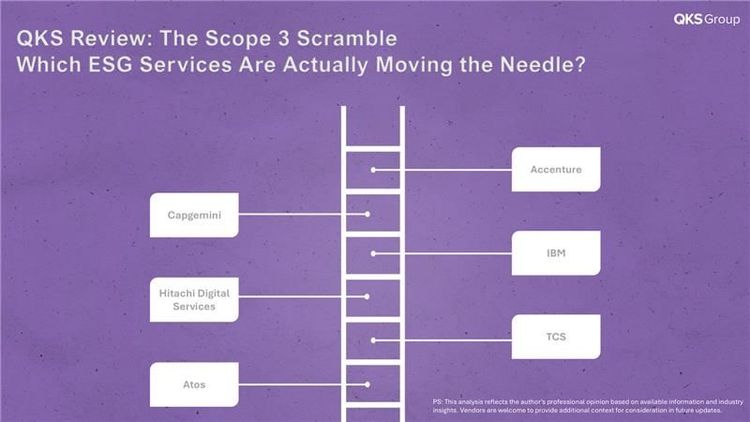
The execution gap is glaring. Most providers excel at producing Scope 3 reports, supplier scorecards, and dashboards — artifacts that satisfy compliance teams but don’t cut emissions. Very few are re-engineering supply chains, shifting procurement models, or financing supplier transitions. Accenture and Capgemini stand out as Leaders for combining strategy with supplier engagement at scale. IBM, Hitachi Digital Services, and TCS sit in the Capable tier, with credible offerings but uneven evidence of real-world reduction. Atos is best seen as Emerging, effective in IT efficiency but too narrow to drive system-wide Scope 3 transformation. Until providers step beyond assessments and into interventions, like renewable PPAs, supplier retrofits, and logistics redesign, the gap between glossy case studies and carbon reality will persist.
What Should Clients Demand?
Enterprises should stop rewarding vendors for polished dashboards and start demanding Scope 3 execution. That means:
- Data rigor: Supplier data integration that goes beyond averages and is audit-ready.
- Supplier enablement: Training, playbooks, and incentives for suppliers to act.
- Industry depth: Benchmarks and strategies tailored to sector realities.
- Technology for reduction: IoT, AI, and digital twins that optimize processes, not just measure them.
- Partnership longevity: Vendors with a track record of sustained supplier transformation, not one-off compliance projects.
Tackling Scope 3 is not a sprint but a decade-long journey. The winners will be those IT service providers who move beyond reporting into real supply chain transformation. Scope 1 and 2 are already commoditized; Scope 3 is where credibility, regulatory risk, and climate impact will be decided. And while Scope 4 offers a glimpse of a future narrative, reframing emissions in terms of avoided impact, clients cannot afford to be distracted. The fight today is about Scope 3, and only a handful of providers are truly moving the needle.
Disclaimer:
This blog is based on independent research and publicly available information. The insights presented reflect the views of QKS Group and are for informational purposes only. While we strive for accuracy, we do not guarantee completeness or absolute correctness. Vendors are welcome to provide clarifications or updates. If any vendor listed in this analysis wishes to provide additional context or clarification, we welcome a briefing call and will consider incorporating relevant updates. This analysis is not intended to disparage any vendor but to provide an informed, balanced perspective. We encourage open and constructive dialogue to foster transparency and a deeper understanding of the industry.
Author: Sahil Dhamgaye, Senior Analyst at QKS Group