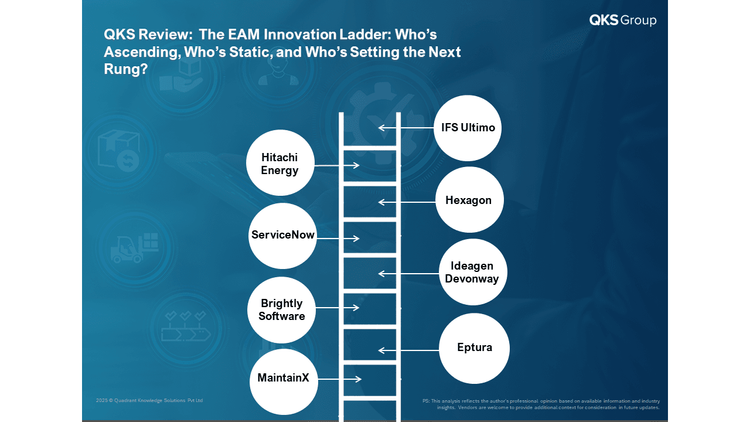
For all the noise about AI, digital twins, and “autonomous maintenance,” the reality is that most Enterprise Asset Management (EAM) vendors are still scattered across the rungs of true innovation. The EAM Innovation Ladder is our response to this landscape, a framework that doesn’t just chart maturity, but spotlights which vendors are genuinely advancing the state of asset management, which are stuck repeating yesterday’s playbook, and which are quietly redefining what’s possible.
In this review, we focus on vendors not previously dissected in our series, mapping their positions on the ladder, and calling out both their breakthroughs and blind spots. If you want to know who’s climbing, who’s clinging, and who’s setting the next rung, read on.
Foundation: Digitizing the Chaos
MaintainX
MaintainX is the archetype for organizations still escaping the tyranny of spreadsheets and whiteboards. Its mobile-first approach and intuitive workflow automation make it a favorite for teams seeking fast wins in work order digitization. But let’s be blunt—while MaintainX nails the basics, it’s a long leap from digitized work orders to strategic asset management. There’s little evidence yet that MaintainX can shepherd organizations up the staircase toward integrated, predictive, or lifecycle-centric EAM.
Middle Ascent: Integration, Compliance, and the Plateau Problem
Brightly Software
Brightly’s reputation for sustainability analytics and smart infrastructure is well-earned. Its platforms help organizations move past basic compliance, layering in energy management and asset performance. Yet, Brightly’s challenge remains depth—can it deliver the cross-functional integration and asset lifecycle insight needed for the next leap?
Eptura
Eptura’s strength is in workplace-asset convergence, optimizing space, assets, and hybrid work environments. For enterprises wrestling with distributed facilities, Eptura offers a credible path to process standardization. But the platform’s focus on the “where” sometimes overshadows the “how well”, especially when it comes to deep asset lifecycle intelligence.
Ideagen Devonway
Ideagen Devonway is a compliance powerhouse, especially in regulated verticals. Its asset management tools are robust for documentation and auditability, but the platform’s conservative design can make it feel like a compliance tool with EAM features, rather than a truly strategic asset platform.
ServiceNow
ServiceNow’s Enterprise Asset Management (EAM) ambitions are built atop its formidable enterprise workflow engine. The latest AI-driven enhancements promise a future of “autonomous IT” and predictive operations. But here’s the catch: ServiceNow’s EAM journey is still maturing. While its integration and automation capabilities are strong, most deployments today remain in the realm of workflow orchestration and IT/OT asset visibility—not yet at the level of strategic, predictive asset management seen at the summit.
Summit: Strategic Asset Lifecycle Excellence
Hexagon
Hexagon stands out for its digital twin capabilities, industrial IoT integration, and advanced visualization. For asset-intensive industries, Hexagon’s platforms are among the few that genuinely connect operational data with business outcomes. The challenge? Complexity and the need for organizational readiness—Hexagon works best where asset management is already a board-level priority.
Hitachi Energy
Hitachi Energy’s EAM approach is tightly woven into grid modernization and the energy transition. Its ability to blend asset management with sustainability and resilience is unmatched in the utilities sector. But as with all summit vendors, the real differentiator is not software alone it’s the combination of technology, methodology, and change management.
IFS Ultimo
IFS Ultimo has quietly built a reputation as a leading player, thanks to its rapid deployment, deep industry functionality, and integration flexibility. Ultimo’s out-of-the-box industry solutions, seamless integrations (including Microsoft ecosystem), and proven ROI (often recouped within two years) set it apart. The SAP-certified solution bridges operational, tactical, and strategic asset management enabling organizations to move from maintenance firefighting to true asset lifecycle optimization that drives collaboration, compliance, and safety. Ultimo boasts a 95% customer retention rate and its base spans manufacturing, logistics, healthcare, and utilities, with consistent praise for usability, agility, and business impact.
The Staircase in Perspective: Why Most Vendors Stall
The dirty secret of Enterprise Asset Management (EAM)? Most organizations and vendors plateau at the middle. Integration and compliance are necessary, but not sufficient. The summit is reserved for those who combine technology with transformation: deep domain expertise, change management, and a relentless focus on business value, not just software features.
What Buyers Should Demand (and Vendors Should Fear)
- Proven Methodologies: Not just software, but a blueprint for organizational change.
- Measurable Outcomes: Can the vendor demonstrate ROI beyond anecdotal case studies?
- Integration Depth: Is the platform an island, or does it truly unify IT, OT, and business systems?
- Scalability and Usability: Does the solution scale without becoming a burden?
Conclusion: The Real Test: Climbing, Not Coasting
The Enterprise Asset Management (EAM) market’s future belongs to vendors who help organizations climb, not coast. The QKS Maturity Staircase is not a marketing prop, it’s a challenge. If you’re a vendor reading this, ask yourself: Are you equipping clients for the summit, or are you content to keep them circling the landing?
Disclaimer:
This blog is based on independent research and publicly available information. The insights presented reflect the views of QKS Group and are for informational purposes only. While we strive for accuracy, we do not guarantee completeness or absolute correctness. Vendors are welcome to provide clarifications or updates. If any vendor listed in this analysis wishes to provide additional context or clarification, we welcome a briefing call and will consider incorporating relevant updates. This analysis is not intended to disparage any vendor but to provide an informed, balanced perspective. We encourage open and constructive dialogue to foster transparency and a deeper understanding of the industry.
Author: Akaash R, Senior Analyst at QKS Group