

12.06.2025
QKS Review
QKS Review:The Cost of Control: Are You Paying Too Much for Privileged Access Management?
Author:
Sanket Kadam


Executive Summary:
As the Privileged Access Management (PAM) market faces rising pressure from cost optimization demands, hybrid IT complexity, and increasing threat exposure, organizations are moving beyond traditional vault-based access control tools.
This review blog by QKS Group assesses whether PAM vendors are truly innovating to meet these demands or merely making incremental updates.
What Modern PAM Should Deliver:
Today’s platforms must offer more than credential vaulting. Critical next-gen capabilities include:
• Transparent and scalable pricing models tailored to cloud-native and hybrid infrastructures
• Integrated secrets management and DevOps-ready access orchestration
• Adaptive cost structures that align with usage, value, and security maturityKey Findings:
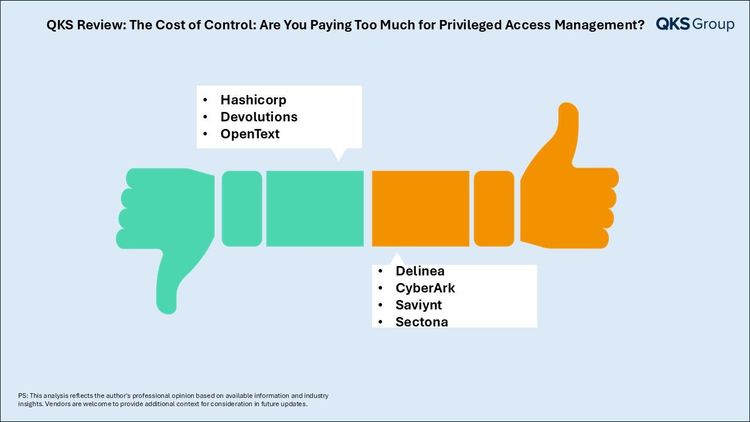
• Leading vendors CyberArk and Delinea stand out with comprehensive, enterprise-grade solutions and strong brand trust, though cost may escalate with scale.
• Capable vendors Saviynt, Sectona, and HashiCorp show promise in specific segments such as convergence, affordability, and DevOps alignment, but face limitations in feature depth or enterprise scaling.
• Lagging vendors OpenText and Devolutions remain focused on traditional licensing and entry-level functionality, risking obsolescence as cost-effective, agile models dominate.
Introduction
Privileged Access Management (PAM) is a foundational element in any modern enterprise security architecture. As organizations scale their digital operations and embrace cloud-native environments, the need to control and secure privileged accounts has never been more urgent. However, the journey to implement PAM is riddled with financial complexity, opaque pricing models, and unforeseen costs that challenge even the most mature IT teams. Are organizations truly investing in security, or are they caught in a cycle of overpriced complexity?
Balancing Cost Without Compromising Enterprise Security Enterprises often struggle to balance the high cost of PAM solutions with the need for comprehensive protection. Many vendors claim to offer full-suite capabilities, but the reality includes hidden costs for modules, licensing tiers, and implementation services. This creates a significant disparity between advertised value and real-world performance. Security leaders must assess whether the costs associated with PAM align with their enterprise’s threat landscape, compliance obligations, and scalability requirements without compromising on protection.
Understanding PAM Pricing Models Privileged Access Management vendors employ various pricing strategies, making direct comparisons difficult. Pricing structures are often tailored to specific customer types, infrastructure scales, and feature usage.
Overview of Common Pricing Structures in the PAM Market

Factors Influencing Pricing: Features, Scalability, and Support
- Feature Set: Advanced capabilities such as behavioral analytics, session recording, and automated access revocation increase costs.
- Scalability: The ability to handle thousands of users, machine identities, and service accounts often demands higher pricing tiers.
- Support & Integration: Vendors charge premium for 24/7 support, custom connectors, professional services, and ecosystem integrations.
Vendor Analysis: Cost vs. Value
Delinea offers a mid-market focused Privileged Access Management solution that blends ease of use with core privileged management capabilities. Its pricing is relatively more transparent than legacy players, offering a mix of subscription and perpetual models. Delinea’s strengths lie in UI simplicity and integration with ITSM tools. However, as organizations scale, costs may rise sharply due to feature add-ons like analytics, DevOps support, and multi-cloud vaulting. While its TCO is lower than some competitors, enterprises must evaluate how quickly the solution becomes fragmented when scaling across complex hybrid environments.
CyberArk is widely recognized as a market leader in PAM, offering enterprise-grade security capabilities including privileged session management, threat analytics, and seamless integration with identity platforms. Its pricing, however, reflects its premium status with substantial upfront licensing, high implementation costs, and modular add-ons. For large enterprises with stringent compliance needs, CyberArk delivers robust value. Yet, its steep learning curve, prolonged deployment timelines, and extensive support requirements can elevate TCO significantly.
Is CyberArk’s elite security performance justifying its cost for all buyers, or does its pricing model limit access for mid-sized organizations?
Saviynt positions itself as a cloud-native identity platform that merges IGA and PAM functionalities. It adopts a usage-based pricing model tied to the number of identities and privilege types managed. This makes it attractive for organizations already aligned with SaaS-first strategies. While the integrated identity approach adds long-term value, PAM-specific capabilities like session control and vaulting may lag behind traditional leaders. Saviynt’s TCO is shaped by its broader identity governance suite rather than PAM alone, prompting a need to weigh bundled value against dedicated PAM tools.
Can Saviynt’s unified identity model offer enough depth to displace standalone PAM leaders?
Sectona is gaining traction in emerging markets for its cost-effective PAM suite that includes vaulting, session management, and JIT access. It offers flexible deployment models with aggressive pricing for SMBs and mid-size enterprises. Sectona’s total cost of ownership is favorable due to lower implementation overhead and bundled features. For organizations prioritizing fast deployment and core PAM coverage at a lower price point, Sectona is a compelling option for large enterprise in Indo-Pacific region but Is Sectona ready to compete with global giants in worldwide arena?
Devolutions offers affordable PAM solutions, tailored primarily for small and mid-sized businesses. It provides essential capabilities such as password vaulting, access control, and auditing within a predictable licensing model. The pricing transparency and ease of deployment make Devolutions a low-barrier entry into PAM. However, it lacks the enterprise features like dynamic policy enforcement, robust API integrations, and advanced analytics. While cost-effective for smaller environments, Devolutions may not meet the demands of complex, distributed enterprises. Is its simplicity a strength or a ceiling for long-term PAM strategy?
HashiCorp Vault delivers a developer-centric approach to secrets management and privilege control. It offers an open-source base and a paid enterprise tier with features like HSM integration, replication, and advanced policies. Vault’s pricing is aligned with usage based on the number of applications or users accessing privileged secrets and data. While ideal for DevOps-heavy environments, the cost can grow steeply as enterprises scale usage. HashiCorp Vault integrates with its HashiCorp boundary platform to offer PAM features like session monitoring and access workflows to secure user access across dynamic environments.
Is Vault’s consumption-based pricing sustainable as the organization’s secret sprawl intensifies?
OpenText offers PAM solution focused on large enterprises with complex IT estates. It provides traditional vaulting, session control, and audit functionalities through perpetual or subscription licensing. While mature in deployment flexibility and compliance readiness, OpenText’s pricing is often opaque and heavily service dependent. Organizations must account for consulting fees, support costs, and long implementation cycles. As digital environments move toward cloud-native and agile security models, does OpenText’s high TCO still deliver relevant value?
Which PAM Solution Offers the Best Value?

Final Take Choosing the right Privileged Access Management solution is not just about maximizing protection it’s about making protection sustainable. Vendors like CyberArk and Delinea offer powerful capabilities, but organizations must ensure those capabilities align with their operational models and growth trajectories. Cost-effective platforms like Devolutions and HashiCorp democratize access to PAM but may not fulfill enterprise demands. As privilege misuse remains a top threat vector, the question isn’t whether you can afford PAM it’s whether you can afford the wrong one.
Disclaimer:
This blog is based on independent research and publicly available information. The insights presented reflect the views of QKS Group and are for informational purposes only. While we strive for accuracy, we do not guarantee completeness or absolute correctness. Vendors are welcome to provide clarifications or updates. If any vendor listed in this analysis wishes to provide additional context or clarification, we welcome a briefing call and will consider incorporating relevant updates. This analysis is not intended to disparage any vendor but to provide an informed, balanced perspective. We encourage open and constructive dialogue to foster transparency and a deeper understanding of the industry.
Author: Sanket Kadam, Analyst - Identity and Access Management (IAM) at QKS Group
Vendors: