

03.07.2025
QKS Review
QKS Review: The Battle for ITIM Supremacy: Which Vendor Stands Out?
Author:
Aditya S


Executive Summary:
Executive Summary:
In today’s complex IT landscape, IT Infrastructure Monitoring (ITIM) platforms are transforming how enterprises maintain system reliability, security, and performance. With the rise of hybrid cloud, edge computing, and AI-driven automation, traditional reactive monitoring approaches are no longer sufficient. Enterprises now demand intelligent ITIM solutions that provide real-time insights, predictive analytics, and seamless integration with modern workflows.
Advanced ITIM platforms leverage AI and machine learning to deliver proactive anomaly detection, automated issue resolution through AIOps, and robust integration with IT Service Management (ITSM) and DevOps ecosystems. As vendors compete to enhance their solutions with AI intelligence, the ITIM market is rapidly evolving. The ability to offer scalable, AI-powered monitoring tools that optimize system resilience, security, and efficiency is defining the leaders in this dynamic digital era.
Why IT Infrastructure Monitoring (ITIM) tools is Essential
In today’s digitally connected world, IT infrastructure serves as the backbone of business operations. ITIM tools are essential for maintaining the health, performance, and security of this infrastructure. They provide continuous monitoring of servers, networks, applications, and cloud resources, allowing organizations to detect and resolve issues before they impact users or disrupt services. With the growing complexity of hybrid and multi-cloud environments, ITIM tools enable centralized control, improve incident response times, and reduce operational risk. By integrating with automation platforms, ITSM systems, and DevOps pipelines, they empower IT teams to deliver resilient, high-performing, and scalable digital services essential for business continuity and innovation.
- System Performance Optimization: ITIM tools continuously monitor system metrics, such as CPU usage, memory, disk I/O, and network performance, identifying inefficiencies and bottlenecks in real time. By leveraging AI-driven analytics, they optimize resource allocation, balance workloads, and ensure high availability, delivering consistent performance for critical applications and improving the end-user experience across distributed environments.
- Predictive Maintenance: Using machine learning, ITIM tools predict potential system failures, such as server crashes, storage capacity issues, or application performance degradation, before they occur. They enable IT teams to take preemptive actions-like resource scaling, system patching, or hardware replacement-reducing unplanned downtime and ensuring continuous service availability for mission-critical operations.
- Unified Visibility Across Environments: ITIM tools provide a single pane of glass for monitoring across physical, virtual, cloud, and edge environments. This unified visibility helps IT teams track system health, application performance, and network activity holistically, breaking down silos between infrastructure components. By centralizing monitoring data, ITIM tools streamline troubleshooting, enhance collaboration across teams, and support faster, data-driven decision-making in complex, hybrid IT ecosystem.
- Automated Threat Detection: AI-powered ITIM tools detect anomalies in system behavior, such as unusual login patterns, unauthorized access attempts, or malware activity, that could indicate security threats. With real-time threat detection and automated response capabilities, these tools can isolate compromised components, block malicious activities, and initiate remediation protocols, minimizing the impact of cyberattacks and ensuring compliance with security standards.
- Operational Efficiency: By automating routine tasks like system diagnostics, log analysis, and performance tuning, ITIM tools significantly reduce manual workloads and operational overhead. They provide actionable insights, accelerate root-cause analysis, and enable faster resolution times, allowing IT teams to focus on strategic initiatives. This boosts productivity, reduces operational costs (OPEX), and supports scalable IT operations in dynamic environments.
With these advantages in mind, let’s explore how leading ITIM vendors are transforming enterprise IT operations.
In the race toward next-generation IT infrastructure management, ITIM tools are no longer optional-they are the backbone of resilient, efficient, and secure IT ecosystems. While many vendors integrate AI into their platforms, the depth and sophistication of their implementations vary. Some pioneers have built AI-driven ITIM solutions from the ground up, delivering fully proactive, self-optimizing systems. Others have adopted an incremental approach, adding AI capabilities to legacy monitoring frameworks, which offer improvements but fall short of true autonomy.
To help enterprises navigate this evolving landscape, we present a strategic breakdown of key players in ITIM, highlighting their technological maturity, architectural depth, and vision for the future.
The IT Infrastructure Monitoring (ITIM)Tools Adoption Landscape
Market Leaders: Strong AI Integration Driving Innovation in ITIM Tools
Splunk: The AI-Driven IT Analytics Powerhouse
Splunk Observability Cloud, a cornerstone of Splunk’s IT Infrastructure Monitoring (IM), is OpenTelemetry-native, enabling organizations to collect and analyze telemetry data without vendor lock-in, giving it an edge over rivals.Splunk is a co-founder and top contributor to the OpenTelemetry project and the only large vendor offering commercial support for OpenTelemetry. It seamlessly integrates with Splunk Application Performance Monitoring and the Splunk Platform for log analytics, providing unified visibility across hybrid cloud environments, including Kubernetes, containers, hosts, virtual machines, servers, and databases. Splunk Infrastructure Monitoring uses AI, trained on extensive customer data, to create accurate alerts, predict potential issues, and offer actionable recommendations, reducing unnecessary alerts and lowering Mean Time to Resolution (MTTR). Its AIOps capabilities, delivered through Splunk ITService Intelligence (ITSI), enhance operational efficiency through automated resource discovery, real-time anomaly detection, and predictive insights, ensuring system reliability and minimal downtime. Splunk’s feature set includes full-stack visibility, real-time analysis, cloud network performance monitoring, and business-specific reporting, supporting cloud-to-edge device monitoring across legacy and modern architectures.
Dynatrace: The Autonomous Cloud Observability Leader
Dynatrace offers an intelligent IT Infrastructure Monitoring platform with end-to-end observability, real-time monitoring, and automated resource discovery, powered by its AI-driven Davis engine for automated root-cause analysis and full-stack visibility across hybrid and multi-cloud environments. Its AIOps engine enhances pattern recognition and noise reduction, enabling faster Mean Time to Repair (MTTR) by identifying root causes and suggesting remediation steps. Grail, its core technology, unifies, stores, and analyzes large volumes of telemetry data without index management or tiered storage, simplifying operations, boosting scalability, and improving cost efficiency. Davis dynamically adjusts thresholds to minimize alert fatigue, optimizing resource performance and streamlining incident management. Dynatrace supports cloud-to-edge management, including Kubernetes monitoring and context-rich data ingestion for AI-driven analytics, ensuring comprehensive visibility.
Datadog: The DevOps-Friendly, Cloud-Native Option
Datadog’s SaaS-based Infrastructure Monitoring tool delivers real-time visualization of IT asset performance, enabling Infrastructure and Operations (I&O) teams to troubleshoot issues, optimize resources, and secure cloud environments across hybrid, multi-cloud, and IoT ecosystems. It monitors full-stack metrics, distributed traces, logs, and serverless functions, offering deep visibility into diverse infrastructure setups, including on-premises environments. Datadog’s AI-driven alerts detect anomalies and provide precise remediation suggestions, enhancing productivity and reducing downtime, while its ability to process unlimited telemetry data ensures comprehensive monitoring at scale. Its seamless integration with Kubernetes, CI/CD workflows, and security monitoring, along with streamlined deployment, reduces maintenance overhead and fosters collaboration.
Strong Performers: Advancing Toward Intelligent IT Operations
Progress software (WhatsUp Gold): The IT Infrastructure Monitoring Specialist
Progress software’ WhatsUp Gold delivers robust IT infrastructure monitoring by leveraging ICMP, SNMP, and WMI protocols for automated network discovery and topology mapping, enabling IT teams to visualize their infrastructure with clarity. Its agentless telemetry simplifies deployment and integrates seamlessly with third-party tools like Elastic Search and PowerShell for enhanced functionality. WhatsUp Gold provides end-to-end real-time monitoring of networks, servers, applications, and security components, ensuring comprehensive visibility into IT infrastructure health and performance. The platform’s automated diagnostic capabilities identify anomalies and execute predefined actions using scripts or SSH commands, minimizing manual intervention. Additionally, its integrated configuration management allows users to audit, archive, and restore device configurations using protocols like Telnet, SSH, TFTP, SFTP, and SCP, ensuring system consistency and efficient troubleshooting. While WhatsUp Gold currently lacks full AIOps support, efforts are underway to introduce AIOps-like functionality to minimize false positives and enhance intelligent automation.
ScienceLogic: The Hybrid IT Champion
ScienceLogic’s SL1 platform provides a comprehensive IT infrastructure monitoring and AIOps solution, offering unified monitoring across hybrid environments through SNMP, APIs, Syslog, and SSH for complete visibility into physical, software-defined, and cloud-based resources. Its Zebrium root-cause analysis engine automates anomaly detection by analyzing log files and correlating them with recent changes and performance metrics, significantly reducing investigation time and enabling proactive remediation. SL1 supports multi-cloud environments, including Kubernetes and Azure, delivering robust monitoring of utilization, availability, and performance metrics. The platform’s proactive application performance monitoring ensures organizations meet SLA requirements by tracking the health, availability, and risks associated with business applications, optimizing end-user experiences. SL1’s workflow automation simplifies operational tasks by automating configuration changes, incident response, and ITSM integration, allowing users to design custom workflows for tailored automation, which reduces manual effort and boosts operational efficiency. However, the platform occasionally encounters bugs, such as missing performance data or API responses, which can disrupt monitoring processes and lead to delays in identifying and addressing system issues.
Emerging Innovators: Fully Autonomous Networking with Zero-Touch Operations
Veryx Technologies: The Agile ITIM Challenger
Veryx Technologies’ Cloudmon platform delivers advanced IT infrastructure monitoring by utilizing probes, agents, and SNMP for data collection, providing real-time insights into performance and health metrics across public and private cloud environments. Cloudmon offers granular visibility into mission-critical resources, enabling organizations to streamline IT monitoring, reduce costs, and accelerate troubleshooting. Its server monitoring capabilities include automatic alerts with integrated root-cause analysis (RCA) when thresholds are breached, facilitating faster issue resolution. Cloudmon supports WAN and LAN monitoring, providing centralized visibility for distributed networks, including remote users and branch offices, through full-stack monitoring and device discovery. Its Digital Experience Monitoring (DEM) feature enhances remote workforce experiences by optimizing device usage while protecting privacy by focusing solely on KPIs. Although Cloudmon has begun integrating AI-assisted features with automated remediation, its predictive analytics capabilities are still evolving, with plans to develop a comprehensive AIOps feature set to further enhance proactive incident detection and resolution.
The Final Take
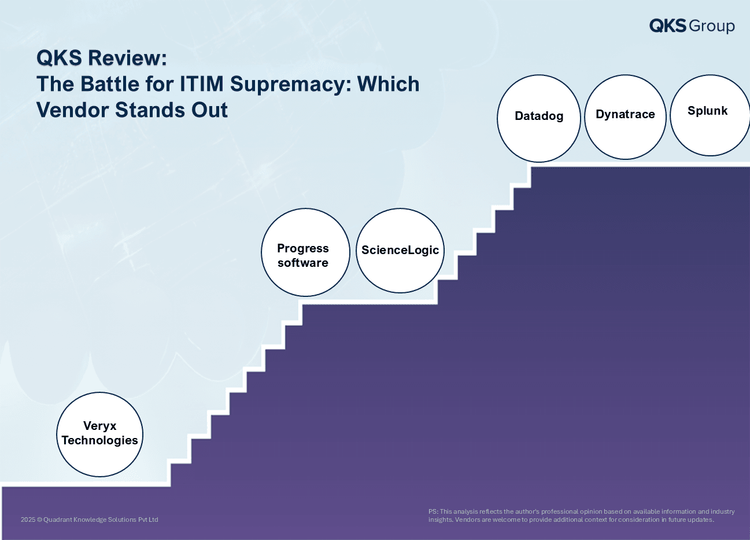
The IT Infrastructure Monitoring (ITIM) landscape is rapidly evolving, with market leaders like Splunk, Dynatrace, and Datadog delivering deeply integrated AI capabilities that enable proactive, self-optimizing, and intelligent IT operations. These platforms excel in providing real-time visibility, predictive analytics, and automated issue resolution, significantly reducing manual intervention and enhancing system reliability. Strong performers such as Progress software (WhatsUp Gold) and ScienceLogic offer robust AI-driven features focused on observability, hybrid environment monitoring, and operational efficiency, though they may still require some manual oversight for advanced automation. Veryx Technologies, an emerging innovator, is pushing boundaries with its Cloudmon platform, designed for near-autonomous monitoring with zero-touch operations, leveraging AI for real-time insights and integrated root-cause analysis. As enterprises demand more agile, intelligent, and efficient IT management solutions, those adopting AI-powered ITIM platforms are best positioned to thrive in the dynamic digital era.
Disclaimer & Invitation:
This blog is based on independent research and publicly available information. The insights presented reflect the views of QKS Group and are for informational purposes only. While we strive for accuracy, we do not guarantee completeness or absolute correctness. Vendors are welcome to provide clarifications or updates. If any vendor listed in this analysis wishes to provide additional context or clarification, we welcome a briefing call and will consider incorporating relevant updates. This analysis is not intended to disparage any vendor but to provide an informed, balanced perspective. We encourage open and constructive dialogue to foster transparency and a deeper understanding of the industry.
Author:Aditya S, Analyst - IT/Network Operations Management at QKS Group
Vendors: