


As the Demand Planning market embraces Artificial Intelligence (AI), vendors are under increasing pressure to turn AI hype into measurable, real-world outcomes. This review blog by QKS Group evaluates how key players in the space—John Galt Solutions, o9 Solutions, RELEX Solutions, SAP, and Oracle—are performing in the race to integrate AI into demand forecasting and planning.
What Modern AI in Demand Planning Should Deliver:
AI in demand planning must offer more than theoretical capabilities. Critical next-gen AI-driven capabilities include:
Real-Time Demand Sensing: The ability to dynamically detect and respond to shifts in demand.
Predictive Forecasting: Incorporation of vast datasets and external factors to improve forecast accuracy.
Automated Decision-Making: Tools that automate responses to demand changes and optimize resource allocation.
Key Findings:
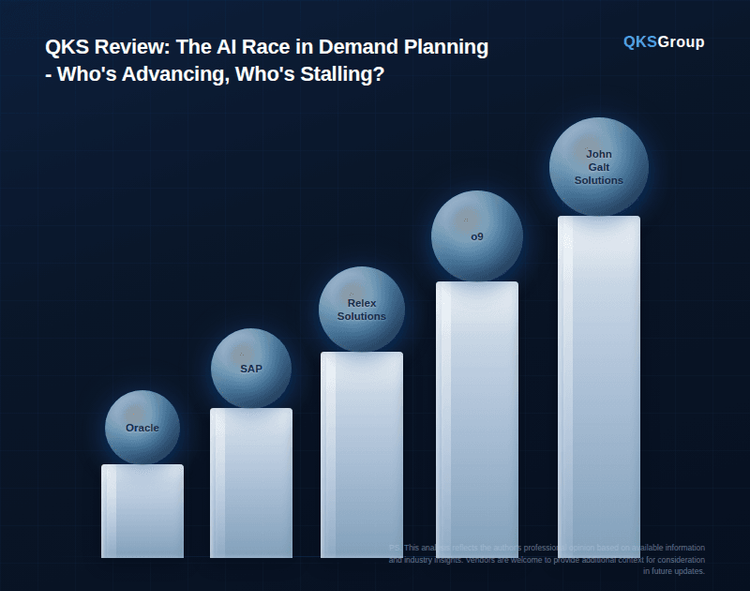
Leading vendors like John Galt Solutions and o9 Solutions are at the forefront, with embedded AI capabilities that enhance forecast precision and agility. These platforms provide comprehensive, real-time decision-making tools, though o9 still faces challenges in handling unstructured data at scale.
Capable vendors like RELEX Solutions excel in retail and grocery demand planning, automating key functions like replenishment and forecasting. However, their AI capabilities are still limited to execution-focused tasks and lack broader strategic planning depth.
Lagging vendors like SAP and Oracle have made substantial AI investments but struggle with platform complexity and integration challenges. SAP’s promising AI shift faces significant gaps in real-world deployment, while Oracle’s legacy limitations hinder the full potential of their AI investments.
QKS Review: The AI Race in Demand Planning - Who’s Advancing, Who’s Stalling?

19.06.2025
QKS Review
QKS Review: The AI Race in Demand Planning - Who’s Advancing, Who’s Stalling?
Author:
Pruthvi Raj V
Executive Summary:
In today’s landscape, having AI is no longer enough, vendors must prove it delivers real-world impact. The winners will be those who turn AI hype into measurable planning outcomes.
Artificial Intelligence (AI) is transforming the way businesses predict and respond to demand. From demand planning and forecasting to real-time demand sensing, AI-driven solutions are reshaping supply chains with unprecedented accuracy and agility. Companies that successfully leverage AI gain a competitive edge, while those slow to adapt risk falling behind in an increasingly data-driven market.
AI enhances demand planning by integrating vast datasets and using predictive analytics to optimize inventory and resource allocation. It refines forecasting through advanced modeling and external factor incorporation, reducing uncertainty in supply chain decisions. Additionally, AI-powered demand sensing empowers businesses to detect real-time shifts in demand, enabling faster, smarter responses.
However, AI adoption across demand management platforms remains uneven. Some vendors are pushing the boundaries with embedded AI capabilities, while others are still adapting legacy foundations. Here’s a closer look at where each stand in the evolution of AI-driven demand planning.
John Galt Solutions: Setting a High Bar for AI-Led Forecasting
John Galt Solutions (JGS) continues to raise expectations with an AI-first approach that delivers both forecasting precision and planning agility. Their Atlas platform combines real-time market signals, probabilistic modelling, and automated workflows, enabling users to make high-quality decisions dynamically.
Strengths:
- AI-powered demand sensing incorporating external real-time inputs
- Decision-centric planning framework that reacts to change rapidly
- Automated workflows that reduce manual overhead
Final Take: JGS sets a strong benchmark for applied AI in demand planning, particularly in environments where responsiveness and forecast precision are critical. Its platform shows clear progress in embedding intelligence into planning workflows without overwhelming operational teams.
o9 Solutions: A Strong Contender
o9 Solutions has emerged as a strong player in AI-enabled demand planning, particularly through its use of graph-based data models and real-time analytics. The company’s Digital Brain framework enables high-frequency sensing and agile decision-making, though some capabilities are still maturing in specific contexts.
Strengths:
- Graph-based AI models with contextual demand insights
- Real-time analytics engine enhancing forecast agility
- Strong integration of AI across planning layers
Challenges: While highly effective in structured environments, further enhancements are needed to handle unpredictable or unstructured data conditions at scale.
Final Take: o9 demonstrates a solid commitment to AI integration and continues to improve its end-to-end decision-making capabilities. Sustained innovation in model flexibility and interpretability will strengthen its positioning.
Relex Solutions: Focused Strength, Expanding Operational Reach
RELEX Solutions has established a stronghold in retail and grocery demand planning, leveraging AI to automate forecasting and replenishment. Recent product enhancements - such as Diagnostics for value chain bottleneck identification and True Inventory for store-level visibility - indicate a clear intent to move beyond core replenishment into adjacent planning functions. However, despite these advancements, RELEX’s AI maturity remains primarily centered on execution-focused scenarios, with limited depth in areas like strategic planning or broader supply chain orchestration.
Strengths
- Specialized machine learning models for retail and grocery demand forecasting
- Automated replenishment capabilities that reduce inventory imbalances and stockouts
- Introduction of store-focused modules like True Inventory and mobile ops tools to close execution gaps.
- Use of Diagnostics to identify upstream and downstream inefficiencies across the value chain.
Challenges
- Platform extensions beyond retail (e.g., manufacturing, CPG) remain underutilised
- Emerging AI use cases outside core focus areas
- Limited capabilities in broader financial planning
Final Take
RELEX remains a compelling option for retailers seeking automation and AI in forecasting and replenishment. The vendor has taken clear steps to broaden its impact across adjacent use cases, but organizations requiring more strategic, enterprise-wide planning capabilities should evaluate RELEX’s roadmap maturity in those areas before adoption.
SAP: Promising AI Shift, But Execution Still Varies
SAP is advancing its AI capabilities with the introduction of a new AI operating foundation, generative AI agents, and broader integration with hyperscalers and AI model providers. These investments point toward a more intelligent and automated planning future, supported by efforts to embed AI across logistics, procurement, and planning workflows.
However, real-world deployment still reflects a significant gap between potential and accessibility. While some customers have realized meaningful improvements through long-term transformations, most users continue to face challenges in activating AI at scale—especially in complex environments where system integration, data alignment, and configuration effort remain high.
SAP Highlights:
- Strategic shift toward generative and agentic AI capabilities
- Investments in ecosystem-wide orchestration via cloud platforms
- Platform complexity and integration effort still impact speed and accessibility
Final Take: SAP has made clear progress in embedding AI across its planning suite. The roadmap is strong, but broad-based adoption will depend on simplifying deployment, enhancing flexibility, and closing the gap between innovation and day-to-day usability.
Oracle: AI Investment Amidst Legacy Limitations
Oracle continue to promote AI across their planning portfolios, yet their operational execution often reflects the weight of legacy systems and traditional forecasting logic. While investments in cloud and automation are ongoing, users still face limitations in flexibility and speed.
Oracle Highlights:
- Some AI features in forecasting and automation are emerging
- Current frameworks rely heavily on structured historical data
- Seamless module integration for AI-driven decisions is still evolving
Final Take: Oracle is working toward modernizing their platforms with AI, but tangible execution gaps remain. Accelerating functional depth and real-time adaptability will be essential for catching up with faster-moving competitors.
Conclusion: Demand Planning AI is Not a Sprint - It’s an Ongoing Transformation
AI in demand planning is not a single race with a finish line; it’s a continuous evolution. Vendors like John Galt Solutions and o9 Solutions are setting the pace with dynamic, embedded intelligence. Others like Relex demonstrate niche excellence but need broader applicability. Meanwhile, SAP and Oracle are progressing incrementally but face significant operational challenges.
For supply chain leaders, the question is no longer who offers AI, it’s who delivers measurable, real-time impact where it matters most. Marketing promises won’t close the gap, execution will.
Disclaimer:
This blog is based on independent research and publicly available information. The insights presented reflect the views of QKS Group and are for informational purposes only. While we strive for accuracy, we do not guarantee completeness or absolute correctness. Vendors are welcome to provide clarifications or updates. If any vendor listed in this analysis wishes to provide additional context or clarification, we welcome a briefing call and will consider incorporating relevant updates. This analysis is not intended to disparage any vendor but to provide an informed, balanced perspective. We encourage open and constructive dialogue to foster transparency and a deeper understanding of the industry.
Author: Pruthvi Raj V, Senior Analyst at QKS Group
Co- Author: Kumar Anand, Associate Director & Principal Industry Analyst at QKS Group
Vendors: