

07.07.2025
QKS Review
QKS Review: The AI Divide - Heavyweights vs. Lightweights Vendors: Who’s really using AI in Digital Marketing Analytics?
Author:
Richa Choubey


Executive Summary:
As the Digital Marketing Analytics (DMA) market faces rising pressure from demand for real-time personalization, predictive campaign performance, and scalable automation, organizations are moving beyond traditional tracking and visualization tools.
This review blog by QKS Group assesses whether DMA vendors are truly innovating with AI integration to meet these demands or merely layering intelligence onto outdated architectures.
What Modern Digital Marketing Analytics Platforms Should Deliver:
Today’s platforms must offer more than dashboards and KPIs. Critical next-gen capabilities include:
- Embedded AI for real-time decision automation
- Predictive modeling across journeys and customer touchpoints
- Intelligent orchestration and adaptive content delivery
Key Findings:
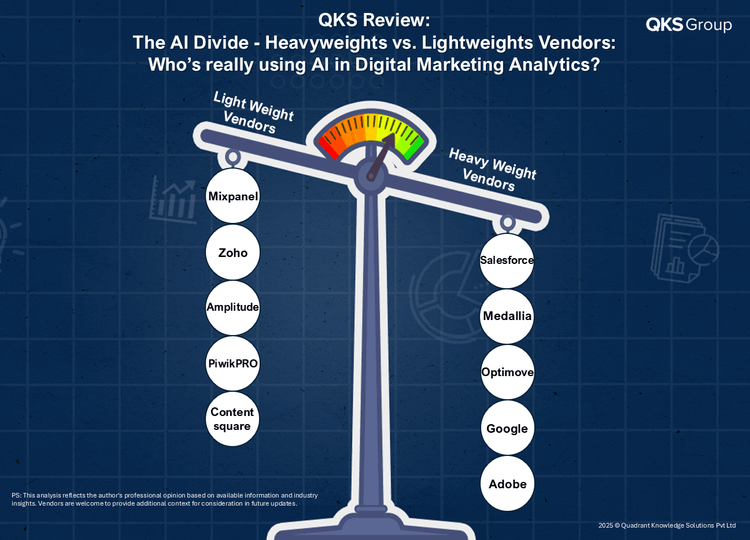
Leading vendors such as Salesforce, Medallia, Adobe, and Optimove stand out with comprehensive, enterprise-grade AI integration across data, orchestration, and insights.
Capable vendors including Mixpanel, Zoho Analytics, and Amplitude show promise in behavioral insights and accessibility but lack orchestration depth or dynamic adaptability.Lagging vendors like Piwik PRO and Contentsquare remain focused on niche use cases or manual analysis workflows, risking obsolescence as intelligence becomes central to DMA strategy.
Artificial intelligence is no longer a future-facing feature in the Digital Marketing Analytics (DMA) space but has become foundation for the modern DMA platforms. As brands started focusing for scalable personalization, journey-level automation, and real-time insight generation, DMA platforms are evolving to integrate intelligence not just in discrete tools but as part of the core system design. However, vendors are approaching this integration differently, some have embedded AI into every layer of their platform, while others are taking a more peripheral approach. This blog explains how key platforms are positioned in the evolving AI curve, the nature of their intelligence frameworks, and what end-users can realistically expect in terms of value, usability, and sophistication.
Heavyweight Vendors:
Salesforce’s AI Engine for Smarter, Data-Driven Marketing Decisions
Salesforce’s DMA platform, anchored by Marketing Cloud Intelligence and powered by Einstein AI, offers uses with a comprehensive suite of AI-driven capabilities designed to optimize campaign performance thus enhance audience understanding, and streamline data management. At its core, Einstein powers predictive features such as engagement scoring, send time optimization, and content tagging enables users to tailor communications based on individual behavior patterns enhancing personalisation. The platform enables organizations to optimize their budget or campaign in real time through its Marketing Cloud Intelligence that extends with automated data harmonization, anomaly detection, and AI-generated recommendations. The platform leverages unified datasets across CRM, advertising, and web platforms thus helps users to do cross-channel performance attribution, predictive lifetime value modeling, and intelligent funnel analysis. Additionally, the platform integrates natural language processing for conversational insights and automated narrative generation, while its Einstein Discovery enables advanced users to build custom predictive models and conduct scenario-based what-if analyses. Overall, the platform’ AI powered capabilities make it a must have powerful engine for making data-driven marketing decisions.
Medallia: Behavioral Precision at the Micro-Level
Medallia differentiates itself by positioning analytics around behavioral signals rather than just performance indicators. The platform uses ML algorithms to identify micro-interactions such as cursor hesitation, scroll patterns, or repeated navigation loops, that helps organizations to track user frustration or friction. These patterns are distilled into insights that inform both product improvements and customer engagement strategies. Medallia's AI-driven tools like Ask Athena and Intelligent Summaries remove the overhead of manual analysis by providing users with the converted feedback data into structured narratives. Smart Response assists frontline teams in crafting personalized communications instantly, while real-time session summarization and root cause tracking allow for prompt resolution of experience-related issues. The platform offers a blend of real-time responsiveness and strategic depth, making it especially relevant for experience-focused teams that must navigate both qualitative and quantitative signals.
Optimove: Campaign-Centric Intelligence with Feedback Loops
Optimove's platform personifies a campaign brain that learns and adapts through is its intelligence layer, known as OptiGenie, that spans insight generation, content generation, and journey orchestration. It uses clustering, uplift modeling, and response measurement to dynamically tailor outreach efforts across campaigns. Rather than isolating intelligence to a reporting interface, Optimove builds it into the campaign engine. Predictive tools anticipate churn or conversion likelihood, and self-optimizing journeys adjust in real time based on user behavior. The platform’ generative tools for copywriting and personalized recommendations enables marketers to scale customized experiences. Its ability to handle campaigns as ongoing experiments aligns closely with B2C models, where responsiveness and personalization are one of the important key drivers of value.
Google Analytics 4 (GA4): Scalable Intelligence for the Mass Market
GA4 represents Google's most advanced effort in transforming intelligence within the analytics landscape, making AI usable for everyone, from solo marketers to enterprise teams. Their Digital Marketing Analytics platform's built-in machine learning features are bundled under the umbrella of Analytics Intelligence, designed to guide marketers with anomaly detection, predictive scoring, and automated alerts. Features like churn prediction and purchase probability help organizations to prioritize their action without requiring technical fluency. The platform’ Integration with Google Ads amplifies the utility of GA4's intelligence by connecting insight with action through automated bidding and cross-channel attribution. For many users, the platform functions with minimal configuration, using historical and real-time data to generate insights at scale. It provides natural language querying and offers customizable alerts through a relatively intuitive interface. While GA4 doesn't dive into prescriptive or generative intelligence models, its strength lies in broad accessibility and consistent performance. The platform supports standardization over its deep customization making it more practical for users looking for wide-scale implementation rather than bespoke intelligence frameworks.
Adobe Analytics: Integrated Intelligence for Enterprise Orchestration
Adobe Analytics takes a wider and more integrated approach by embedding its intelligence layer, Sensei, across its multiple products in the Adobe Experience Cloud. The platform offers users with intelligent alerts, automated segmentation, lookalike modeling, and contribution analysis while also seamlessly benefits users with these insights through Adobe Target and Campaign to enable fully automated, dynamic customer experiences. The platform caters to organizations with high data volumes and complex engagement workflows through its unique capabilities such as B2B account-based tracking, real-time streaming analytics, and AI-assisted root cause analysis. The company enhances operability for non-technical users by enabling them with conversational querying via its Data Insights Agent. With personalization and journey optimization capabilities tightly integrated into its platform, making it well-suited for mature marketing teams seeking operational precision and strategic agility. Its layered architecture also ensures intelligence is not a add-on but a thread running through analytics, activation, and optimization.
Lightweight Vendors:
Mixpanel: Product Analytics with Real-Time Responsiveness
Mixpanel offers AI capabilities in a focused and differentiated manner in its Digital Marketing Analytics platform by centering its capabilities more on real-time behavioral analytics rather than on wider generative or prescriptive applications. Its AI is purpose-built to help users to uncover patterns in user behavior, identify funnel inefficiencies, and surface drop-offs that can hinder engagement and retention. The platform leverages historical event data enables users to predict user retention, feature adoption, and conversion likelihood through its advanced cohort analysis and trend projection. The platform strength lies in its enabling immediate, actionable insights for optimizing digital customer experiences. The platform's Spark AI capability allows users to query their data in natural language, easing access for non-technical stakeholders. Intelligence is embedded directly into the dashboard environment, making it easy to visualize user flow, identify drop-off points, and uncover patterns tied to adoption and engagement. Mixpanel is geared toward digital product teams that require a real-time, data-driven feedback mechanism to fine-tune features and user journeys. While it doesn't offer adaptive workflows or automated decision-making, it excels at behavioral insight generation within a compact use case.
Zoho Analytics’ Practical AI for Mid-Market Users
Zoho's AI assistant, Zia, adds an assistive intelligence layer to the platform by allowing users to perform natural language queries, generate auto-summaries, detect anomalies, and receive correlation suggestions. The system is designed for accessibility, targeting users without having a specialized analytics expertise thus improving operability. Its AI assistant, Zia, has a widespread across its Zoho's ecosystem including CRM, finance, and HR, makes it a real-world solution for mid-sized businesses those seeking for a unified insights without relying on heavy customization. However, its intelligence functionality works as a user assistant rather than autonomous and its forecasting models that are based on straightforward rule logic, and decision-support is more reactive than predictive.
Amplitude’s AI: Strong on Behavioral Insights, Limited on Execution
Amplitude integrates AI across its DMA platform through features like Predictive Cohorts, Amplitude Recommend, and automated journey analysis. The platform’ AI capabilities focus on identifying high-value user behaviours, forecasting churn or conversion likelihood, and surfacing anomalies in user flows using behavioral data and machine learning. The platform suggests users with a use’s collaborative filtering for personalized product suggestions, while its event-based architecture supports flexible experimentation and attribution. However, the platform lacks a native orchestration layer for campaign execution, thus hindering its end-to-end utility for users. It also falls short in creative optimization, real-time cross-channel personalization, and doesn’t offer a unified AI decision engine like some peers. Smaller teams may struggle with the data volume requirements of predictive features, and the platform offers limited transparency or customization in its AI models, which may pose challenges in regulated environments or for teams needing deep interpretability.
Piwik PRO: AI-Agnostic by Design, Privacy-First by Default
Piwik PRO takes a privacy-first approach, minimizing reliance on AI in favor of user control and compliance. Designed for organizations with strict data governance requirements, the platform offers granular access permissions, consent tools, and self-hosting options. Intelligence functionality is limited; most segmentation and analysis are manual. For users prioritizing data ownership over automation, this trade-off may be acceptable, but the platform's capacity for real-time intelligence and automation remains modest.
Contentsquare: Experience AI for UX Alignment
Contentsquare converts session data into visual maps that highlight user friction, scroll depth, and click behavior. Its intelligence layer identifies patterns and prioritizes issues by business impact, helping teams direct their optimization efforts effectively. While it excels in highlighting UX inefficiencies, its intelligence is more diagnostic than prescriptive. Integration with content delivery tools remains nascent, and predictive capabilities are emerging but not yet central to its offering. Still, for design-led teams, Contentsquare acts as a valuable translation layer between raw user behavior and strategic UX decisions.
Analyst Take:
AI is no longer a Differentiator - It's a Divider
As the digital marketing analytics ecosystem becoming more integrated and customer expectations is rising, the role of intelligence has been shifting from optional layer to architectural pillar. Platforms that embed intelligence directly into orchestration, automation, and insight generation are enabling marketers to move from observation to action. Meanwhile, tools that focuses primarily on aggregation or static reporting increasingly serve as infrastructure or assistant rather than insight engines. The divide between intelligence-first platforms and utility-focused tools will continue to define how marketing organizations choose, invest in, and grow with their analytics environments.
Disclaimer:
This blog is based on independent research and publicly available information. The insights presented reflect the views of QKS Group and are for informational purposes only. While we strive for accuracy, we do not guarantee completeness or absolute correctness. Vendors are welcome to provide clarifications or updates. If any vendor listed in this analysis wishes to provide additional context or clarification, we welcome a briefing call and will consider incorporating relevant updates. This analysis is not intended to disparage any vendor but to provide an informed, balanced perspective. We encourage open and constructive dialogue to foster transparency and a deeper understanding of the industry.
Author: Richa Choubey, Analyst MarTech at QKS Group
Vendors: