As the Secure Access Service Edge (SASE) model matures, the conversation is shifting from performance and convergence to control, autonomy, and compliance, in other words, sovereignty. Governments, critical infrastructure operators, and privacy-conscious enterprises are now demanding SASE architectures that keep data, identities, and control policies within national borders, under their jurisdiction, and outside the reach of foreign influence or surveillance.
What is Sovereign SASE?
Sovereign SASE extends the core idea of SASE, converging networking (SD-WAN) and cloud-delivered security (ZTNA, SWG, CASB, FWaaS), with a foundational principle: preserving jurisdictional control over infrastructure, data, and policies. Key elements include:
- Local Data Anchoring: Ensuring that user traffic, logs, and inspection processes occur within specific geographies.
- Policy Autonomy: Full control over access and security policies, including encryption key ownership and admin-level enforcement.
- Distributed Control Plane: Avoiding centralized management outside the organization’s jurisdiction.
- Infrastructure Sovereignty: Enabling customer- or partner-hosted SASE infrastructure on-prem or in-country.
This matters in a world where cross-border data transfers are legally risky, and cloud-delivered platforms may trigger exposure to foreign laws (e.g., CLOUD Act, GDPR Schrems II ruling). Sovereign SASE is not just about compliance, it’s about strategic digital autonomy.
Architected for Sovereignty
Versa Networks
Versa has built a unified, software-defined architecture where customers can deploy all SASE components on-premises, in-country private clouds, or managed infrastructure, without compromising functionality. Its single-stack design means networking and security policy enforcement happen locally and consistently. The control plane can be fully isolated, and Versa supports in-region analytics and logs, a key need for regulated sectors. Encryption key control and full policy autonomy are native features. Sovereignty here is not a bolt-on; it’s built-in.
Fortinet
Fortinet delivers Sovereign SASE through deeply integrated hardware and software stacks. Its FortiOS platform and FortiGate appliances provide local enforcement of SD-WAN and security functions, supporting data localization and inspection without traffic offloading to global clouds. Customers can manage policy and keys directly and can keep data flows entirely within private or national networks. Fortinet’s strength lies in high-performance, in-country enforcement, especially valuable for telcos and defense sectors, though its SASE is still primarily appliance-centric.
Technically Capable, But Operationally Challenging
Palo Alto Networks
Palo Alto’s Prisma Secure Access Service Edge (SASE) offers extensive cloud-delivered security with optional regional data processing and support for customer-managed encryption keys. Its architecture allows for data residency, and policy control is granular. However, Prisma’s heavy reliance on Palo Alto’s public cloud infrastructure means true isolation and control plane sovereignty can be difficult to achieve without engaging in complex deployments or managed services. Enterprises must validate how regional PoPs and compliance overlays are implemented in practice.
Cisco
Cisco’s SASE approach is modular, combining Umbrella, Duo, and SD-WAN with Secure Access and ThousandEyes visibility. Sovereignty can be achieved with customer-managed SD-WAN infrastructure and regional cloud security enforcement. However, because Cisco’s SASE is composed of loosely coupled components, sovereignty outcomes depend on how well the integration is executed. The burden of orchestration falls on the customer or partner, and centralized elements like analytics and policy engines may reside outside the sovereign boundary unless explicitly configured.
Gaps in Architectural Alignment
Juniper Networks
Juniper’s AI-driven networking strategy, enhanced by Mist and 128 Technology, brings intelligent routing and session awareness, but its Secure Access Service Edge (SASE) proposition lacks a cohesive security stack. Its reliance on third-party integrations for SSE components makes it difficult to guarantee data anchoring, control plane localization, or enforcement sovereignty. Juniper’s SASE is more network-first than security-sovereign, enterprises must construct a sovereignty model using disjointed components, and even then, visibility and policy integration may remain fragmented.
Check Point Software Technologies
Check Point has strong security DNA, but its SASE platform (Harmony Connect) is still maturing in terms of convergence and deployment flexibility. Sovereignty support, such as regional inspection, admin control, and customer-hosted options, is limited or inconsistently documented. While policy controls are robust, global cloud dependence and limited integration across networking and security layers reduce Check Point’s ability to meet strict sovereignty requirements without complex workarounds or dedicated service-provider involvement.
Final Thoughts: Choosing Sovereignty with Intent
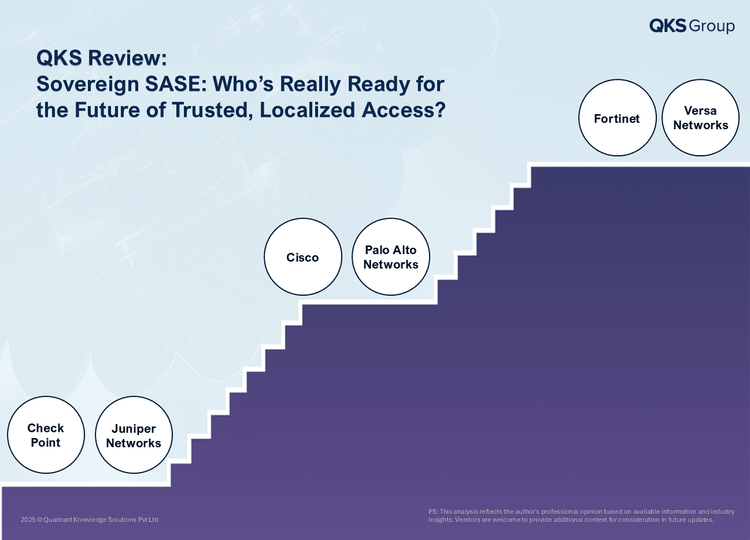
Sovereign SASE isn’t simply about where your data resides, it’s about having non-negotiable control over security posture, routing, inspection, and compliance enforcement. Versa networks, and Fortinet lead the field with architecturally sovereign options. Palo Alto and Cisco are viable with effort and customization. Juniper and Check Point will need to evolve their Secure Access Service Edge (SASE) maturity and integration depth to meet serious sovereignty needs.
When choosing a vendor, ask:
- Can I control where and how traffic is inspected?
- Is the control plane under my governance or externally hosted?
- Who holds the keys, me or the provider?
- Can the platform comply with jurisdictional restrictions by design, not as an afterthought?
In a world of rising digital nationalism, choosing a Sovereign SASE vendor isn’t just a technical decision, it’s a declaration of trust and control.
Disclaimer:
This blog is based on independent research and publicly available information. The insights presented reflect the views of QKS Group and are for informational purposes only. While we strive for accuracy, we do not guarantee completeness or absolute correctness. Vendors are welcome to provide clarifications or updates. If any vendor listed in this analysis wishes to provide additional context or clarification, we welcome a briefing call and will consider incorporating relevant updates. This analysis is not intended to disparage any vendor but to provide an informed, balanced perspective. We encourage open and constructive dialogue to foster transparency and a deeper understanding of the industry.
Author: Kaushik V., Analyst at QKS Group