

24.06.2025
QKS Review
QKS Review: Smarter Portfolios: A Comparative Analysis of AI-Powered Automation in Emerging PPM Platforms: Bubble vs. Meisterplan
Author:
Ashray Gadekar
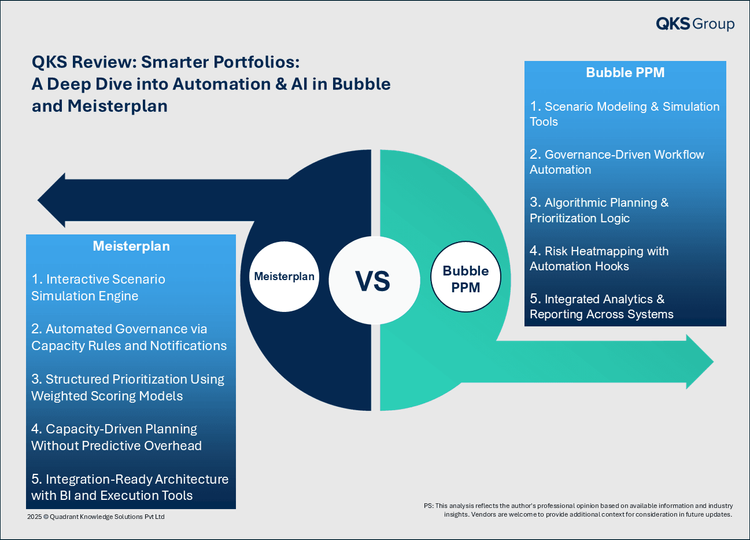


Executive Summary:
As the Project Portfolio Management (PPM) market faces rising pressure from increasing complexity, resource constraints, and the need for continuous planning, organizations are moving beyond traditional project tracking tools. The shift reflects a demand for platforms that not only offer visibility but also embed automation and intelligence into planning, execution, and governance processes. This review blog by QKS Group assesses whether emerging vendors like Bubble and Meisterplan are truly innovating to meet these evolving demands or merely layering automation on top of legacy processes.
What Modern PPM Platforms Should Deliver
Today’s PPM platforms must go beyond static dashboards and manual workflows. They should embed rule-based automation across core processes such as resource allocation, risk escalation, and portfolio governance. This includes enabling automated approvals, stage-gate workflows, and dynamic reporting aligned with real-time changes.
Equally essential is intelligent decision support. Modern platforms should leverage data to simulate planning scenarios, prioritize initiatives, and guide users with algorithmic assistance without overwhelming them with complex AI infrastructure. Whether through deterministic logic or lightweight predictive models, PPM tools must empower users to navigate trade-offs proactively.
Lastly, scenario modeling must be foundational. From budget simulations to capacity-driven planning, organizations need the ability to create, compare, and act upon alternate strategies with confidence. True next-gen platforms integrate these capabilities into a cohesive planning cycle that aligns strategy with execution and enables continuous portfolio recalibration.
Key Findings
Vendors like Bubble PPM and Meisterplan stand out for embedding automation into their core architectures, offering rule-based decision matrices, scenario simulations, and intelligent planning support that align with real-world portfolio governance needs. Bubble differentiates with its simulation-driven planning and structured automation, especially for enterprises managing high-governance, cross-functional portfolios. Meisterplan, by contrast, delivers pragmatic intelligence for lean, mid-sized portfolios through simplified scenario modeling, resource-aware prioritization, and dynamic plan versioning.
While both platforms deliver significant value, Meisterplan may appeal more to organizations prioritizing agility, speed, and transparency, whereas Bubble supports deeper governance alignment through structured, logic-driven automation. Vendors lacking integrated AI and automation remain reliant on manual processes and static tracking. These platforms risk losing relevance in strategic evaluations especially where planning agility and intelligent governance are key selection criteria.
Automation and artificial intelligence features in Project Portfolio Management tools are becoming important differentiators as enterprise organizations look for alignment between strategy and execution. AI is reshaping PPM tools by enabling systems to go beyond static tracking and offer dynamic, data-driven decision support. AI in PPM can automate effort estimation using historical velocity data, forecast delivery risk based on milestone slippage patterns, and optimize resource allocation through constraint-based algorithms. Machine learning models can identify early signals of project failure, predict capacity bottlenecks, and suggest optimal funding distribution across strategic initiatives. Vendors that embed these AI capabilities can support continuous planning, accelerate portfolio simulation, and enable autonomous decision augmentation.
In contrast, vendors lacking AI functionality lose relevance in environments demanding agility and scale. Without AI, platforms are limited to retrospective reporting, manual scenario modeling, and rule-based workflows, hindering their ability to support real-time course correction, adaptive prioritization, and investment optimization. As AI becomes embedded in enterprise architecture, absence of such intelligence in PPM can lead to disqualification in strategic tooling evaluations.
The analysis describes how Meisterplan and Bubble Project Portfolio Management integrate automation and AI features into their platforms, emphasizing risk analytics, scenario modeling, AI-driven assistance and planning support, workflow orchestration, intelligent decision support, and automation of core PPM processes.
1. Workflow Automation
In Project Portfolio Management, workflow automation helps standardize and streamline routine processes such as task approvals, project status updates, document routing, and compliance checks. AI enhances this automation by learning from past workflows to intelligently route tasks, predict delays in approvals, and recommend optimizations. This results in reduced manual workload, fewer process errors, and improved consistency in execution for users managing complex project portfolios.
Bubble PPM
Through predefined workflows and phase-gate governance to manage business rules that set up automatic actions based on specified criteria, like project stage transitions, milestone completions, or deviations from schedule baselines, Bubble PPM facilitates process-driven automation. The platform supports end-to-end automation across project lifecycles and portfolio orchestration, streamlining stage-gate approvals, initiation workflows, and KPI-based reporting while enforcing methodology compliance through a template-driven process modeling engine. Users transition from manually managing project approvals, milestone tracking, and compliance checks to a streamlined, rules-based environment where stage transitions, reporting triggers, and governance actions are executed automatically reducing administrative effort by implementing automated workflows in Bubble Project Portfolio Management.
Meisterplan
At the core of Meisterplan’s automation philosophy is its focus on workflow simplification and governance reinforcement. The platform enables users to set up structured project templates, configure resource allocation rules, and automate key notifications across planning cycles. When project allocations change or capacity thresholds are exceeded, the system automatically notifies relevant stakeholders, ensuring timely coordination. Moreover, its snapshot and versioning capabilities allow users to back up their “plan of record” before simulating alternate scenarios, thereby preserving governance integrity while enabling flexibility. These automations, though not machine-learned, effectively reduce manual overhead and keep planning cycles both traceable and responsive.
2. AI-Driven Assistance and Planning Support
AI-driven assistance in PPM tools provides users with intelligent recommendations across planning functions, such as assigning resources, setting priorities, and forecasting timelines. By analyzing historical project data, team performance, and capacity constraints, AI engines offer contextual suggestions to optimize planning decisions. This support enables users to move from reactive to proactive planning, resulting in better resource utilization, faster decision-making, and increased alignment with organizational goals.
Bubble PPM
Bubble Project Portfolio Management incorporates algorithmic planning tools that assist in decision-making for high-complexity portfolios, despite not being specifically marketed under the artificial intelligence umbrella. The platform's strategic alignment matrices enable automated project proposal scoring against business objectives using customizable weighting logic and prioritization frameworks. Bubble also has a scenario planning engine that lets users model different investment paths, simulate the effects of changing timelines, and examine results according to funding or resource limitations. Although they lack adaptive learning, these features function similarly to deterministic AI using a rule-based decision matrix and conditional forecast logic.
The system facilitates resource and budget allocation decisions by utilizing data-driven prioritization frameworks like the Analytical Hierarchy Process (AHP) and Monte Carlo simulation techniques. This allows program managers to have access to intelligent planning tools that simulate long-term impact based on current data inputs without the need for manual recalculations.
Meisterplan
In the area of planning support, Meisterplan provides intelligent guidance through its algorithmic scoring and prioritization models. Project proposals can be evaluated against customizable business criteria using structured weighting logic, helping portfolio managers identify initiatives with the highest strategic value. This kind of deterministic intelligence is further extended through Meisterplan’s scenario simulation engine, where users can drag-and-drop projects on a timeline to test different execution strategies, evaluate capacity impacts, or simulate delayed starts and budget changes. Unlike probabilistic AI systems, Meisterplan favors rule-based decision matrices that offer clarity, repeatability, and control, especially valued in governance-heavy industries.
3. Predictive Analytics and Scenario Modeling
Predictive analytics and scenario modeling allow portfolio managers to forecast potential outcomes and simulate the impact of different strategic decisions before they are implemented. AI plays a crucial role here by detecting historical patterns, analyzing real-time data, and generating probable future scenarios based on project variables and dependencies. Users benefit by gaining early visibility into potential risks and trade-offs, helping them make more informed, confident, and adaptive decisions across portfolios.
Bubble PPM
Bubble Project Portfolio Management incorporates what-if analysis tools at the portfolio level that model possible outcomes based on various funding levels allowing PMOs to see trade-offs between cost, scope, schedule, and benefit realization utilizing constraint-based optimization logic. Dashboards for portfolio simulations that take interdependencies, resource bottlenecks, and milestone convergence into consideration allow users to assess various scenarios. The analytics employ investment scoring, Gantt network analyses, and resource leveling algorithms to create optimal execution paths under various constraints.
Meisterplan
Where Meisterplan particularly excels is in predictive scenario modeling. The what-if planning capabilities allow users to create sandboxed versions of their portfolios, simulate the effects of adding or removing projects, and assess how shifts in timing or resourcing would impact delivery pipelines. These scenario models are not abstract, users can compare them side-by-side with live plans, track trade-offs in cost, timeline, and benefit realization, and make decisions grounded in transparent, real-time data. Though it doesn’t feature machine learning or predictive analytics in the traditional AI sense, Meisterplan’s constraint-based optimization logic helps organizations stay ahead of risks and make proactive decisions in complex portfolio environments.
4. Automation in Risk and Time Management
The management of risk and schedules across multiple projects becomes more effective when automated systems track key risk indicators, deadlines, and milestone dependencies. AI further strengthens this by predicting where timelines may slip or risks may escalate, based on real-time performance data and past outcomes. This gives users timely alerts and mitigation recommendations, enabling them to proactively manage delays and risks rather than reacting after problems surface, ultimately improving delivery confidence and project control.
Bubble PPM
Bubble PPM incorporates mechanisms for tracking and identifying risks into its project structures. Users can establish automatic escalation rules based on predetermined impact-probability thresholds with configurable risk matrices to support enterprise risk heatmapping. Users can leverage schedule variance thresholds and earned value management (EVM) to configure these capabilities, enabling automated workflows that trigger corrective actions tied to key governance milestones.
Meisterplan
Risk and time management in Meisterplan is handled with automation triggers tied to capacity, scheduling, and milestone adherence. As changes are made to project timelines or resource assignments, the platform highlights over-allocations, missed deadlines, and capacity imbalances, offering teams a real-time view into operational health. Automated alerts and emails are sent when thresholds are breached, keeping all contributors informed without needing manual follow-ups. While the platform does not feature advanced risk prediction or intelligent risk scoring, its automation architecture ensures timely escalations and mitigation support for project-level disruptions.
5. Integration of AI with Core PPM Processes
Modern Project Portfolio Management platforms increasingly embed AI into core functions like budgeting, prioritization, demand planning, and performance tracking. Rather than using AI as a bolt-on, these systems integrate intelligence across workflows to continuously learn from data and dynamically adjust processes. This translates into a more cohesive and responsive system that aligns project execution with changing strategic priorities, providing a competitive edge through real-time adaptability and smarter governance for users.
Bubble PPM
Bubble PPM incorporates intelligence primarily through its analytics-driven automation layer, which supports resource optimization, benefit realization tracking, and strategic alignment. Rather than relying on adaptive models or machine learning frameworks, the platform uses deterministic decision trees and predefined algorithms to deliver consistent, rules-based automation. While it does not feature conversational AI, natural language processing, or autonomous agents, Bubble provides intelligent reporting by tailoring metrics to user roles, project classifications, and performance indicators. This structured approach allows users to make informed, data-backed decisions, without the unpredictability or complexity of self-learning systems, particularly valuable in regulated or highly structured environments. Additionally, Bubble’s API-based integrations enable data consolidation across enterprise systems, ensuring a single source of truth for analytics and reporting.
Meisterplan
Meisterplan embeds intelligence across the entire PPM process without overwhelming users with complexity. Its integration architecture connects with tools like Jira, MS Project, ServiceNow, and Excel, enabling synchronized planning across task-level and portfolio-level systems. Its compatibility with Power BI, Tableau, and other business intelligence tools allows organizations to conduct deep-dive analytics without relying on proprietary reporting. Even though Meisterplan doesn’t implement self-learning models or natural language processing, it succeeds in presenting curated, role-specific dashboards and scenario metrics that aid smart governance and strategic clarity.
Conclusion
The group of emerging Project Portfolio Management vendors demonstrates a pragmatic approach to AI and automation, focusing on rule-based logic, templated assistance, and scenario modeling rather than advanced machine learning. While they are still enhancing adaptive intelligence or predictive depth, they deliver tangible value through structured workflows, guided planning, and automated reporting. Ideal for mid-sized portfolios, these platforms strike a balance between usability and control, supporting organizations that prioritize operational efficiency, governance adherence, and planning support without the overhead of complex AI infrastructures.
Although they use these features in different operational layers, Bubble PPM and Meisterplan both integrate automation and fundamental AI features from a functional standpoint. Bubble PPM focuses on scenario-based planning, risk governance, and strategic alignment automation. It supports portfolio-level decision-making by integrating algorithmic logic into forecasting engines and planning tools. Its rule-based automation architecture prioritizes simulation logic and the enforcement of governance processes. Ultimately, Meisterplan represents a modern vision for automation in PPM: one that favours deterministic intelligence over speculative AI. Its strength lies in enabling human decision-makers with the right data, structured simulations, and automated workflows. For organizations looking to balance agility with governance, Meisterplan delivers a planning environment that’s as intelligent as it is practical, bridging the gap between static project control and adaptive portfolio leadership.
Disclaimer:
This blog is based on independent research and publicly available information. The insights presented reflect the views of QKS Group and are for informational purposes only. While we strive for accuracy, we do not guarantee completeness or absolute correctness. Vendors are welcome to provide clarifications or updates. If any vendor listed in this analysis wishes to provide additional context or clarification, we welcome a briefing call and will consider incorporating relevant updates. This analysis is not intended to disparage any vendor but to provide an informed, balanced perspective. We encourage open and constructive dialogue to foster transparency and a deeper understanding of the industry.
Author: Ashray Gadekar, Analyst - Strategic Portfolio Management at QKS Group
Vendors: