Introduction:
Security Information and Event Management (SIEM) platforms have long been foundational to enterprise defense but many were architected for a different era. Originally built to collect, normalize, and store logs, traditional SIEMs were optimized for compliance and forensic investigation rather than real-time detection. Today, that model is showing its age.
Modern adversaries don’t behave like log entries. They abuse identities, mimic legitimate workflows, chain cloud and endpoint activities, and operate across fragmented environments. As security operations centers (SOCs) face rising alert fatigue, tool sprawl, and infrastructure complexity, a critical question emerges:
Are you detecting threats or just storing logs?
This QKS Review analyzes how leading vendors are adapting (or failing to adapt) to this shift from log-centric architectures to signal-first, context-aware detection models. We evaluate which platforms are actively modeling context, embedding behavioral signals, and enabling smarter triage and which ones still rely on outdated parsing pipelines and rule-based correlation.
Legacy SIEMs were built for retention, not resolution. They parse logs, normalize them into rigid schemas, and correlate events using predefined rules. That approach worked when threats followed linear patterns. But today’s adversaries move laterally, abuse identities, exploit federated services, and camouflage activity within legitimate workflows. Logs alone often fail to capture these dynamics.
With the rise of ephemeral infrastructure, distributed identities, and API-first applications, the modern SOC needs more than storage. It needs high-fidelity signals detections enriched with identity, intent, and behavioral context that explain not just what happened, but why it matters.
This is more than a technical upgrade. It's a philosophical one. And not every vendor is ready.
Palo Alto Networks
Palo Alto Networks is making the boldest pivot toward signal-centric analytics. Cortex XSIAM isn’t just a Security Information and Event Management (SIEM); it’s a platform designed to model operational context around detections.
Rather than rely on logs alone, XSIAM fuses telemetry from Cortex XDR, Prisma Cloud, and third-party tools to generate enriched, high-confidence alerts. Signals are stitched with user and asset context, scored using behavioral baselines, and infused with threat intelligence from Unit 42. This isn’t post-facto enrichment, it’s prioritization at ingestion. Analysts receive narratives, not noise.
But there’s a trade-off. XSIAM’s contextual power is largely tied to Palo Alto’s ecosystem. Third-party integrations exist but rarely match the depth of native sources. Still, if the goal is context-aware detection that accelerates triage, XSIAM leads the curve.
Google Security Operations
Chronicle was officially rebranded to Google Security Operations (Google SecOps)—a move that reflects Google’s broader vision of delivering a unified, AI-powered platform that integrates SIEM, SOAR, and threat intelligence into a cohesive SecOps experience. While the branding changed, the platform's underlying architecture and capabilities remained intact, continuing to offer cloud-native speed, scalability, and behavioral detection precision.
The detection engine supports YARA-L rules, time-sequenced logic, and asset relationship modeling, enabling alerts that mirror real attacker behaviors rather than just matching IOCs. Paired with curated threat intelligence from Mandiant and VirusTotal, Google SecOps delivers pre-enriched detections to reduce analyst burden. Its Autonomic Security Operations initiative pushes this further by integrating Chronicle with BigQuery and Mandiant to drive semi-autonomous defense.
While integration depth can vary especially for customers outside the Google ecosystem, SecOps remains one of the few platforms actively building a true signal-first detection engine at scale.
Rapid7
Rapid7’s rebranding of its SIEM to Incident Command signals renewed attention to operations. However, the core architecture remains log-first. Correlation works well for mid-market teams, and the UI supports action. But true context-aware detection still depends heavily on manual enrichment.
Analysts must piece together insights via integrations with InsightVM, InsightConnect, and other modules. UEBA is present, but not deeply embedded into triage. Identity scoring and anomaly detection exist but as separate lenses, not foundational signals.
Incident Command supports the signal-first vision in theory, but in practice, it still requires significant analyst effort. It’s a step forward but not a paradigm shift.
Logpoint
Logpoint offers a modular, enrichment-aware approach through its Cyber Defense Platform, with out-of-the-box support for UEBA, identity context, and threat intel. But architectural constraints persist.
Logpoint’s rigid schema model limits how flexibly new signals can be fused. While entity analytics and anomaly detection exist, aligning log sources, injecting behavior models, and normalizing telemetry often falls on the customer.
The shift to Converged Security Information and Event Management (SIEM) integrating SIEM, SOAR, and endpoint signals is promising. However, the SOAR+SIEM integration remains a work in progress, and signal fidelity is still treated as an add-on, not a core design principle. For now, Logpoint is an intelligent log platform, not yet a signal-native engine.
Fortinet
Fortinet’s FortiSIEM is still anchored in infrastructure telemetry. It ingests logs at scale, offers rule-based correlation, and fits well into Fortinet’s appliance-first model. But it lacks the architectural rethinking needed for pre-enriched detection.
Contextual awareness depends on hand-crafted rules and downstream playbooks. FortiAI, embedded in FortiSOAR, uses LLMs to guide workflows but operates after detection, not during it.
The broader Fortinet ecosystem, FortiEDR, FortiNDR, FortiAnalyzer offers rich telemetry. Yet without a fusion layer, FortiSIEM doesn’t convert these inputs into intent-aware signals. It treats context as a post-processing task, not a first-class data asset.
Conclusion:
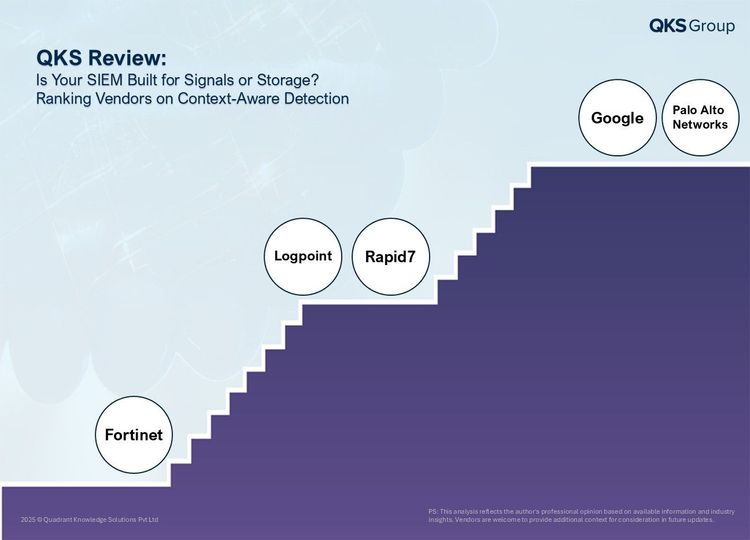
In the evolving landscape of security analytics, the real differentiator isn’t how much data a platform can ingest, but how effectively it can transform that data into high-fidelity signals enriched with context, behavior, and intent. Palo Alto’s Cortex XSIAM and Google Security Operations stand out for operationalizing this shift, embedding context directly into the detection pipeline. Rapid7 and Logpoint show promise but still rely heavily on post-detection enrichment and analyst intervention. Fortinet, while robust in log handling, remains tethered to a traditional, rule-based model. As SOCs modernize, the platforms that surface the right signals, not just the most data will define the next era of threat detection.
Disclaimer:
This blog is based on independent research and publicly available information. The insights presented reflect the views of QKS Group and are for informational purposes only. While we strive for accuracy, we do not guarantee completeness or absolute correctness. Vendors are welcome to provide clarifications or updates. If any vendor listed in this analysis wishes to provide additional context or clarification, we welcome a briefing call and will consider incorporating relevant updates. This analysis is not intended to disparage any vendor but to provide an informed, balanced perspective. We encourage open and constructive dialogue to foster transparency and a deeper understanding of the industry.
Author: Arpita Dash, Analyst - Security Analytics and Automation at QKS Group