

17.06.2025
QKS Review
QKS Review- Routing Realities: Who’s Building for Performance, Who’s Standing Still, and Who’s Falling Behind
Author:
Pradnya Gugale


Executive Summary:
As the global payments market faces rising pressure from declining rate reduction, cost control, and multi-rail orchestration, organisations are moving beyond traditional rule-based transaction routing tools.
This review blog by QKS Group assesses whether payment platform vendors are truly innovating to meet these demands-or merely making incremental updates.
What Modern Payment Platforms Should Deliver:
Today’s platforms must offer more than static routing configurations. Critical next-gen capabilities include:
• Data-driven, AI/ML-powered routing for dynamic optimisation
• Multi-rail orchestration with retry logic and real-time decisioning
• Flexible API support and granular routing control for issuers and acquirers
Key Findings:
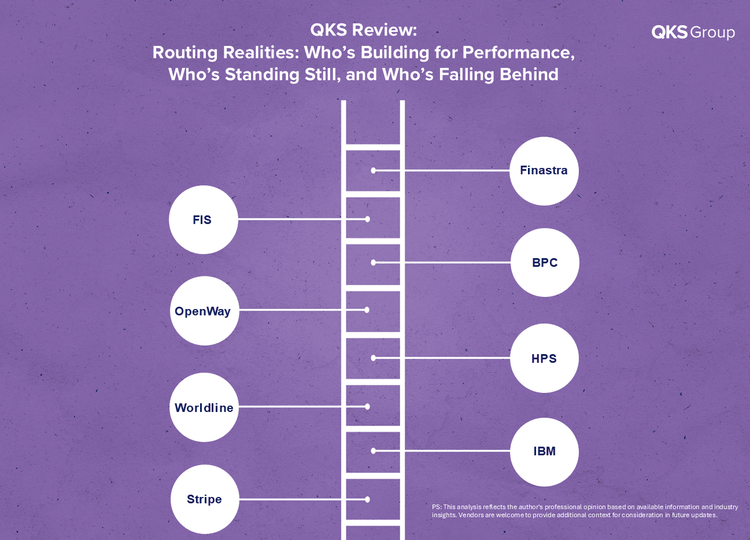
• Leading vendors (Finastra, FIS, BPC) stand out with adaptive routing engines that support performance, cost-efficiency, and regulatory flexibility at scale.
• Capable vendors (OpenWay, HPS, Worldline) offer strong foundational tools but lack consistent depth in AI-driven automation or transparency.
• Lagging vendors (IBM, Stripe) continue to rely on backend logic and rigid rule sets, limiting real-time adaptability and enterprise-grade control.
Routing is now central to payment optimization. It determines not only the cost of a transaction but its success rate, speed, and regulatory alignment. Vendors are increasingly marketing their routing capabilities as smart or intelligent but under scrutiny, the depth, adaptability, and automation behind these claims vary significantly. Some are embedding routing into broader orchestration and payment intelligence strategies, while others are still offering limited, rule-based systems with minimal flexibility.
Routing in payment systems refers to how a transaction is directed through different networks, processors, or rails to reach its destination. Traditional forms like rule-based routing, tariff-based routing, and event-driven routing rely on static trigger such as geography, transaction amount, or fixed cost thresholds offering limited real-time adaptability. However, it’s intelligent/smart routing that goes further: factoring in dynamic inputs like issuer performance, scheme availability, cost, and transaction type to make context-aware, optimized decisions in real time. This level of routing is essential for reducing decline rates, optimizing for cost, and maintaining resilience across multiple rails-especially in environments dealing with cross-border flows, multiple acquirers, or high transaction volumes. AI/ML is increasingly being applied to enhance intelligent routing decisions. By learning from historical transaction behavior, issuer performance trends, and fraud signals, these models can dynamically adjust routing paths to improve authorization rates, minimize cost, and reduce operational risk.
Finastra’s Smart Routing Package supports message ingestion across channels and formats, followed by validation, enrichment, and intelligent routing decisions for downstream processing. By factoring in cost, speed, scheme reachability, and regulatory conditions, the platform supports both single and batch payment flows across high-value, ACH, instant, and cross-border schemes, including Visa Direct. Its APIs allow banks and corporates to validate clearing memberships, dynamically determine routes, and assemble correspondent banking chains, making the solution adaptable across both embedded banking channels and traditional payment engines.
FIS also offers a smart-routing decision engine that evaluates transaction conditions and selects the most efficient rail in real time- ACH, same-day ACH, RTP, wires, and FedNow, and automates the entire process. This approach emphasizes automation and speed, with built-in cost awareness and payment type optimization that aligns well with the needs of banks and large corporate processors operating in multi-rail environments.
BPC supports intelligent routing as well, with Switch-to-Issuer and Switch-to-Acquirer models and configurable smart routing logic. It provides a foundation for acquirers and issuers to manage transaction flow based on custom logic, network preferences, and processing priorities. The platform offers flexible routing configuration capabilities using routing tables, and where needed, a Business Process Management (BPM) engine to support more complex transaction workflows. Additionally, BPC enables least-cost routing strategies, allowing processors to prioritize cost efficiency without sacrificing transaction success rates. The level of configurability that BPC offers makes it suitable for issuers or acquirers with strong internal capabilities seeking fine-grained control over routing behavior.
OpenWay offers a more modular model-its routing system supports smart routing with customizable rule-driven control delegated to the CIO or product team. It includes dynamic pricing-based and event-driven routing, giving operators the ability to respond to external variables and cost triggers. Operators can configure routing logic to respond to external variables such as processing fees, counterpart outages, or volume surges. The platform delegates control to internal teams, allowing product or technology leads to tailor routing decisions for specific business goals. This design is particularly suited to institutions seeking granular control over transaction flows and cost efficiency.
HPS provides a smart and dynamic routing engine that can be configured across multiple criteria, enabling the optimization of authorizations and transaction flows to acquirers. The platform supports rule-based decisioning to secure the best cost for each transaction and allows for seamless protocol conversion when required. While detailed documentation on real-time retry logic and API-driven optimization is limited, the system is equipped to support dynamic routing use cases in a configurable manner.
Worldline supports multi-bank routing, retry logic, and transaction routing based on geography, value, and issuer response. However, the platform lacks event-driven and tariff-based routing, which will not be a very good option for businesses having highlyspecific requirement of routing purely based on fee tables or external transaction triggers. Worldline also offers both smart and intelligent routing capabilities, combining rules-based decisioning with performance-driven optimization. However, it does not explicitly promote advanced AI/ML-driven routing engines or proprietary algorithmic models to the same extent as other leading vendors who emphasize predictive success scoring and machine learning-based decision automation.
IBM continues to offer routing through its Financial Transaction Manager, leveraging configurable rules within broader transaction workflows. It includes a robust rules-based environment for payment routing and exception management. However, the platform lacks dynamic optimization triggers or real-time adaptability. There’s no indication of intelligent routing behavior based on issuer response, network latency, or transaction cost-capabilities increasingly critical for modern, performance-sensitive payment environments.
Stripe promotes global smart routing and partner selection based on card type and geography, which supports performance improvements at scale. It offers granular transaction routing; Connect provides a powerful global routing and payout engine that makes it easy to send money to users quickly, securely, and without any manual reconciliation work. While Stripe offers internal optimization features such as Adaptive Acceptance and Smart Retries, it does not support tariff-based decisioning or merchant-configurable routing logic. Its routing remains backend-driven, with limited transparency or control for organizations.
As payment volumes grow and infrastructures diversify, routing is no longer just a technical layer it’s a competitive differentiator. Vendors that treat routing as an intelligent, adaptive engine rather than a static configuration are better positioned to deliver higher authorization rates, lower processing costs, and resilient, multi-rail performance. While providers like FIS, Finastra, and BPC are embedding routing within broader automation and cost-awareness frameworks, others remain anchored to rule-based models or offer limited merchant visibility. The next phase of innovation won’t be defined by who uses the term “smart” or “intelligent,” but by who delivers routing that’s truly dynamic, data-driven, and designed for performance at scale.
Disclaimer:
This blog is based on independent research and publicly available information. The insights presented reflect the views of QKS Group and are for informational purposes only. While we strive for accuracy, we do not guarantee completeness or absolute correctness. Vendors are welcome to provide clarifications or updates. If any vendor listed in this analysis wishes to provide additional context or clarification, we welcome a briefing call and will consider incorporating relevant updates. This analysis is not intended to disparage any vendor but to provide an informed, balanced perspective. We encourage open and constructive dialogue to foster transparency and a deeper understanding of the industry.
Author: Pradnya Gugale, Principal Analyst at QKS Group
Vendors: