

25.06.2025
QKS Review
QKS Review: Proactive vs. Reactive OT Security: Vendors Leading the Way or Stuck in the Past?
Author:
Kunal Kumar


Executive Summary:
As cyber threats against industrial systems surge, the OT security market is sharply divided between vendors embracing proactive defence and those stuck in a reactive, compliance-first mindset. With ransomware attacks on industrial targets rising by 87% and 25% leading to full operational shutdowns (Dragos, 2024), organizations must pivot from passive monitoring to predictive, AI-driven security with active threat engagement.
This QKS Group analysis benchmarks eight OT security vendors across five future-critical capabilities: predictive AI, deception technology, automated threat hunting, threat intelligence integration, and resilience.
What Future-Ready OT Platforms Must Deliver:
- Predictive AI & ML for anomaly detection and early warnings.
- Deception technologies to mislead attackers and gather insights.
- Autonomous threat hunting and response orchestration.
- Integrated OT-specific threat intelligence feeds.
- Built-in resilience features like zero-trust segmentation and recovery tools.
Key Findings:
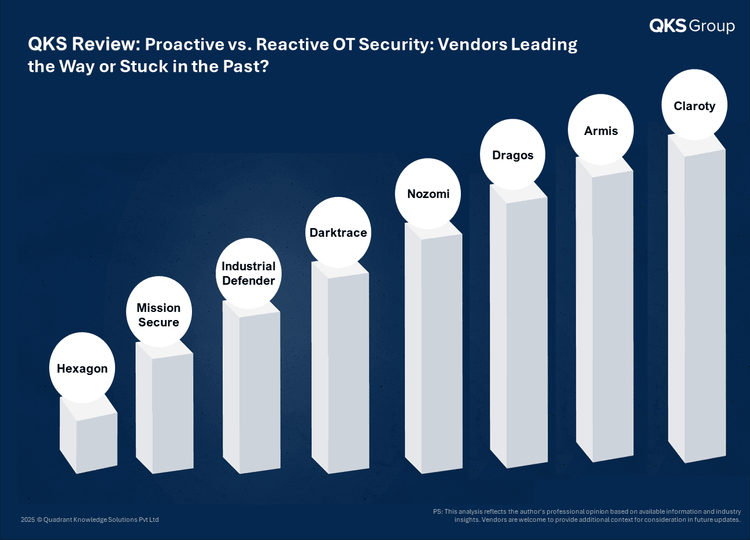
- Dominant Players (Armis, Claroty, Dragos) are defining the proactive frontier with AI-enhanced detection, live decoys, continuous hunting, and curated OT intel. Armis leads in deception and early-warning, Claroty excels in visibility and threat modelling, while Dragos offers unparalleled OT-specific threat intelligence and human-led threat hunting.
- Capable Players (Darktrace, Nozomi) offer strong AI-based anomaly detection and autonomous response, but lack native deception capabilities and bespoke threat intelligence, limiting their proactivity in high-stakes OT environments.
- Slow Movers (Industrial Defender, Mission Secure, Hexagon) remain rooted in compliance and configuration monitoring. With minimal AI, no deception, and reactive detection models, these vendors lag behind the threat curve and offer limited protection against emerging OT-targeted attacks.
Introduction:
In 2024, industrial control systems (ICS) and operational technology (OT) environments faced unprecedented cyber threats. Dragos reported a staggering 87% increase in ransomware attacks on industrial organizations compared to the previous year, with 1,693 incidents recorded. Notably, 25% of these attacks resulted in complete operational shutdowns, while 75% caused partial disruptions. The manufacturing sector bore the brunt, accounting for over 50% of the victims. The threat landscape was further complicated by the activities of nine distinct adversary groups targeting OT systems, as identified by Dragos.
Among these, four groups Bauxite, Chernovite, Voltzite, and Electrum demonstrated advanced capabilities, reaching Stage 2 of the ICS Cyber Kill Chain, indicating their ability to develop and test specific attacks on industrial control systems. These developments underscore the escalating risks to critical infrastructure, highlighting the need for robust cybersecurity measures in OT environments. Nation-state actors increasingly target critical infrastructure: Dragos observed nine distinct adversary groups in OT, four of which had tested attacks on ICS. In this escalating threat landscape, the question is no longer if a company will be targeted, but how prepared they are to face future threats instead of only reacting to breaches.
Key proactive strategies now include:
- Predictive AI & Behavioural Analytics: Using machine learning to establish “normal” behaviour and flag anomalies before an attack happens.
- Deception Technology: Deploying honeypots and decoys to mislead attackers and reveal their tactics.
- Automated Threat Hunting: Continuously scanning the environment and auto-responding to emerging threats in real time.
- Threat Intelligence Integration: Ingesting OT-specific intel feeds (e.g. from dedicated ICS threat teams) to enrich detections and risk assessments.
- Resilience Measures: Embracing zero-trust segmentation, backups, and self-healing systems to withstand attacks.
Vendors that innovate with these tools can detect novel threats and even flip the script- “turning the hunter into the hunted”. Those that lag rely on signature-based or compliance-focused tools, essentially “patching the past.” The table below evaluates eight key OT security vendors on these five criteria. We group them as Dominant Players (Claroty, Armis, Dragos), Capable Players (Darktrace, Nozomi), and Slow Movers (Industrial Defender, Mission Secure (ServiceNow), Hexagon):

Note: “Yes” indicates a substantive capability; “No” means missing or very limited support.
Dominant Players: Deep Domain Expertise and Cutting-Edge Tech
Armis: The asset-visibility specialist has aggressively moved toward prediction and deception. In 2024 Armis acquired CTCI to integrate AI-driven pre-attack threat hunting into its Centrix™ platform. Its “Asset Intelligence Engine” now models billions of device profiles and deploys dynamic honeypots optimized for live network assets. According to Armis, this allows “thousands of honeypots…scrutinizing attack behaviours…as early as the reconnaissance stage”. In practice, Armis merges behavioural ML with dark-web and human-sourced intelligence to “turn the hunter into the hunted”. That puts Armis squarely in a future-ready camp: proactive threat hunting with live decoys.
Claroty:Claroty’s platform is built around continuous threat detection (CTD) and OT asset risk management, backed by its Team82 research team. It uses machine-learning and DPI to filter normal OT traffic and flag anomalies. Claroty even adds “exposure scenarios” (rule-based threat models) from its threat intel team to proactively mitigate vulnerabilities before they’re exploited. Claroty excels in visibility and integration: its CTD engine automates asset discovery and segmented network zoning (virtual zones) and rapidly groups similar devices into secure zones. It also publishes daily ICS-focused intel through Threat Center (Team82), which feeds into the platform. However, Claroty does not offer native deception technologies, no honeypots, so attackers might not be lured into traps. Overall, Claroty scores high on predictive detection and intel integration, with strong segmentation (zero-trust) measures.
Dragos:Dragos is widely regarded as a leader in industrial threat intelligence and response. Their DRAGOS platform combines asset inventory with signature and behaviour-based detection for ICS traffic. While Dragos hasn’t emphasized AI in marketing as heavily as others, it does leverage analytic engines and human analysis to flag unusual ICS behaviours. More importantly, Dragos offers expert threat hunting services and an OT-CERT, supplying tailored ICS threat intelligence (Dragos WorldView) to customers. In effect, Dragos analysts hunt weekly and provide OT-tailored IOCs, something none of the “IT-centric” vendors typically do. Dragos was also the originator of the concept of “Neighborhood Keeper,” a community-based detection network. The flip side is that Dragos, like Claroty, lacks built-in honeypots or traps. In summary, Dragos is proactive in providing bespoke intelligence and human-led hunting, but its platform itself is less about deception and more about expert analysis and robust incident response (including forensics and recovery) when an attack occurs.
Capable Players: Strong Detection, Weak Deception
Nozomi Networks: Nozomi’s Guardian sensor and Vantage IQ analytics exemplify modern OT AI. Since 2013 Nozomi has built AI-powered anomaly detection into its OT monitoring: Guardian establishes adaptive baselines and uses ML to catch even zero-day deviations. In 2023 Nozomi introduced Vantage IQ, an AI analysis engine that emulates human analysts. It automatically correlates and prioritizes alerts, using deep neural nets to predict out-of-range sensor behaviours. Nozomi also offers integrated threat intelligence: a 50K+ honeypot network feeds its TI, and a Mandiant-powered expansion pack provides OT-specific IOCs. Like Claroty, however, Nozomi does not natively deploy deception traps. Its strength is in continuous ML-powered detection and asset fingerprinting. The platform likewise touts improved resilience, the company claims its solutions “minimize risk and maximize resilience” via comprehensive visibility and vulnerability management.
Darktrace: Darktrace/OT is known for its self-learning AI. It continuously “listens” to OT network traffic and builds probabilistic models (Bayesian, deep learning) of normal operations. This enables Darktrace to spot zero-day anomalies without prior signatures. In practice, Darktrace’s AI “populates asset inventories” and flags deviations in real time. The platform also features autonomous response (“Antigena”) that can automatically throttle or isolate suspicious traffic what Darktrace calls an “AI-driven immune system”. Darktrace does not incorporate deception (no honeypots) and relies on its cloud or appliance analytics. Threat intelligence is handled differently: Darktrace relies more on its 24/7 SOC analysts for hunting and intel, rather than external feeds. Still, Darktrace’s predictive ML is powerful for novel threats, and its automated actions improve resilience. In short, it’s future-ready on detection but stops short of baiting adversaries or leveraging curated OT-specific intel feeds. In summary, Darktrace and Nozomi straddle the line: they champion AI-driven detection and response, but neither really “hunts” attackers with decoys. They are certainly more forward-looking than the slow movers, but not fully proactive in the deception or intel-sharing sense.
Slow Movers: Compliance Tools with a Legacy Mindset
Industrial Defender: One of the oldest OT cybersecurity firms, Industrial Defender has historically focused on compliance and asset management. It only introduced its OT Machine Learning (OTML) engine in 2021, using Splunk’s ML toolkit on endpoint and network logs. This let them apply predictive modelling (e.g. for ransomware patterns) across IT/OT data. In other words, yes, Industrial Defender has some AI/ML capabilities now, but only because they offloaded them to Splunk. The platform still revolves around configuration/change management, vulnerability tracking, and compliance reporting. It offers baseline monitoring but no honeypots or insider-threat traps. It has automated playbooks via Splunk (“incident response playbooks”), but no native threat-hunting engine or OT-specific intel feed. It also lacks zero-trust segmentation, it’s more about reporting than real-time enforcement. In practice, Industrial Defender is reactive and compliance-oriented; it claims to predict threats via ML, but in a way that feels bolted-on.
Mission Secure (ServiceNow): Mission Secure positions itself as an “OT-native zero-trust” platform, but in reality, it’s mostly a sophisticated monitoring tool. It continuously inspects network traffic and even Level 0 (sensor) signals, issuing custom alerts on unusual patterns. Its patented Level 0 monitoring is a novel feature: it can detect out-of-range PLC values that conventional tools would miss. But aside from this, Mission Secure offers little in advanced tech. There is no AI learning or anomaly prediction alert rules are manually configured. There are no honeypots and no built-in threat intel service. The platform does emphasize rapid response and segmentation: it automatically enforces fine-grained network policies and isolates threats according to its “zero trust” model. In short, Mission Secure delivers fine asset visibility and segmentation, but it’s essentially reactive detection (powered by human-set rules). Its core innovation is Level 0 monitoring, not proactive AI or deception.
Hexagon (PAS Cyber Integrity): Hexagon’s offering is primarily a risk and recovery solution for control systems. PAS Cyber Integrity maintains a complete OT asset inventory, monitors configurations, and continuously scans for vulnerabilities. Critically, it includes backup and recovery tools for PLCs and controllers, enabling rapid restoration after an incident. In other words, Hexagon focuses on resilience and compliance: it “accelerates recovery” and prevents unplanned shutdowns. However, there is no predictive AI or automated hunting in PAS. It offers static inventory and vulnerability management, but no behaviour analytics. It has no deception or traps, and it doesn’t pull in external threat feeds (its “threat intelligence” is really just vulnerability signatures). Hexagon’s platform helps operators know their systems and bounce back from attacks, but it is fundamentally reactive, it helps you respond to incidents, not anticipate them.
Final Verdict: Future-Ready or Yesterday’s Patch?
Leaders Win with AI and Deception- Armis, Claroty and Dragos clearly dominate the proactive end of the spectrum. Armis is aggressively future-proofing its platform, it markets an AI-driven “Early Warning” system that hunts threats on the dark web and draws adversaries into honeypots. Claroty and Dragos leverage their deep OT expertise to add intelligence and automated detection. Claroty’s Team82 regularly feeds zero-day ICS IOCs into its CTD engine, while Dragos deploys its WorldView OT threat database and human hunters to find the next industrial cyber weapon. These vendors score “Yes” on nearly all criteria (see table), meaning they have largely practiced what they preach. The pure-play OT security companies like Claroty and Dragos bring specialized, vertical-focused innovation to the market. Indeed, Claroty and Dragos top rankings alongside Armis, underscoring their leadership. In short, the leaders are genuinely future-ready, they advance beyond signature-based detection to predictive AI, threat intel, and even deception.
Capable Players Bridge Old and New- Darktrace and Nozomi occupy the middle ground. Both rely heavily on machine learning to spot anomalies (Darktrace with self-learning Bayesian models and Nozomi with deep neural analysis) and automate responses. These approaches certainly improve on classic reactive tools. However, they don’t offer everything, neither Darktrace nor Nozomi deploy decoys inside customer networks, and they lack any native “automated hunting” beyond their models. Instead, they focus on identifying anomalies (often via cloud analytics) and letting automated playbooks or human analysts handle them. They do integrate some intel such as Darktrace’s SOC shares aggregated threat trends, and Nozomi ties into threat feeds, but not with the depth of, say, Dragos’s dedicated intelligence service. The net effect is that Darktrace and Nozomi are more proactive than slow movers (they do anticipate novel threats via AI), but less so than the dominant players (they lack the full suite of deception and bespoke intel).
Slow Movers Are Stuck in Legacy- Industrial Defender, Mission Secure and Hexagon largely embody a reactive/compliance mindset. Even Industrial Defender’s ML is essentially Splunk-based anomaly monitoring useful, but hardly cutting-edge. Their platforms centre on inventory, patch reporting and rule-based alerts, not on stalking adversaries. Mission Secure’s level-0 scanning is clever, but it’s a specialized sensor feed, not an AI. Hexagon’s PAS Cyber Integrity is essentially a risk-management portal with backups. None of these companies deploy honeypots or automated threat-hunting AI. We found “No” in almost every column for these vendors. Industrial Defender’s own press touted its first ML engine in 2021 nearly a decade after competitors were already using ML for OT. In short, these vendors help you document vulnerabilities and recover from incidents, but they are not actively changing the game.
Bottom Line:
The divide is clear. Armis, Claroty and Dragos have embraced the future predictive ML, deception, automated hunting and threat intel. Darktrace and Nozomi are solid on AI-driven detection but stop short of trapping attackers or wielding deep OT intelligence. Industrial Defender, Mission Secure and Hexagon offer important compliance and visibility features, but they remain largely reactive.
In a nutshell, the truly future-ready OT vendors are those investing in forward-looking tech today i.e. predictive AI, deception, and 24/7 threat-hunting. The rest are mainly patching yesterday’s vulnerabilities. Organizations that choose the wrong tool risk being blind to the next wave of OT attacks.
Disclaimer & Invitation:
This blog is based on independent research and publicly available information. The insights presented reflect the views of QKS Group and are for informational purposes only. While we strive for accuracy, we do not guarantee completeness or absolute correctness. Vendors are welcome to provide clarifications or updates. If any vendor listed in this analysis wishes to provide additional context or clarification, we welcome a briefing call and will consider incorporating relevant updates. This analysis is not intended to disparage any vendor but to provide an informed, balanced perspective. We encourage open and constructive dialogue to foster transparency and a deeper understanding of the industry.
Author: Kunal Kumar, Senior Analyst at QKS Group
Vendors: