

30.06.2025
QKS Review
QKS Review: Planning in the Age of Disruption - Who’s Truly Resilient, and Who’s Just Repackaging Legacy Systems?
Author:
Pruthvi Raj


Executive Summary:
As Supply Chain Planning (SCP) evolves, the need for true resilience in the face of disruption has never been more critical. This review blog by QKS Group evaluates vendors based on their ability to deliver genuine, operational resilience—separating those who are truly embedding disruption readiness into their platforms from those merely repackaging legacy systems under new names.
What Modern SCP Should Deliver:
SCP platforms must provide more than just basic functionality. Key capabilities for true resilience include:
Real-Time Market Sensing: Ability to detect shifts and disruptions in supply and demand.
Scenario-Driven Planning: Rapid simulation of various disruption scenarios and prescriptive decision-making.
Seamless Integration: Unified platform functionality that synchronizes across all planning modules for real-time response.
Key Findings:
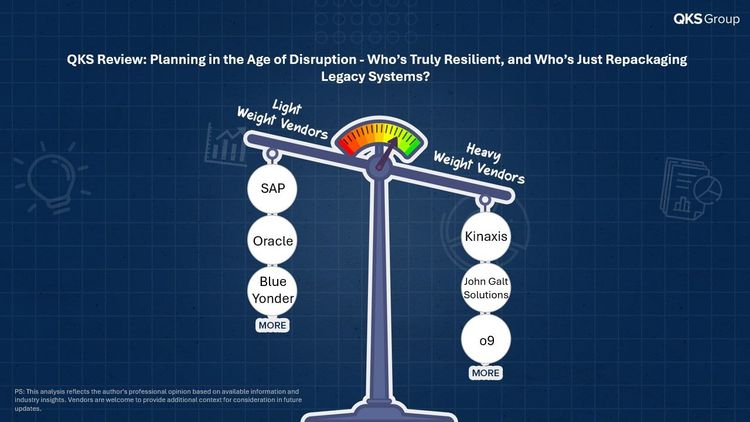
Leading vendors like o9 Solutions, Kinaxis, and John Galt Solutions are building true resilience into their core architectures. These vendors provide real-time sensing, constraint-based optimization, and prescriptive simulations that allow users to make intelligent decisions quickly in the face of disruptions.
Lagging vendors like SAP, Oracle, and Blue Yonder may offer "resilience" claims but fail to deliver the agility and real-time capabilities needed for disruption management. These platforms are still hindered by legacy systems, siloed operations, and slow decision-making processes.
The true competitive divide is clear: resilient platforms enable quick, intelligent decisions at scale, while those relying on legacy foundations simply cannot match the speed and adaptability required in today’s volatile market.
When disruption strikes, which platforms empower action and which simply advertise it?
In today’s volatile economy, Supply Chain Planning (SCP) can no longer be static, siloed, or speculative. Resilience isn't a nice-to-have, it’s the ultimate differentiator. Yet as vendors saturate the market with "resilience-ready" promises, how do you distinguish engineered capability from marketing spin?
At QKS Group, we moved beyond vendor claims and assessed real-world resilience readiness by separating those who are building next generation planning cores from those merely recycling legacy architectures under new labels.
The Real Competitive Divide: True Resilience Builders vs. Buzzword Amplifiers
Heavyweight Vendors: Platforms Built for Dynamic Disruption
These vendors aren't just tweaking old architectures. They are embedding resilience into the foundation of planning itself.
o9 Solutions
With its Digital Brain architecture, o9 transforms scenario-driven planning from theory into operational discipline. Real-time sensing, constraint-based optimization, and prescriptive simulations are not add-ons - they are native. When disruption hits, o9 doesn't just report it - it enables immediate, intelligent course corrections at scale.
Kinaxis
If resilience demands real-time agility, Kinaxis sets the benchmark. Its concurrency engine enables continuous, interconnected planning across demand, supply, and execution. The true differentiator? Speed with decision quality - empowering users to shift strategies within hours, not days, across global networks.
John Galt Solutions
Often underestimated, John Galt Solutions (JGS) offers a compelling alternative for mid-market and large manufacturers and CPGs. The Atlas platform delivers advanced collaboration, time-phased planning, and rapid scenario testing - without the overhead complexity seen in suites from other vendors. Resilience here is practical, scalable, and user centric.
Lightweight Vendors: Buzzwords, Not Business Shields
These vendors command headlines and placements but still lag in delivering true resilience in execution.
SAP
Despite strong marketing around "intelligent" and "resilient" planning, SAP IBP’s reliance on batch-based processes and ongoing transition from APO-era structures create practical limitations. While the platform is evolving, many users still face agility barriers due to extended configuration cycles and deployment timelines. Can it be called resilient if responsiveness is gated by the system itself?
Oracle
Oracle sells an AI-driven vision but operationally, traditional optimization models and fragmented demand/supply handoffs undermine real-time agility. How resilient is a platform if disruption simulations cannot synchronize instantly across core modules? Real-time disruption management cannot live in isolated silos.
Blue Yonder
Blue Yonder’s historical strength in demand planning hasn’t seamlessly extended into full-spectrum resilience. The Blue Yonder platform shows promise, but persistent integration gaps and limited upstream-downstream visibility keep true disruption-readiness at arm’s length. Is resilience a reality - or still a roadmap under construction?
Why It Matters: Resilience Is Not a Feature - It’s an Operating Model
If your platform cannot:
- Continuously sense market and operational shifts
- Rapidly simulate what-if scenarios
- Prescribe pre-emptive decisions at scale
Then it is not resilient, no matter what the marketing says. Supply chain planning platforms must evolve from static report generators into autonomous decision intelligence systems. Anything less is a liability disguised as leadership.
The Final Question: Are You Investing in True Defense or Just Buying Familiar Names?
Before signing a multi-year commitment, supply chain leaders must ask:
Are we selecting based on vendor marketing and analyst visibility or on the platform’s proven ability to defend the business under real disruption?
In an era where volatility is the baseline, choosing the “safe” name may be the riskiest decision of all.
Stop optimizing for comfort. Start optimizing for resilience.
Disclaimer:
This blog is based on independent research and publicly available information. The insights presented reflect the views of QKS Group and are for informational purposes only. While we strive for accuracy, we do not guarantee completeness or absolute correctness. Vendors are welcome to provide clarifications or updates. If any vendor listed in this analysis wishes to provide additional context or clarification, we welcome a briefing call and will consider incorporating relevant updates. This analysis is not intended to disparage any vendor but to provide an informed, balanced perspective. We encourage open and constructive dialogue to foster transparency and a deeper understanding of the industry.
Author: Pruthvi Raj, Senior Analyst at QKS Group
Co- Author: Kumar Anand, Associate Director & Principal Industry Analyst at QKS Group
Vendors: