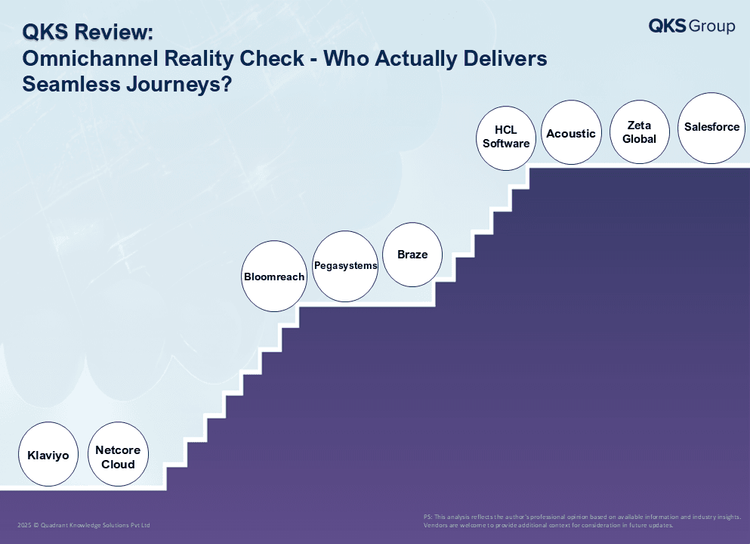
Many platforms claim seamless journeys, but few deliver them in day-to-day operations. Credible execution rests on four conditions: a single governed profile, event-driven orchestration on live context, decisioning that reaches the website, the app, the contact center, and the point of service, and closed-loop measurement that can verify uplift without breaking eligibility or consent. Judged against these criteria, here is where vendors actually stand.
Salesforce delivers one of the most unified production environments for cross-channel execution. Its Data Cloud manages a governed customer record with streaming data ingestion and real-time identity resolution, ensuring alignment of eligibility and suppression across touchpoints. Marketing Cloud Engagement runs event-driven journeys across email, SMS, push, ads, and custom channels, all referencing the live profile. Marketing Cloud Personalization adds millisecond-level decisioning on web and app, feeding results back into the journey for closed-loop synchronization. Service Cloud Omni-Channel complements this with intelligent routing that preserves context across service channels. With Marketing Cloud Next and Agentforce, governed agents can design, execute, and optimize within policy boundaries. The outcome is a measurable, auditable loop such as browsing abandonment converted into assisted sales supported by end-to-end visibility.
Zeta Global’s Zeta Marketing Platform functions as a cohesive system rather than a collection of stitched-together tools. Its CDP sustains person-level identity with low-latency updates, keeping eligibility and frequency coherent across all channels. Zeta Data and Opportunity Explorer extend reach beyond CRM retargeting by identifying new intent signals. Its unified canvas spans email, SMS, push, web, paid, and programmatic including CTV and direct mail, all under shared governance. Zeta AI continuously evaluates affinities and fatigue to synchronize on-site and outbound experiences. Its emerging agent workflows automate audience discovery and campaign optimization within auditable controls. This architecture allows brands to execute acquisition-to-lifecycle journeys governed by one identity and policy layer. Zeta has also announced a definitive agreement to acquire Marigold’s Enterprise Business, expanding its profile with advanced loyalty and dynamic content capabilities.
Acoustic Connect establishes a live-profile foundation combined with event-driven orchestration across owned channels. It integrates behavioral, campaign, audience, product catalog, and consent data into governed profiles that drive orchestration, personalization, segmentation and suppression. Journeys are triggered by fine-grained events and follow shared eligibility and consent rules. Channel coverage includes email, SMS, WhatsApp, and push through a single editor, while built-in behavioral intelligence enables rapid testing and dynamic experiences on web and app. Integrated reporting and CDP interoperability support short feedback cycles without re-platforming. Role-based governance aids multi-brand organizations in maintaining consistency.
HCLSoftware’s Unica+ offers robust orchestration and governance capabilities suited for large enterprises. Unica Campaign handles complex segmentation and multi-wave scheduling, while Unica Journey provides an event-driven canvas with measurable outcomes. Unica Interact powers next-best actions across digital and assisted touchpoints including web, app, call center, POS, ATMs, and kiosks ensuring contextual continuity. Centralized constraint management through Unica Optimize maintains pressure, legal, and brand rules. Unica Deliver supports omnichannel messaging across email, SMS, WhatsApp, RCS, and push, while Unica Discover surfaces friction insights that feed back into orchestration. While technically advanced, effective deployment depends on disciplined data modeling, identity stewardship, and clear operational ownership.
Braze excels in real-time orchestration through SDKs and APIs that feed live events into dynamic profiles. Canvas Flow supports signal-driven journeys with embedded testing, while Currents streams granular outcomes back to data warehouses. Channels cover the full spectrum from email and SMS to in-app, push, and Content Cards. Personalization leverages Liquid scripting and live API calls for contextual decisions. However, organizations must maintain strict identity hygiene, learn Braze Canvas’s programming model, manage warehouse-first analytics, and watch costs as scale increases.
Pegasystems’ Pega Customer Decision Hub centralizes next-best-action decisioning across inbound and outbound interactions. Adaptive models learn continuously, optimizing by propensity and value within policy limits. The same logic applies across web, app, IVR, contact center, and paid media. Tight integration with Pega Customer Service ensures contextual handoffs. One-to-One Operations Manager enforces auditability. Still, successful use requires strong identity and event plumbing (often via a CDP), latency management for inbound channels, and careful governance to prevent decision sprawl.
Bloomreach Engagement brings a commerce-centric design, combining CDP-grade profiles, real-time events, and product data in a single system. Scenarios power lifecycle automation, from welcome to cart recovery with testing embedded. Channel reach spans email, SMS, push, in-app, WhatsApp, and ad audiences. Loomi provides product and behavioral recommendations that drive personalization across outbound and on-site experiences. Implementation success depends on disciplined event design, developer collaboration for web layers, and clear data ownership when coexisting with other CDPs.
Netcore Cloud integrates profiles, predictive segments, and product data to orchestrate journeys across email, SMS, WhatsApp, RCS, push, and on-site experiences. Its AI, Raman, optimizes channel mix and timing, while Netcore Personalization aligns merchandising and content decisions. Despite its breadth, user feedback points to limited native reporting, interface constraints, and uneven support quality. Integration breadth remains narrower than larger ecosystems. Performance depends on disciplined data governance and strong measurement frameworks.
Klaviyo offers a agile, commerce-oriented stack integrating data, orchestration, and channels. Profiles update instantly from connected systems and power journeys across email, SMS, push, WhatsApp, and ads. Predictive metrics like next order date and lifetime value drive automation decisions. However, scaling can be costly, advanced workflows carry a learning curve, and regional gaps persist in WhatsApp and RCS delivery. Many teams still rely on external content tools for richer landing experiences.
Analyst Take
Seamless journeys are not defined by the number of channels but by the integrity of the decisioning architecture. True orchestration requires a governed live profile, unified policy enforcement, synchronized inbound and outbound decisions, and measurable uplift validated under consent and eligibility controls. Among current vendors, Salesforce and Zeta Global stand out for consistent execution of these principles. Acoustic and HCLSoftware follow closely, excelling in deterministic governance and strong owned-channel control. Braze, Pegasystems, and Bloomreach perform well when data discipline and organizational rigor are in place. Netcore Cloud and Klaviyo can achieve meaningful results in commerce and mid-market contexts if teams invest in sound event design, consent hygiene, and disciplined reporting.
Disclaimer & Invitation:
This blog is based on independent research and publicly available information. The insights presented reflect the views of QKS Group and are for informational purposes only. While we strive for accuracy, we do not guarantee completeness or absolute correctness. Vendors are welcome to provide clarifications or updates. If any vendor listed in this analysis wishes to provide additional context or clarification, we welcome a briefing call and will consider incorporating relevant updates. This analysis is not intended to disparage any vendor but to provide an informed, balanced perspective. We encourage open and constructive dialogue to foster transparency and a deeper understanding of the industry.
Author: Richa Choubey, Senior Analyst – MarTech at QKS Group