


As service parts planning becomes a critical driver of operational efficiency and customer satisfaction in manufacturing and retail, AI-driven forecasting and real-time inventory management are now essential tools. This review blog by QKS Group evaluates how top vendors in the field are addressing the growing demands for agile, accurate, and intelligent service parts management.
What Modern Service Parts Planning Should Deliver:
Today’s service parts planning platforms must provide more than basic inventory management. Key capabilities include:
AI-Driven Forecasting: The ability to predict demand accurately by leveraging vast datasets, including historical demand, market trends, and external factors.
Real-Time Inventory Visibility: Tracking service parts in real time using IoT sensors and RFID technology to optimize inventory and ensure timely replenishment.
Scenario Modeling and Predictive Planning: Tools to simulate various supply and demand scenarios and proactively address potential disruptions.
Key Findings:
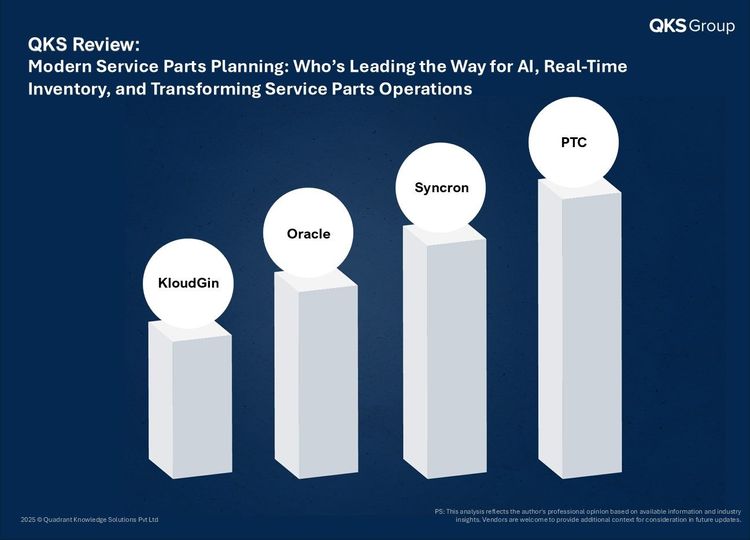
Leading vendors like PTC lead the way with their AI-driven service parts management platform, offering real-time inventory tracking and predictive service planning capabilities. Their innovative use of scenario modeling and proactive replenishment strategies sets a new standard for the industry.
Capable vendors like Syncron offer a solid, reliable solution for manufacturers, with strong demand forecasting and intelligent inventory management. While it lacks the depth of AI seen in platforms like PTC, its flexibility and cloud-based solutions make it a dependable choice for many industries.
Lagging vendors like Oracle and KloudGin face significant challenges. Oracle’s reliance on legacy systems and rigid workflows limits its agility, while KloudGin
28.07.2025
QKS Review
QKS Review: Modern Service Parts Planning: Who’s Leading the Way for AI, Real-Time Inventory, and Transforming Service Parts Operations
Author:
Pruthvi Raj V
Executive Summary:
In today's fast-paced manufacturing and retail environments, service parts planning is no longer just a back-end function - it's a critical driver of business efficiency, customer satisfaction, and operational cost management. But many businesses are still grappling with outdated systems that fail to meet the complexities of modern supply chains. As demands for real-time, accurate inventory grow, and AI-driven forecasting becomes more prevalent, the question remains: which vendors are leading the way in transforming service parts planning?
Challenges in Service Parts Planning: The Pain Points of End-Users
The complexities involved in managing service parts are manifold. In manufacturing, parts are often needed quickly and in varying quantities, making it difficult to manage inventory effectively. With a global supply chain, timely access to the right parts is crucial, and delays or inaccuracies in forecasting can disrupt production lines, impact service levels, and increase costs. Here are some common pain points:
- Inaccurate Demand Forecasting: Traditional forecasting models struggle to predict parts demand accurately, especially in a dynamic, global market where external factors like geopolitical shifts or sudden changes in consumer behavior can impact parts needs.
- Excessive Inventory or Stockouts: Without real-time data, businesses often hold excess inventory to mitigate the risk of stockouts, which ties up valuable capital. Alternatively, inaccurate forecasts lead to stockouts, affecting production schedules and service levels.
- Fragmented Systems: Many manufacturers rely on patchwork of legacy ERP, CRM, and SCM systems, leading to silos in data, inconsistent inventory tracking, and a lack of real-time insights. These issues hinder the ability to quickly respond to changes in demand or supply chain disruptions.
The Role of AI and Real-Time Inventory in Service Parts Planning
As manufacturers seek to overcome these challenges, AI-driven solutions and real-time inventory management are emerging as critical enablers of more efficient and accurate service parts planning.
AI-Driven Forecasting
AI’s ability to analyze vast amounts of data from multiple sources - such as historical demand, weather patterns, and market trends - helps generate more accurate demand forecasts. Machine learning algorithms can continuously improve predictions by learning from real-time data, adapting to shifts in demand patterns that traditional models simply cannot handle.
AI can forecast not only demand for specific parts but also when to replenish inventory, factoring in lead times, supplier performance, and transportation delays. This results in better alignment between supply and demand, reducing both excess inventory and stockouts.
Real-Time Inventory Management
Real-time inventory management goes hand-in-hand with AI-driven forecasting. By leveraging IoT sensors and RFID technology, businesses can track service parts in real time, allowing for better visibility across the supply chain. This enables manufacturers to optimize inventory levels, ensuring that the right parts are available at the right time, while also reducing costs associated with storing excess parts.
The integration of real-time inventory systems allows companies to respond more quickly to demand changes, adjust their plans dynamically, and improve the speed and accuracy of replenishment processes. Real-time data also helps to avoid production delays by enabling faster identification of inventory shortages.
How Top Vendors Are Addressing These Needs
In this evolving landscape, some vendors are taking the lead in providing the tools necessary to meet the complex demands of service parts planning.
PTC:Leading with Innovation
PTC has long been recognized for its advanced capabilities in digital transformation and its AI-driven solutions. Their Service Parts Management platform integrates AI-powered forecasting with real-time inventory tracking to deliver a seamless, end-to-end solution for manufacturers.
What differentiates PTC is its use of advanced scenario modeling tools and predictive service planning features. These allow manufacturers to model multiple what-if conditions, optimize inventory levels across regions, and preempt potential part failures - leading to proactive replenishment strategies and improved service outcomes.
PTC’s integrated systems provide a unified view of service parts inventory across global operations, enabling dynamic planning and execution. With a strong focus on innovation and end-user agility, PTC continues to redefine what modern service parts planning looks like.
Syncron:A Balanced Approach
Syncron takes a slightly more conservative approach but is no less effective. Their Service Parts Optimization solution helps manufacturers plan parts availability by combining demand forecasting with intelligent inventory management. Syncron’s strengths lie in its ability to offer cloud-based solutions that can be tailored to different industries, providing a solid platform for manufacturers seeking efficiency without overhauling existing systems.
While Syncron may not be flashy, its reliability across high-pressure, service-intensive environments - especially in asset-heavy industries - demonstrates its value. The platform excels in aligning parts planning with installed base visibility and aftermarket lifecycle needs.
However, some users find that Syncron lacks the depth of advanced AI capabilities seen in more aggressive platforms. Despite this, Syncron’s ease of integration and industry-specific flexibility make it a dependable choice for organizations seeking stability and performance.
Oracle:Burdened by Legacy
Oracle’s service parts planning solutions, though part of a broad supply chain suite, often feel weighed down by legacy architecture. While it offers tools for forecasting and inventory management, the platform’s reliance on traditional system design and complex workflows can hinder agility.
Users have noted that extensive customization is often required to align Oracle’s offerings with modern service parts planning needs. The absence of advanced AI-driven adaptability and real-time decision-making creates challenges in fast-moving environments. Oracle’s roadmap may evolve, but for now, its approach remains too rigid for manufacturers seeking rapid transformation.
KloudGin:Ambition Outpacing Execution
KloudGin brings a fresh, cloud-native approach to service parts planning with a strong emphasis on AI and usability. Its interface is modern and intuitive, and the solution promises real-time data visibility and intelligent inventory strategies.
However, challenges remain - especially in large-scale deployments. Integration complexity with enterprise systems and limited configuration depth for intricate planning scenarios can impede performance. While promising on paper, KloudGin’s current offering still needs to mature to fully meet the demands of large manufacturers with complex, multi-tier supply networks.
Conclusion: The Future of Service Parts Planning
In an era where manufacturers need agility, accuracy, and real-time responsiveness, service parts planning is no longer just about managing inventory - it’s about driving operational efficiency and enhancing customer satisfaction. AI and real-time inventory management are no longer optional; they are essential for businesses that want to stay competitive.
As we’ve seen, PTC leads the charge by combining AI, scenario modeling, and real-time visibility into a powerful planning engine. Syncron offers a balanced, dependable platform, well-suited for high-pressure industries, albeit with lighter AI depth. Meanwhile, Oracle and KloudGin face headwinds - the former due to legacy limitations, the latter due to execution challenges in complex enterprise environments.
For manufacturers looking to future-proof their service parts planning operations, investing in AI-powered, real-time solutions is no longer a choice - it’s a necessity. The future is digital, and the vendors who master AI and real-time data will be the ones defining it.
Disclaimer:
This blog is based on independent research and publicly available information. The insights presented reflect the views of QKS Group and are for informational purposes only. While we strive for accuracy, we do not guarantee completeness or absolute correctness. Vendors are welcome to provide clarifications or updates. If any vendor listed in this analysis wishes to provide additional context or clarification, we welcome a briefing call and will consider incorporating relevant updates. This analysis is not intended to disparage any vendor but to provide an informed, balanced perspective. We encourage open and constructive dialogue to foster transparency and a deeper understanding of the industry.
Author: Pruthvi Raj V, Senior Analyst at QKS Group
Co-Author: Kumar Anand, Associate Director & Principal Industry Analyst at QKS Group
Vendors: