

18.07.2025
QKS Review
QKS Review: Functional Maturity in RPA: How 5 Leading Vendors Stack Up in 2025
Author:
Kunal Pakhale


Executive Summary:
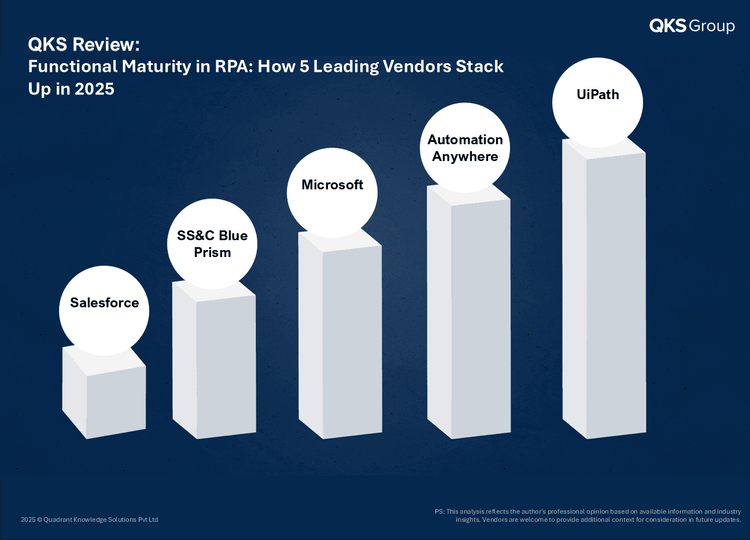
The Robotic Process Automation (RPA) market stands at a critical inflection point as vendors navigate the transition from traditional task automation to Agentic Process Automation (APA), with five major platforms revealing distinct strategic positions in this evolving landscape. UiPath maintains market leadership through superior technical capabilities and enterprise-grade orchestration but faces the challenge of evolving from a powerful executor to an intelligent collaborator capable of adaptive decision-making. Automation Anywhere emerges as the strategic innovator with its cloud-native architecture, intuitive low-code approach, and bold vision for generative AI integration, positioning it well for the agentic automation future if execution matches ambition.
SS&C Blue Prism remains the stability champion for regulated industries requiring strict compliance but risks obsolescence without aggressive modernization toward AI-driven capabilities and improved user experience. Microsoft Power Automate leverages ecosystem advantages through unmatched integration with Microsoft's business suite and growing AI capabilities via Copilot, yet has yet to demonstrate enterprise-scale orchestration capabilities necessary for true agentic automation. Salesforce's MuleSoft Robotic Process Automation (RPA) represents untapped potential with its integration-first approach and CRM-centric automation, but fragmented tooling and lack of autonomous agent vision position it as an automation add-on rather than a core engine. The verdict is clear: as automation evolves toward autonomous, decision-making agents, vendors must balance proven functional capabilities with innovative AI integration. Winners will be those who successfully transform from task execution to intelligent automation.
As the automation landscape shifts toward Agentic Process Automation, functional capabilities remain the foundation upon which advanced intelligence and autonomy are built. This blog evaluates UiPath, Automation Anywhere, SS&C Blue Prism, Microsoft Power Automate, and Salesforce Einstein Automate across key Robotic Process Automation (RPA) functions, revealing who is ready to lead and who needs to catch up.
UiPath
UiPath continues to lead the Robotic Process Automation (RPA) market with one of the most complete and polished toolsets available. It’s clear the platform was built with scale and enterprise readiness in mind, from its dual-editor approach (Studio for pros, StudioX for business users) to its highly mature Orchestrator for managing bots, queues, and schedules across the enterprise. UiPath handles both attended and unattended automation with ease, and its strength in screen scraping, task recording, and multi-bot execution is best in the market. That said, while its architecture is API-friendly and integrations are robust, its native AI features still feel somewhat stitched into scripts rather than deeply embedded. Studio is powerful, but it’s not exactly beginner-friendly. And as automation shifts toward agentic and autonomous enterprises, UiPath is making moves with AI copilots and assistants, but it's treading carefully. The big question is whether it can evolve from being a powerhouse executor to an intelligent collaborator, one where bots don’t just follow commands, but understand and adapt to changing environments.
Automation Anywhere
Automation Anywhere strikes a compelling balance between ease of use and enterprise-grade solution. Its cloud-native platform is refreshingly intuitive, making automation feel less like coding and more like building with blocks, making it ideal for both business users and developers. The platform handles screen scraping and task recording well, and the cloud-based Control Room is great for centralized governance. What makes it stand out is the low-code flexibility and composable design, reusable bots, built-in analytics via Bot Insight, and a clean Design Studio that makes automation approachable. However, that abstraction comes at a cost: advanced scripting and complex edge-case scenarios still feel constrained. As the vendor pivots toward Agentic Process Automation (APA), it's placing big bets on generative AI and decisioning layers. The roadmap is bold, but execution will be key. If Automation Anywhere can turn its vision into a scalable, agent-driven platform, not just for automating tasks but for automating decisions, it could very well redefine what "intelligent automation" actually means.
SS&C Blue Prism
SS&C Blue Prism is still a go-to for highly regulated sectors that prioritize control, compliance, and operational stability. Its platform excels in centralized orchestration, multi-bot execution, and scripting environments, all of which are especially attractive to IT-heavy organizations. Blue Prism’s visual logic model is robust for those who know how to use it, but it has a certain learning curve, and it’s not easy to pick up. Compared to newer platforms, the interface feels dated, and business-user friendliness is lacking. Screen scraping lags behind modern AI-driven approaches, and while attended automation is available, it doesn’t feel like a core strength. The lack of a true API-first design and a heavier on-prem presence also make integration slower and more cumbersome in cloud-native environments. With the market leaning hard into AI, low-code, and autonomous agents, Blue Prism risks falling behind unless it modernizes aggressively.
Microsoft Power Automate
Microsoft Power Automate has grown from a simple workflow tool into a serious automation contender, especially for enterprises already deep in the Microsoft ecosystem. Its native integration with Microsoft 365, Dynamics, and Azure gives it unmatched context-awareness in business environments. Power Automate does a solid job with UI automation via Power Automate Desktop, while its hundreds of connectors make it easy to integrate just about anything. It’s friendly for citizen developers, but developers looking for deep scripting control may find it a bit limiting. The orchestration layer, while improving, still lacks the robust queueing and failure recovery mechanisms that you’d find in platforms like UiPath or Blue Prism. On the plus side, Microsoft is embedding AI capabilities like Copilot and AI Builder directly into its tooling, which hints at bigger things ahead. Still, right now, Power Automate shines most in task automation and departmental workflows, it hasn’t yet cracked the code for true, enterprise-wide agentic automation.
Salesforce
Salesforce brings a unique flavor to the Robotic Process Automation (RPA) space, one centered around integration rather than pure automation. With MuleSoft RPA, it’s carving out a niche where automation lives inside the data and process flows of Salesforce’s CRM stack. The approach makes sense: use automation to enhance customer and operational workflows. MuleSoft RPA covers the basics, screen scraping, task automation, and orchestration via RPA Manager, but the features aren’t as mature or battle-tested as those from RPA veterans.
The ecosystem is somewhat fragmented, too, spread across Flow, Composer, and RPA Builder, which can complicate end-to-end use case development. While the API-first, low-code approach is good and well aligned with Salesforce’s DNA, the platform lacks advanced bot management, flexible scripting, and a coherent vision for autonomous agents. For now, Salesforce’s automation suite feels more like an add-on than a core engine. To stay competitive as automation moves toward autonomy and decisioning, Salesforce must unify its tooling, harden orchestration, and double down on intelligent, agent-driven workflows.
Disclaimer:
This blog is based on independent research and publicly available information. The insights presented reflect the views of QKS Group and are for informational purposes only. While we strive for accuracy, we do not guarantee completeness or absolute correctness. Vendors are welcome to provide clarifications or updates. If any vendor listed in this analysis wishes to provide additional context or clarification, we welcome a briefing call and will consider incorporating relevant updates. This analysis is not intended to disparage any vendor but to provide an informed, balanced perspective. We encourage open and constructive dialogue to foster transparency and a deeper understanding of the industry.
Author:Kunal Pakhale, Senior Analyst - Process Automation Solutions at QKS Group
Vendors: