

21.07.2025
QKS Review
QKS Review: From Discovery to Disillusionment: What Went Wrong with Task Mining?
Author:
Pranjal Singh


Executive Summary:
Task mining entered the market as the missing link between process maps and real-world work patterns, promising behavioural insights, automation readiness, and orchestration at scale. In 2025, the market shows a different reality: while a few vendors are delivering enterprise-grade intelligence, many remain stuck in fragmented execution, legacy thinking, or shallow AI overlays. This review blog by QKS Group critically examines eleven major players to separate strategic leaders from those still treating task mining as an RPA add-on.
What Modern Task Mining Platforms Must Deliver:
Enterprise buyers now demand platforms that move beyond passive observation to deliver operationalized behavioural intelligence. Key capabilities include:
- GenAI-native orchestration triggers and next-best-action recommendations
- Contextual modelling for hybrid, exception-heavy workflows
- Integration with automation, decisioning, and analytics ecosystems
Key Findings:
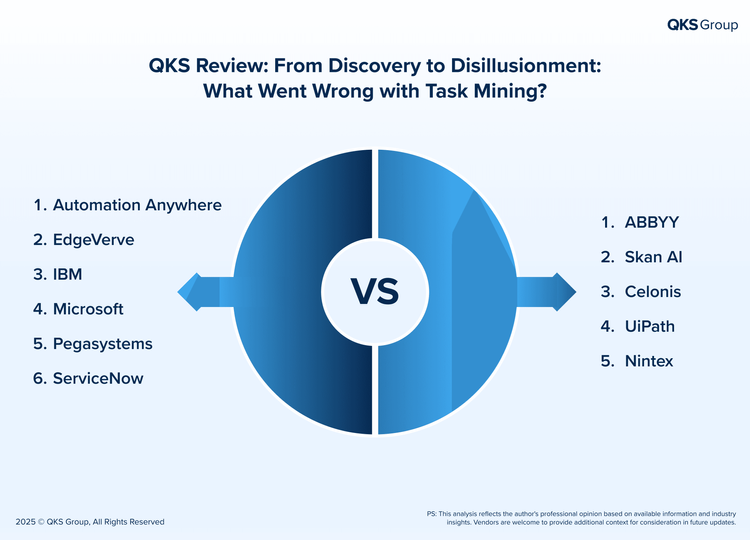
Leading vendors ABBYY and Skan AI deliver strategic, AI-native task intelligence with clear enterprise alignment, security, and explainability.
Capable but evolving vendors Celonis, UiPath, and Nintex offer functional integration into automation stacks but lack depth in cross-functional behavioural modelling.
Lagging vendors, Automation Anywhere, EdgeVerve, IBM, Microsoft, Pegasystems, and ServiceNow provide fragmented, niche, or IT-centric task insights, limiting transformation impact.
Introduction
Task mining once promised a revolution, seamless automation, deep behavioural insights, and intelligent orchestration of work. It was supposed to be the bridge between business process mapping and actual user behaviour, the final visibility layer needed to unlock enterprise-wide transformation. But fast-forward to 2025, and the landscape tells a quite different story. While a handful of vendors have genuinely innovated, the majority are battling with fragmentation, legacy baggage, or half-baked AI overlays. This blog evaluates eleven vendors critically, including ABBYY, Skan.ai, Celonis, Automation Anywhere, EdgeVerve, IBM, Microsoft, Nintex, Pegasystems, ServiceNow, and UiPath. Who is out there getting real-world outcomes? Who is evolving-but-cautiously? And who is still trying to recycle legacy thinking in a market that demands next-gen intelligence
ABBYY - Staying Disciplined in a Noisy Market
ABBYY continues to be a rare example of focus and depth in task mining. Rather than being distracted by trends, ABBYY has anchored its product vision in content intelligence and behavioural insight. Its Timeline product doesn’t just observe activity, it contextualizes it by leveraging years of OCR, IDP, and process intelligence experience to surface meaningful patterns. In an era where GenAI noise has overtaken true capability, ABBYY stands out for resisting shallow integrations. Instead, it layers AI thoughtfully to improve discovery, user behaviour clustering, and productivity insights. It’s not the flashiest platform, but it’s consistently aligned with enterprise needs, including explainability, security, and outcomes. ABBYY also caters to regulated industries like insurance, healthcare, and financial services, where precision and traceability matter more than flashy dashboards. Its depth in content-centric process analytics sets it apart from workflow-first platforms.
Skan AI - Building the Future, Most Vendors Only Talk About
Skan AI has redefined task mining by avoiding the traditional obsession with screen capture and logs. Its AI-native platform builds a dynamic Digital Twin of Human Work, capable of turning fragmented behaviours into structured, interpretable work intelligence. What separates Skan AI is its systemic understanding of how humans interact with applications across complex environments, without any integrations, it offers continuous behavioural intelligence at scale. It’s the only platform that feels like it was designed for the hybrid, exception-heavy, high-compliance reality of modern enterprises. Skan AI is building the intelligence layer that many vendors are still pretending to have. Skan AI’s analytics resonate with change agents looking to convert human activity into operational foresight. Its native AI capabilities also enable faster summarization, behaviour clustering, and what-if simulations that drive boardroom conversations.
Celonis - Mature Infrastructure, Cautious Expansion
Celonis is known as a leader in process mining, and their approach to task mining is similar: organized, analytics-driven, and enterprise-grade. The platform does an excellent job of combining task mining with process-level analysis to give a complete picture of how well things are running. But its task mining module still feels like an extra feature instead of an equivalent intelligence layer. It doesn't have the flexibility and real-time detail that modern workplaces need. That being said, Celonis is taking its time and not rushing features, but making sure they fit. The foundation is solid; the next step is acceleration. It continues to appeal to large enterprises that prefer stability and strategic alignment over experimentation. But the lack of disruptive UX or advanced behavioural AI in its task mining limits its innovation narrative.
Automation Anywhere - Vision Realignment Still in Progress
Automation Anywhere was among the very few RPA vendors to enter task mining, and has indeed undergone an uneven journey. The Discovery Bot laid the groundwork, and with the FortressIQ acquisition, enterprise scalability had been promised. But the transition has not been so smooth after all. Inconsistent customer experiences are now in place, with unclear migration paths and gated features. While GenAI marketing is strong, the execution therein is weak. The task mining in the platform still feels like a feature being developed rather than a seamless intelligence engine that it aspires to be. It was marketed ahead of its delivery, and on the technical side, while integrations exist, significant usability gaps and a lack of transparency in the roadmap continue to frustrate early adopters.
EdgeVerve - Operational Discipline, Innovation Hesitation
EdgeVerve's AssistEdge Discover is more diffusely set up across Infosys-led transformation programs, with special attention on structured, compliance-driven processes. The tool works best under BFSI and telecom settings and provides reliable data on task durations, application usage, and SLA compliance. It leans more into operational reporting rather than dynamic task intelligence. In this market that demands GenAI and business-user-friendly modelling, EdgeVerve feels conservative. EdgeVerve has not fully embraced GenAI capabilities and conversational analytics. It is best used where the tasks are clearly defined and the environment is tightly governed. But this very strength limits its ability to adapt to the modern workflows that are increasingly fluid and multi-departmental, and hybrid in nature.
IBM - Powerful Toolbox, Scattered User Journey
IBM brings immense capability across automation, AI, and decisioning. However, its task mining experience remains fragmented, spread across acquired components like myInvenio and surfaced via extensions in IBM Process Mining and Cloud Pak for Business Automation. While technically rich, the experience lacks cohesion. IBM’s cognitive depth could be a strength, but the platform often requires specialized configuration and lacks an intuitive behavioural discovery engine. There is little out-of-the-box GenAI integration focused on task analysis. As a result, IBM risks being viewed more as an integrator of capabilities than a purposeful task mining solution.
Microsoft - Productivity-Centric, But Light on Depth
Microsoft’s task-level insights are embedded in its broader productivity and analytics tools, particularly through Power Automate and its process advisor capabilities. While this provides an easy on-ramp for users within the Microsoft 365 ecosystem, the depth of behavioural analysis remains limited. There is a strong emphasis on usability, but limited depth in cognitive models, GenAI behaviour clustering, or real-time deviation detection. It fits well in small-scale environments or departmental-level use cases but lacks the richness for enterprise-grade transformation.
Nintex - Simplifying Discovery Through AI-Powered Capture
Nintex offers a strong low-code platform, especially for form building, workflow automation, and document generation. The company has evolved into a unified intelligent process automation suite, with task mining delivered through its AI-powered process capture. Avoiding complex instrumentation, Nintex enables users, including technical and non-technical alike, to generate process maps using activity recordings and text prompts. The Nintex Process Capture module, part of Nintex Process Manager, leverages OpenAI LLMs hosted on Microsoft Azure alongside app metadata, OCR, and screenshots to provide a clear view of user activity. This lightweight approach is ideal for early-stage discovery, especially where traditional tools may be too complex. However, Nintex’s task mining still lacks deeper behavioural modelling, GenAI-based abstraction, and simulation features. Its integration with the broader automation lifecycle also remains a work in progress.
Pegasystems - Rules-Driven Legacy, Human-Centric Blindspot
Pegasystems excels in case management, decisioning, and rule-driven process automation. But its approach to task mining lacks modern behavioural modelling. Its process AI and workforce intelligence are powerful within Pega-centric ecosystems, but struggle to observe and interpret user-level interactions across third-party systems. While its case orchestration is industry-proven, the task mining perspective remains shallow, more about operational metrics than cognitive insights. GenAI potential exists, but hasn’t yet been channelled to augment discovery or simulation.
ServiceNow - IT-Centric Focus, Limited Functional Breadth
ServiceNow’s task insights are strongest in IT service management and support workflows. It offers clear value in analyzing agent productivity, ticket resolution, and incident flow. But beyond IT, its task mining capabilities remain light and reactive. The Now platform has potential, especially with GenAI enhancements like chat summarization, but broader use case expansion is lacking. Task discovery doesn’t yet span into operations like finance or HR with sufficient granularity.
UiPath - Integrated by Design, Evolving in Scope
UiPath has expanded beyond RPA to deliver a tightly integrated platform combining task mining, process mining, and Studio. Its task mining capability allows users to zoom in on process maps and directly export automation flows into Studio, enabling a seamless transition from insight to execution. This integration supports closed-loop automation and bottleneck resolution without relying on GenAI. GenAI capabilities, delivered through Autopilot, further enhance the experience with natural language queries and improvement suggestions. While technically robust within the UiPath ecosystem, some customers note that task mining remains largely automation-centric, with limited support for broader workforce insights or cross-functional performance benchmarking. To lead in enterprise-wide task intelligence, UiPath must evolve its narrative beyond automation enablement.
Final Takeaway
Task mining began as a promising bridge between process discovery and intelligent automation. But in 2025, it stands at a crossroads. The most successful vendors have realized that collecting user activity isn't enough, they must transform it into dynamic, actionable intelligence that empowers real-time decision-making, automation orchestration, and workforce augmentation. This blog makes one thing clear that the task mining market is no longer about ticking checkboxes or embedding telemetry into RPA pipelines. It's about delivering behavioural intelligence that aligns with enterprise transformation goals. Vendors like ABBYY and Skan.ai demonstrate that task mining can be both strategic and scalable. Meanwhile, others still treat it as a passive analytics layer, fragmented, disconnected, and reactive.
The next wave of winners in this space will be those who:
- Reimagine task mining as a design-time and run-time intelligence layer
- Integrate GenAI natively to translate behaviour into orchestration triggers
- Embrace usability and interoperability across diverse enterprise ecosystems
Vendors that fail to adapt will risk irrelevance, not because they lack features, but because they lack the clarity and conviction to redefine how work intelligence should evolve. Task mining’s future is not about watching screens, it’s about understanding human-machine collaboration at scale. That’s where true transformation begins.
Disclaimer:
This blog is based on independent research and publicly available information. The insights presented reflect the views of QKS Group and are for informational purposes only. While we strive for accuracy, we do not guarantee completeness or absolute correctness. Vendors are welcome to provide clarifications or updates. If any vendor listed in this analysis wishes to provide additional context or clarification, we welcome a briefing call and will consider incorporating relevant updates. This analysis is not intended to disparage any vendor but to provide an informed, balanced perspective. We encourage open and constructive dialogue to foster transparency and a deeper understanding of the industry.
Author: Pranjal Singh, Principal Industry Analyst at QKS Group
Vendors: