

30.09.2025
QKS Review
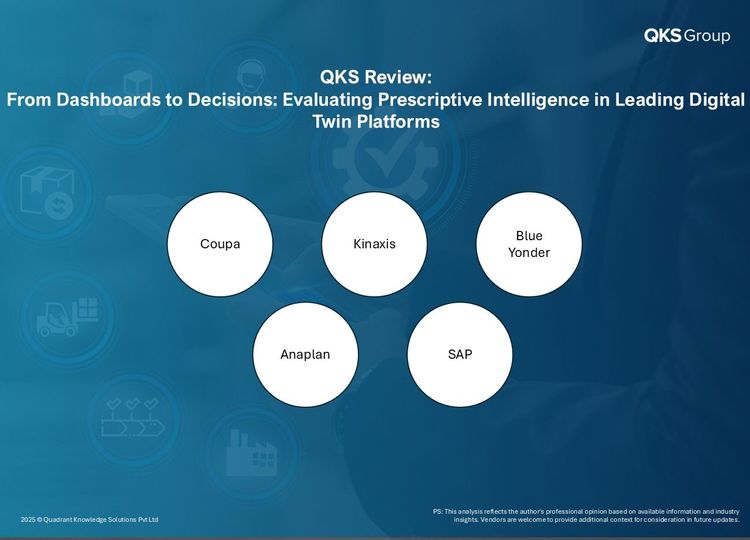
QKS Review: From Dashboards to Decisions: Evaluating Prescriptive Intelligence in Leading Digital Twin Platforms
Author:
Nithin Bhaskaran


Executive Summary:
As supply chains face growing volatility from sudden demand shifts to supplier disruptions enterprises are turning to digital twin platforms that promise to move beyond dashboards and scenario modeling toward prescriptive decision intelligence. These solutions aim not only to simulate options but also to recommend, explain, and in some cases automate, corrective actions in real time.
What Modern Digital Twin Platforms Should Deliver:
- Continuous sensing and rapid scenario refresh across supply, demand, and inventory
- AI-driven prescriptions that recommend or trigger concrete operational actions
- Explainable recommendations to build planner trust and support adoption
- Seamless integration with ERP, execution, and partner systems
Key Findings:
- Leading vendor (Kinaxis) demonstrates real-time concurrency and explainable AI outputs, enabling fast, transparent recommendations, though execution still involves human approval.
- Visionary vendor (Blue Yonder) extends into multi-enterprise orchestration with AI agents, but customer adoption shows uneven maturity and complex integrations.
- Capable vendor (Coupa) excels at strategic optimization through LLamasoft’s engine, but remains batch-oriented and less effective in live operational decisioning.
- Capable vendor (Anaplan) unifies finance and supply chain planning, providing strong cross-functional alignment, though prescriptive intelligence remains limited.
- Lagging vendor (SAP IBP) offers dependable integration and demand sensing but remains largely planner-led, with conservative use of prescriptive AI.
Conclusion: While digital twin platforms are evolving rapidly, most remain in transition from decision support to decision intelligence. For organizations, vendor selection should align with priorities whether strategic design, operational agility, or enterprise-wide alignment recognizing that fully autonomous prescription is still emerging.
Coupa: Strength in Strategic Design
Coupa’s capabilities are anchored in LLamasoft’s optimization engine, widely recognized for its ability to solve complex network design and cost-to-serve challenges. For strategic decisions such as sourcing diversification or facility placement, Coupa provides highly detailed optimization models that generate clear recommendations.
However, Coupa’s approach is typically batch-oriented rather than continuous. While strong in long-term strategy, its operational prescriptive intelligence responding to live disruptions in real time is still developing.
Kinaxis: Real-Time Planning with Emphasis on Explainability
Kinaxis Maestro is designed for concurrent planning, enabling scenarios to be refreshed in near real time through its in-memory data model. This allows organizations to shorten decision cycles significantly and test multiple alternatives rapidly.
Kinaxis also places emphasis on explainability: its AI modules provide context for forecasts and recommendations, building user trust. Customers benefit from faster, more transparent scenario-based decision-making.
While Kinaxis markets the concept of a “self-healing supply chain,” execution still involves human oversight. The system surfaces risks and proposes options, but users typically confirm and implement actions.
Blue Yonder: Expanding Toward Multi-Enterprise Orchestration
Blue Yonder has broadened its capabilities significantly with the integration of OneNetwork, positioning itself to deliver multi-enterprise orchestration. The platform aims to enable AI-driven agents that monitor networks, detect disruptions, and propose corrective actions across partners.
This vision is compelling, but customer experience suggests outcomes vary depending on integration maturity and deployment scope. For many organizations, Blue Yonder currently provides strong visibility and alerts, with prescriptive intelligence emerging as the platform evolves.
Anaplan: Connected Planning Across Functions
Anaplan differentiates itself as a connected planning platform, unifying supply chain, finance, and operations in a single model. It enables extensive scenario modeling, allowing organizations to test the impact of changes across functions.
Where Anaplan is strong is in cross-functional alignment bringing finance and supply chain together in shared planning cycles. However, its prescriptive intelligence is limited. The platform provides insights and scenarios but depends on users to interpret recommendations and execute actions.
SAP IBP: Reliable Integration, Conservative Intelligence
SAP IBP is often the preferred choice for enterprises operating within the SAP ecosystem. It delivers robust planning, fast simulations, and seamless integration with S/4HANA and related systems. Features such as demand sensing and automated buffer adjustments provide incremental prescriptive benefits.
However, IBP’s approach remains largely planner-centric. While effective at surfacing alerts and running scenarios, prescriptive recommendations are typically high-level, with execution still guided by users.
Strategic Outlook
The evolution of supply chain digital twins toward prescriptive decision intelligence is clear, but uneven:
- Kinaxis leads in real-time operational maturity and explainability.
- Blue Yonder offers the boldest multi-enterprise vision, though delivery varies.
- Anaplan enables valuable cross-functional planning but offers limited prescriptive capabilities
- Coupa provides strong strategic optimization, less so operational prescription.
- SAP IBP excels in integration but remains planner-led.
Conclusion: Today’s platforms are moving beyond visibility and simulation, but most remain in transition from decision support to decision intelligence. For organizations evaluating these solutions, the key is to match vendor strengths with business priorities—whether that is strategic design, operational agility, or inventory precision while recognizing that fully autonomous prescription is still on the horizon.
Disclaimer:
This blog is based on independent research and publicly available information. The insights presented reflect the views of QKS Group and are for informational purposes only. While we strive for accuracy, we do not guarantee completeness or absolute correctness. Vendors are welcome to provide clarifications or updates. If any vendor listed in this analysis wishes to provide additional context or clarification, we welcome a briefing call and will consider incorporating relevant updates. This analysis is not intended to disparage any vendor but to provide an informed, balanced perspective. We encourage open and constructive dialogue to foster transparency and a deeper understanding of the industry.
Author: Nithin Bhaskaran, Senior Analyst at QKS Group
Co-author: Kumar Anand, Associate Director & Principal Industry Analyst at QKS Group
Vendors: