As the Exposure Management market faces rising pressure from industry-specific threats, operational fragmentation, and outdated vulnerability scanning, organizations are moving beyond traditional vulnerability management tools.
This review blog by QKS Group assesses whether exposure management vendors are truly innovating to meet these diverse sectoral demands or merely making incremental updates.
What Modern Exposure Management Platforms Should Deliver: Today’s platforms must offer more than core features. Critical next-gen capabilities include: • Real-time asset and exposure modelling across IT, OT, IoT, and cloud environments • Contextual risk prioritization aligned with industry regulations and attacker behaviour • Actionable workflows integrating with ITSM, SIEM, and compliance systems
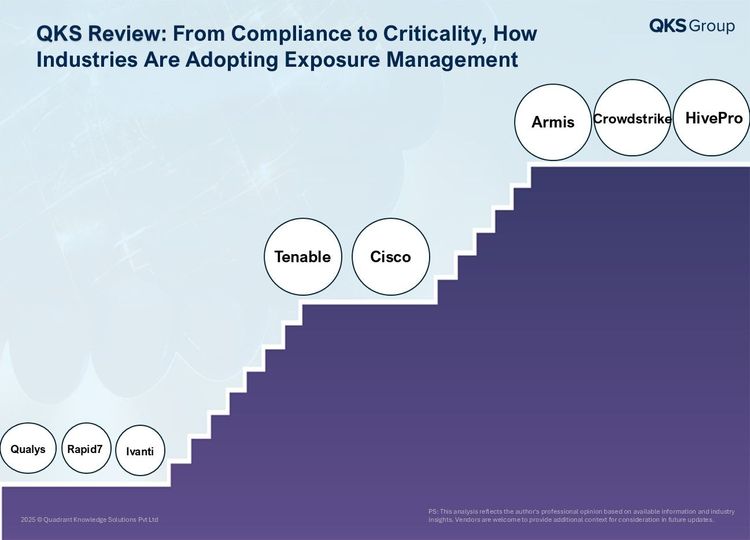
Key Findings: Leading vendors Armis, CrowdStrike, Hive Pro stand out with verticalized capabilities and outcome-centric architectures tailored for healthcare, manufacturing, finance, and retail. Capable vendors Cisco/Kenna show strength in reporting and visibility but fall short on orchestration and live remediation. Lagging vendors Ivanti, Qualys, Rapid7, Tenable remain anchored to legacy scanning, lacking depth in industry-specific intelligence and actionability.
Cyberattacks don’t discriminate but industries must. As the exposure landscape grows more complex, one reality is becoming clear: traditional vulnerability management is obsolete. Static CVE scoring and scheduled scans simply can’t keep up with dynamic threats or sector-specific risk.
This is where Exposure Management steps in not as a rebrand, but as a strategic evolution. It's no longer about detecting vulnerabilities; it's about understanding what matters, how threats propagate in your specific infrastructure, and what actions must be prioritized. But here’s the catch: no two industries adopt it the same way and not all vendors are equipped to support the shift.
Here’s how five critical sectors are adapting, and which vendors are actually delivering on the promise.
Healthcare & Life Sciences: Beyond the Endpoint
Medical environments are a perfect storm of risk: outdated systems, unscannable medical devices, fragmented IT/OT networks, and strict compliance mandates (HIPAA, HITECH, FDA).
Why Armis Leads? Armis sidesteps the limitations of traditional tools by offering agentless visibility into medical devices MRI machines, infusion pumps, ventilators that can’t tolerate downtime. More importantly, Armis prioritizes exposures based on operational impact, not just CVSS scores. This is real-world contextual security, not theoretical risk management.
HCA Healthcare and NHS Trusts are integrating Armis into SIEM and CMDB systems to trigger real-time, context-driven remediation workflows.
Why Ivanti Lags? Ivanti’s strength in patching endpoints doesn’t extend into clinical OT or biomedical networks. It can’t correlate device behavior with active threats, leaving hospitals with blind spots.
Bottom Line: In healthcare, unmanaged doesn’t mean unimportant. Armis gets that. Ivanti doesn’t.
Financial Services: Where Exposure Meets Auditability
Banks and insurers operate under constant pressure from attackers and auditors alike. The challenge? Aligning cyber risk with compliance frameworks like FFIEC, PCI DSS, and NYDFS.
Why Hive Pro Wins? Hive Pro’s SLA-based remediation model is built for financial institutions. Its Predictive Vulnerability Intelligence (PVI) connects threats, assets, business impact, and regulatory compliance into a single, defensible workflow.
A Tier 1 bank in the Middle East reduced remediation times by 37% using Hive Pro’s attacker-centric intelligence and ITSM integrations.
Why Rapid7 Stalls? InsightVM provides visibility but lacks deep compliance alignment. Risk prioritization is disconnected from audit requirements, leaving CISOs translating dashboards into policy manually.
Bottom Line: Hive Pro turns exposure data into compliance-ready insights. Rapid7 turns it into homework.
Manufacturing: Securing What You Can’t Touch
In OT-heavy sectors like manufacturing, downtime equals dollars lost and in many cases, safety risk. Air-gapped systems, legacy SCADA, and minimal patch windows complicate traditional security practices.
Why Armis and CrowdStrike Stand Out? Armis maps OT networks without agents, offering passive, non-disruptive monitoring a must for industrial control systems. CrowdStrike, meanwhile, brings real-time attacker correlation via its Threat Graph, identifying potential APT activity before it hits critical systems.
Siemens Energy and multiple electronics manufacturers are using these tools to defend field-deployed assets and predict attack paths in real time.
Why Tenable Struggles to Scale? Tenable.ot adds basic OT scanning to its legacy VM stack but lacks adversary-aware prioritization and real-time validation unless paired with third-party tools.
Bottom Line: In OT, visibility without safety is a liability. Armis and CrowdStrike respect the difference. Tenable doesn’t always.
Retail & Consumer Tech: Fast, Distributed, and Exposed
Retailers face a unique challenge: securing thousands of endpoints across seasonal, transient infrastructures all while responding to malware campaigns targeting POS systems and mobile devices.
Why CrowdStrike Shines? Falcon’s lightweight agent delivers consistent visibility across 3,000+ stores for one Fortune 500 retailer. Its threat-informed patching helps prioritize the vulnerabilities tied to real-world exploit kits.
One enterprise reduced detection-to-response times by 48% over 12 months by aligning Falcon with its audit and threat response systems.
Why Qualys Misses the Mark? Heavy on scanning, light on orchestration. Qualys lacks the agile integration and real-time prioritization needed to operate across dynamic, distributed retail networks.
Bottom Line: CrowdStrike scales with your stores. Qualys scales with your scan jobs.
Public Sector: Mandates Without Modernization
Government agencies face the paradox of needing cutting-edge defenses while operating in legacy environments. Executive orders (EO 14028), CISA’s directives (BOD 22-01), and Zero Trust mandates demand Exposure Management, but procurement cycles and FedRAMP constraints stall adoption.
Why Cisco(Kenna Security) Sits in the Middle? Kenna provides strong dashboards and exposure scoring good for reporting, not great for action. Without built-in orchestration or adversary emulation, agencies end up patching reactively.
Why Ivanti and Qualys Fall Flat? Neither vendor addresses hybrid infrastructure coverage or live exposure validation both critical for Zero Trust and mission continuity.
Bottom Line: The public sector needs decision engines, not scorecards. Kenna gets halfway there. Ivanti and Qualys don’t leave the gate.
Final Take: Exposure Management Is a Vertical Game
The path to Exposure Management isn’t uniform. It’s shaped by industry-specific realities:
What the Leaders Are Doing Differently?
The top performers Armis, CrowdStrike, Hive Pro share three traits:
Real-time asset and exposure modeling, not static scans
Contextual prioritization based on attacker behavior, not CVSS
Actionable integrations with ITSM, SIEM, and compliance workflows
They aren’t just vendors. They’re enablers of risk-centric security strategy.
The rest? Still offering vulnerability management by another name.
If your platform can’t tell you what’s exploitable, who should fix it, and whether it’s fixed it's not Exposure Management.
Disclaimer:
This blog is based on independent research and publicly available information. The insights presented reflect the views of QKS Group and are for informational purposes only. While we strive for accuracy, we do not guarantee completeness or absolute correctness. Vendors are welcome to provide clarifications or updates. If any vendor listed in this analysis wishes to provide additional context or clarification, we welcome a briefing call and will consider incorporating relevant updates. This analysis is not intended to disparage any vendor but to provide an informed, balanced perspective. We encourage open and constructive dialogue to foster transparency and a deeper understanding of the industry.
Author:Sujit Dubal, Analyst - Network Security at QKS Group