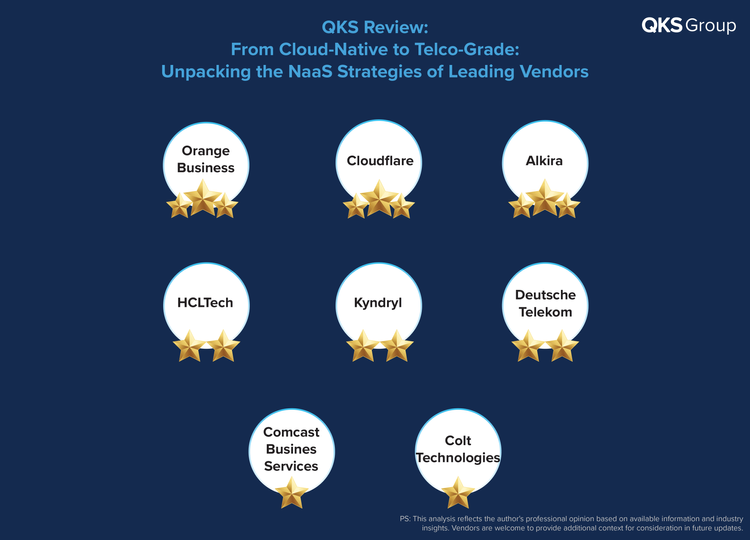
Enterprises being cloud-first in their approach leaves usual network paradigms inadequate, unable to serve distributed workloads, hybrid user environments, and applications with high-performance demands. Thus, the need for Network-as-a-Service has risen to keep up with an on-demand, truly modern networking environment that is flexible and scalable. While the NaaS model is still evolving, vendors currently differentiate between themselves based on degree of cloud integration, automation, security posture, and geographic breadth of their offerings. This blog covers a comparison of major providers with classifications of Leaders, Strong Performers, and Laggards based on technical maturity, ability to execute, and innovation orientation.
Leaders: Orange Business, Cloudflare, and Alkira
Orange Business delivers one of the most globally extensive IP/MPLS networks to back the NaaS proposition. Combined into one platform are managed SD-WAN, secure hybrid networking, and edge/cloud integrations. Orange stands out from others because it is working network intelligence, automation, security and policy-driven orchestration within its backbone. With the integration of Kubernetes-native platforms, analytics, and service abstraction layers, the provider is working on accelerating its move toward cloud-native control. The strength of the provider lies in the fulfillment of complex multinational clients' hybrid regulatory, latency, and segmentation needs.
Cloudflare and Alkira are leading-edge players from a cloud-native view. Cloudflare is the best fit for developer-centric and SaaS-heavy enterprises, thanks to its programmable edge, Zero Trust architecture, and fully software-defined policy enforcement. Alkira, on the other hand, abstracts network and security infrastructure as code via its Cloud Exchange Points (CXPs) and provides full-stack visibility, segmentation, and elastic scale. Both vendors focus on being infrastructure-agnostic and highly DevOps-aligned. These characteristics are a key differentiator within high-change environments.
Strong Performers: HCLTech, Kyndryl, and Deutsche Telekom
HCLTech continues to grow and nurture its NaaS programs under the Net-Centric Services section. Network orchestration and telemetry, along with service assurance, are embedded in digital transformation initiatives. The firm places significant emphasis on global deployments of SD-WAN and Zero Trust, although this distinction sits much closer to the classical IT service delivery practice than with native networking innovation. HCLTech works well for enterprises whose transformation programs are attempting to weave NaaS with a blurred line between IT and OT.
Kyndryl, which stemmed from IBM's managed infrastructure, has been revamping some network services through modular, consumption-style offerings. Its value proposition treats networking as a composite element within a larger digital transformation fabric, with a particular emphasis in brownfield type enterprise environments. Kyndryl is a technically sound option for integrating legacy networks with modern SDN overlays, but it is still transitioning in other respects, in particular automating edge, zero trust, and policy-based orchestration at scale.
Deutsche Telekom has a strong foundation in MPLS and mobile infrastructure, and is building NaaS capabilities through T-Systems, which integrates SD-WAN, multi-cloud connectivity, and managed security. While technically solid and supported by significant European backbone capacity, Deutsche Telekom's approach is still evolving in programmability and cloud-native orchestration. However, the company is making focused efforts to standardize network APIs, integrate security services, and support containerized network functions.
Laggards: Comcast Business Services, and Colt Technologies
Comcast Business Services, while dominant in U.S.-based enterprise broadband and Ethernet access, is still early in articulating a comprehensive NaaS vision. Its SD-WAN and security offerings are primarily delivered through OEM partnerships with limited customization or policy orchestration capabilities. The platform is largely focused on SMB and mid-market segments and lacks the granular control, API exposure, and cloud integration that large enterprises require in a modern NaaS platform.
Colt Technologies has a strong fiber-based network across Europe and Asia, and provides flexible SDN-enabled services like Colt IQ. However, its NaaS approach remains primarily connectivity-centric, with limited differentiation in orchestration layers or developer integrations. While Colt offers solid service levels and automation at the transport layer, it lacks the deeper integration into cloud-native ecosystems or programmable infrastructure needed to compete at the top tier.
Summary Insights
The Network-as-a-Service market is stratifying along lines of infrastructure agility, programmability, and platform intelligence. Vendors like Cloudflare, Alkira, and Orange Business are pushing the boundaries with automation, software-defined architectures, and deep cloud integration, making them the natural choice for global, cloud-native enterprise models. HCLTech, Kyndryl, and Deutsche Telekom offer stable, modular approaches to embedding NaaS into broader IT modernization efforts. Meanwhile, Comcast and Colt Technologies remain relevant in connectivity but must evolve toward programmable, intelligent networking constructs to compete with more agile players.
As NaaS evolves from bandwidth delivery to intelligent service abstraction, enterprises must look beyond connectivity to evaluate orchestration depth, policy automation, and integration flexibility. Ultimately, the leaders will be those who can deliver not just network-as-a-service, but network-as-code, as-policy, and as-intelligence.
Disclaimer:
This blog is based on independent research and publicly available information. The insights presented reflect the views of QKS Group and are for informational purposes only. While we strive for accuracy, we do not guarantee completeness or absolute correctness. Vendors are welcome to provide clarifications or updates. If any vendor listed in this analysis wishes to provide additional context or clarification, we welcome a briefing call and will consider incorporating relevant updates. This analysis is not intended to disparage any vendor but to provide an informed, balanced perspective. We encourage open and constructive dialogue to foster transparency and a deeper understanding of the industry.
Author: Kaushik V, Analyst at QKS Group