Introduction: Locking in Trust during the Build Phase
In recent years, software supply chain attacks have become a prevailing threat vector within the threat landscape. From SolarWinds to Log4j, adversaries have proven the advanced capability to exploit the implied trust businesses have in their software components whether open-source dependencies, container images, or build artifacts. This transition in attack strategy portends a greater shift: the battlefield has shifted from network borders to development pipelines. Here, the integrity, authenticity, and traceability of all software artifacts are mission-critical. The only viable way forward is to embrace mechanisms that make formerly opaque software supply chains transparent, verifiable chains. Artifact attestation is at the centre of this shift.
Artifact attestation is not only a security capability it is a paradigm change. It allows organizations to shift from blind faith in their development process to one in which each component is supported by cryptographic evidence of its origin and integrity. This authentication forms the basis of contemporary Software Supply Chain Security Management (SSCSM), allowing organizations to create, distribute, and deploy software with certainty. This post investigates the function of artifact attestation in the assurance of the software supply chain, its strategic and technical significance, the effects of not having it, and the architectural features that businesses must require of their vendors.
Artifact Attestation: A Foundational Control for Modern Software Assurance
Artifact attestation consists of producing verifiable metadata describing how a software artifact was constructed, by whom, with what dependencies, and under what circumstances. The metadata is cryptographically signed to guarantee integrity and authenticity, including information such as source commit hashes, build steps, dependency graphs, runtime settings, and the CI/CD pipeline utilized. Signed attestations are retained along with the artifact, allowing them to be read from and audited over the entire software lifecycle.
What distinguishes artifact attestation is its capability as machine-verifiable proof. Attestations can be verified automatically during runtime, deployment, or policy enforcement, unlike manual documentation. Backed by standards including SLSA, in-toto, and Sigstore's Cosign/Rekor, attestations allow organizations to implement policies that prevent unverified artifacts or un-attested artifacts for vulnerability scans, SBOMs, or license compliance which adds automation, transparency and trust to the software supply chain.
From Control to Compliance: Scaling SSCSM With Verifiable Build Artifacts
In the larger scope of Software Supply Chain Security Management, artifact attestation is essential because it makes verifiable trust operational. Software artifacts go through dozens of hands and systems from developer check-ins, automated builds, dependency pulls, and vulnerability scans to final deployment. Lacking a formal, tamper-evident process to log and authenticate each step, companies have no defendable confidence that what was constructed is actually what is being delivered. It is not a hypothetical issue; actual events have demonstrated how attackers take advantage of this same lack of insight to insert backdoors, swap out dependencies, or poison containers in-transit.
Artifact attestation solves this issue by providing each step of the pipeline as traceable and accountable. It delivers the data integrity layer that supports all the other security controls throughout the software lifecycle. With attestations, organizations can specify fine-grained policies for instance, that all artifacts must be built on hardened runners, must pass vulnerability scans, or can only use approved base images. Without attestation, these policies are dependent on good faith or small slices of log data, which are vulnerable and inadequate in high-stakes contexts like financial services, healthcare, or government infrastructure. Attestation is then the glue that makes enforcement of Zero Trust principles possible in CI/CD pipelines.
The Cost of Opaque Pipelines: Security and Business Risks Without Attestation
The availability or unavailability of artifact attestation has a heavy bearing on organizational software risk management, incident response, and regulatory compliance. In effective implementation, attestation can facilitate policy-driven deployments that ensure artifacts are signed by trusted pipelines, scanned for vulnerabilities, and documented with SBOMs. This accuracy speeds up incident response since security teams can map problems straight to particular builds, commits, and maintainers, allowing for targeted fixes versus wholesale rollbacks.
Without attestation, organizations are based on assumption, not assurance. They don't have any way of consistently knowing if a container image was created from trusted code or changed after being built. Forensics are speculative, relying on logs that could be missing or fake. This visibility gap is particularly dangerous in multi-team or outsourced situations, heightening exposure to dependency confusion, typosquatting, and insider threats.
For customers, the lack of attestation undermines confidence in both internal and external software. It mandates a reactive stance, with security controls arriving too late. On the other hand, robust attestation frameworks mandate proactive defence allowing secure, efficient development while security teams can enforce scalable, automated trust policies.
Assessing Attestation Readiness: Capabilities That Set Secure Supply Chain Platforms Apart
Since it is a core enabler of supply chain security, artifact attestation needs to be one of the top assessment criteria when selecting SSCSM providers. Not all implementations are equal, though. The maturity, scope, and operational readiness of attestation features differ dramatically between platforms. Companies need to go beyond lip service and assess the architectural rigor of attestation solutions.
First, the platform should accommodate open standards like SLSA and in-toto. Proprietary formats have the tendency to bind organizations to certain tools or workflows, which eliminates interoperability a very important requirement in today's hybrid and multi-cloud environments. Attestation functionality should be extensible so that organizations can tailor what metadata is gathered and what policies are applied at every lifecycle phase.
Second, the attestation system must have secure key management for verification and signing. This involves support for cloud key management services (KMS), hardware security modules (HSMs), and identity provider integration for signing identities. A weak key infrastructure undermines the guarantees of integrity that attestations intend to offer.
Third, integration with current CI/CD tools is important. The platform must be able to produce attestations natively or through plugins for common systems such as Jenkins, GitHub Actions, GitLab CI. Attestation must not be an afterthought or security measure that is optional it must be baked into the build and release process by default.
Finally, there needs to be lifecycle support spanning years for attestations, i.e., storage, retrieval, expiration, and revocation. Organizations need to audit artifacts years after deployment, which means that there needs to be secure and durable attestation storage that is compatible with artifact registries.
Competition Evaluation:
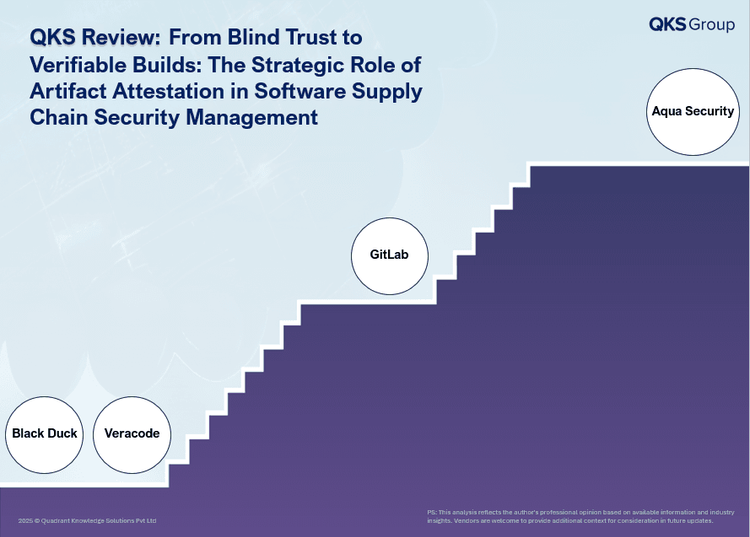
We have taken Aqua Security, GitLab, Veracode, and Black Duck as they are key vendors in SSCS and trusted by a large number of users. They represent a wide range of approaches:
- Aqua Security and GitLab lead with build-time attestation capabilities.
- Veracode and Black Duck are well-established in vulnerability and compliance scanning but largely silent in artifact verification.
Together, these four provide a panoramic view of how security vendors are either embracing or bypassing artifact attestation, setting the stage for contrasting philosophies.
Attestation-First Platforms
Aqua Security – Build-Trust Engine
Aqua Security delivers an enterprise-grade, fully integrated artifact attestation system that meets all core criteria at a mature level. It captures rich metadata during the CI process and secures it through digitally signed SBOMs and cryptographic artifact signatures. Using eBPF-based runtime tracing, Aqua monitors the CI/CD environment in real time to ensure only approved tools and actions are used. Its cryptographic signing is anchored in a controlled key management system, ensuring high integrity and traceability. Aqua’s proactive enforcement blocks deployments upon policy violations or deviations from trusted pipelines. With comprehensive metadata capture, it establishes a tamper-proof chain of custody from source to image aligning well with frameworks like SLSA and NIST SSDF.
Aqua’s tightly integrated attestation framework is designed for security-first organizations that demand verifiable trust throughout the software development lifecycle. By embedding strong cryptographic guarantees and real-time build monitoring into CI/CD workflows, Aqua enables users to prevent build tampering and reduce downstream risk before software even reaches production. Its proprietary and deterministic approach to key management gives it a trust advantage over keyless systems, minimizing the risk of impersonation or shadow signing. This makes Aqua especially valuable in regulated industries or high-compliance environments where proof of integrity, reproducibility, and build provenance is not optional but critical for auditability, vendor assurance, and breach containment.
GitLab – Community-Aligned Build Verification
GitLab leverages Sigstore to offer keyless artifact signing within its native CI/CD platform. Developers can sign build outputs using Cosign, with provenance stored in Rekor transparency logs. This setup allows GitLab to offer support for artifact attestation and public verification without the need for key distribution or storage, reducing friction in DevSecOps adoption. Its attestation is integrated into CI pipelines, allowing users to embed verification gates pre-deployment. GitLab also captures contextual build metadata and ties signatures to developer identities using ephemeral keys.
GitLab’s adoption of open-source, standards-aligned tooling in addition to automated SBOM generation, dependency and container scanning, and compliance policy enforcement makes it a strong option for developer-centric teams that prioritize automation, speed, and ecosystem compatibility. It lowers the barrier for artifact attestation through its keyless approach and positions itself as a bridge between traditional DevOps and modern supply chain security practices. However, the reliance on ephemeral keys and public logs introduces risk if not paired with strict identity management and policy controls. For users in less regulated environments, GitLab’s flexibility and simplicity are compelling, but for high-assurance use cases, its lack of deterministic trust guarantees and enforcement granularity is a limitation.
Scan-Centric Platforms
Veracode – Code & Dependency Guard
Veracode offers a robust platform that integrates SAST, DAST, and SCA, excelling in policy enforcement and early detection of vulnerabilities across both proprietary and open-source code. Its Package Firewall helps block unsafe dependencies before they reach the codebase. However, it lacks native support for artifact attestation such as cryptographic signing or tracking build provenance which limits visibility into who built an artifact, when, and under what conditions.
From a CI/CD perspective, Veracode integrates well with pipelines, enabling builds to be gated based on scan results. Yet, its focus remains on vulnerability detection rather than capturing detailed build-time metadata like timestamps, commit IDs, or toolchain context. Features such as digital signature enforcement and provenance verification are not core to its offering. As a result, while Veracode strengthens application security, organizations aiming for full supply chain traceability may need complementary solutions to align with DevSecOps and modern SSCSM practices
Black Duck – Open-Source Risk Specialist
Black Duck is known for its strong focus on open-source license compliance, vulnerability detection, and policy enforcement at the component level. It offers comprehensive SCA capabilities, scanning both source and binary code to uncover open-source risks in software artifacts. Its integrations with CI tools and container registries help enforce SBOM compliance across the SDLC. However, Black Duck lacks direct support for artifact attestation. There’s no facility to cryptographically bind build metadata to the final software artifacts, nor to sign or verify them as part of the pipeline.
While Black Duck offers strong visibility into the components within an artifact, particularly in terms of open-source license compliance and vulnerability detection, it provides limited insight into how the artifact was built. Its metadata collection focuses primarily on component-level details rather than the full build context. Additionally, features such as digital signing and runtime verification of artifact provenance are not natively integrated into the platform. As a result, while Black Duck assumes the artifact being scanned is trustworthy, it does not currently provide mechanisms for cryptographic validation or CI/CD policy enforcement to detect potential tampering. This positions its capabilities more around scanning and compliance, rather than the full spectrum of software supply chain integrity.
Software Trust is Earned, Not Assumed: Why Attestation Must Be the Default
As software ecosystems grow more distributed, interdependent, and fast-paced, the traditional assumptions of trust and control are no longer sufficient to defend against supply chain threats. The future of secure software delivery lies not in retrospective scanning or manual reviews, but in the ability to enforce verifiable trust through automation and cryptography. Artifact attestation is the mechanism that makes this vision real. It transforms artifacts from opaque binaries into transparent, trustworthy components whose origin, integrity, and compliance posture can be proven, not assumed.
The organizations that embrace artifact attestation today are not only securing their pipelines they are future-proofing their development practices against a wave of regulatory changes and threat evolutions. Meanwhile, those that continue to operate without attestations leave themselves exposed to preventable breaches, regulatory penalties, and reputational damage. As such, the question is no longer whether to adopt artifact attestation, but how quickly and comprehensively it can be integrated into existing SSCSM frameworks.
In a landscape where software is assembled more than written, and where trust is exploited more often than breached, artifact attestation is the trust anchor that modern software supply chains can no longer afford to ignore.
Disclaimer:
This blog is based on independent research and publicly available information. The insights presented reflect the views of QKS Group and are for informational purposes only. While we strive for accuracy, we do not guarantee completeness or absolute correctness. Vendors are welcome to provide clarifications or updates. If any vendor listed in this analysis wishes to provide additional context or clarification, we welcome a briefing call and will consider incorporating relevant updates. This analysis is not intended to disparage any vendor but to provide an informed, balanced perspective. We encourage open and constructive dialogue to foster transparency and a deeper understanding of the industry.
Author: Shiva Bhardwaj, Analyst at QKS Group