

02.07.2025
QKS Review
QKS Review: From Automation to Orchestration: Evaluating Network Tools for Intelligent IT Operations
Author:
Aditya S


Executive Summary:
Executive Summary:
As enterprise IT grows more decentralized and dynamic, the ability to orchestrate infrastructure, applications, and networks in real-time has become a strategic imperative. Network Automation Tools (NATs) are no longer confined to automating basic network tasks-they have evolved into orchestration engines that enable unified, policy-driven control across hybrid, multi-cloud, and edge environments.
This shift is being driven by enterprise demand for platforms that not only automate device configurations, but also integrate with IT workflows, enforce business intent, and adapt dynamically to real-time telemetry. Today’s leading NAT providers are embedding orchestration capabilities that bridge silos between NetOps, SecOps, and DevOps-delivering a cohesive foundation for intelligent IT automation. This research explores how key vendors are advancing NAT platforms to support holistic, end-to-end IT orchestration and why these capabilities are now critical for operational resilience, security, and agility.
So, who are the leaders shaping this transformation, who are the aspirants catching up, and what lies ahead for the future of intelligent network operations? Let’s take a closer look.
The Strategic Imperative for Orchestrated Network Automation
Today’s enterprise IT operations span across multiple domains: data centers, public clouds, edge networks, and remote endpoints. Traditional network management approaches fall short in this environment, where real-time responsiveness and policy alignment are critical. NATs now serve as the connective tissue enabling:
- End-to-End Policy Orchestration: Enforcing consistent policies across cloud and on-prem infrastructure.
- Event-Driven Automation: Dynamically triggering workflows in response to performance, compliance, or security anomalies.
- Intent-Based Configuration: Translating high-level business intents into low-level network actions.
- Closed-Loop Remediation: Detecting, diagnosing, and resolving issues autonomously using AI/ML.
- Infrastructure-as-Code: Aligning network provisioning with DevOps practices and CI/CD pipelines.
By harnessing these capabilities, network automation tools empower businesses to build agile, resilient, and secure networks. They reduce operational overhead, enhance user experiences, and drive innovation in an increasingly connected world. Embrace Network Automation Tools to unlock the full potential of your network infrastructure in the digital era.
The Network automation Tool Landscape
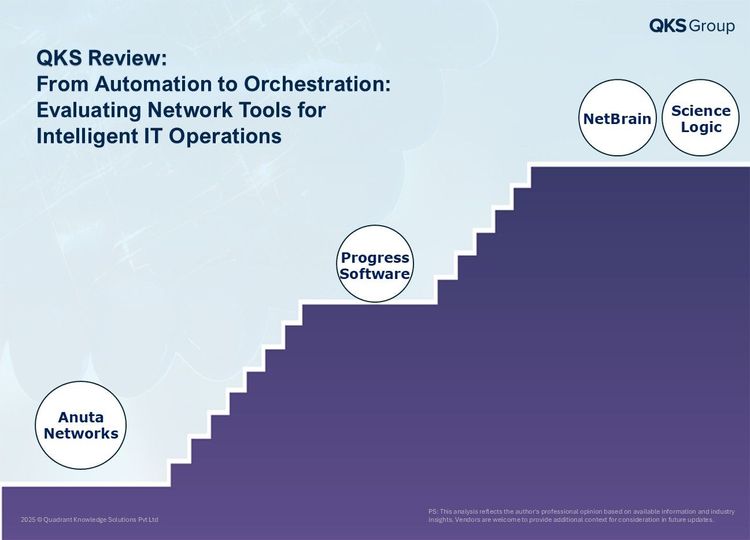
Market Leaders: Leaders in Network-Oriented IT Orchestration
ScienceLogic: Build in an AIOps-Driven, Compliance-First Automation Fabric
ScienceLogic has emerged as a frontrunner by embedding orchestration capabilities into its SL1 platform. Through integration with Restorepoint, it enables deep Network Configuration and Change Management (NCCM) combined with AIOps. SL1 allows enterprises to establish proactive change policies, enforce security compliance, and automate recovery from network failures-all from a unified control plane.
Its vendor-agnostic design and API-rich architecture allow orchestration beyond network devices into application and infrastructure tiers. With real-time topology correlation, predictive alerts, and automated incident workflows, ScienceLogic bridges the gap between IT operations and business risk management.
NetBrain:Operationalizing Network Intent for Multi-Domain Automation:
NetBrain’s platform translates network expertise into scalable, repeatable automation logic. Its low-code/no-code interface empowers engineers and operations teams to encode domain knowledge as intent-based policies that drive dynamic orchestration across heterogeneous environments.
With dynamic network maps, contextual diagnostics, and a distributed automation engine, NetBrain supports proactive remediation and compliance. Its “Intents Library” enables automation based on business outcomes rather than device configurations-ideal for highly regulated, complex infrastructures.
Strong Performers:
Progress Software:Bridging Monitoring and Automation with Incremental Orchestration
Progress Software, through Flowmon and WhatsUp Gold, is evolving from a monitoring provider to an orchestration-capable automation vendor. Flowmon’s ML-powered analytics, network telemetry and packet-level visibility offer granular data to trigger automated workflows. WhatsUp Gold enhances this with SNMP management and smart topology discovery.
While not yet a full orchestration platform, Progress delivers solid API integration and visualization capabilities-ideal for enterprises in early stages of automation adoption. Its observability stack lays a strong foundation for gradual automation maturity.
The Road Ahead: Anuta Networks: Architecting Cross-Domain, Scalable Orchestration at the Edge.
Anuta’s ATOM platform is built with microservices and Kubernetes-native design, enabling scalable orchestration across network, IT, and security domains. Its BPMN 2.0-compliant workflow engine and AI/ML-powered assurance tools allow users to create adaptive, event-driven automation flows.
ATOM supports closed-loop automation through continuous telemetry and feedback loops, integrates with ITSM platforms for ticketing, and applies intent-based configuration across heterogeneous networks. With its SaaS and on-premises deployment options, Anuta is ideal for enterprises requiring federated orchestration across distributed environments.
The Final Take
Network Automation Tools have evolved beyond basic configuration management. They now serve as orchestration enablers that align infrastructure behavior with real-time business priorities. Vendors like ScienceLogic and NetBrain offer mature, extensible orchestration frameworks, while Progress and Anuta provide unique paths to automation maturity through observability and multi-domain orchestration.
In an era of digital transformation, IT organizations must look beyond tools that automate the past. The future lies in orchestration-ready platforms capable of abstracting complexity, enforcing compliance, and dynamically optimizing performance. Early adopters of these intelligent Network Automation Tools platforms will drive the next wave of IT efficiency, security, and innovation.
Anuta Networks stands out as a forward-looking vendor with its microservices-based ATOM platform designed for scalable, cross-domain automation. Its flexible deployment models and strong orchestration capabilities make it a strategic player to watch as organizations move toward cloud-native and intent-based architectures.
As network demands increase and manual processes continue to falter, early adopters of intelligent network automation will be better positioned to drive agility, ensure compliance, reduce downtime, and achieve end-to-end visibility across their infrastructure-gaining a decisive edge in the digital era.
Disclaimer:
This blog is based on independent research and publicly available information. The insights presented reflect the views of QKS Group and are for informational purposes only. While we strive for accuracy, we do not guarantee completeness or absolute correctness. Vendors are welcome to provide clarifications or updates. If any vendor listed in this analysis wishes to provide additional context or clarification, we welcome a briefing call and will consider incorporating relevant updates. This analysis is not intended to disparage any vendor but to provide an informed, balanced perspective. We encourage open and constructive dialogue to foster transparency and a deeper understanding of the industry.
Author: Aditya S, Analyst - IT/Network Operations Management at QKS Group
Vendors: