In past I argued that traditional exposure management anchored in scanning, scoring, and static patching can’t keep up with the automated pace of modern adversaries. What followed was a wave of validation: conversations with teams wrestling with alert fatigue, struggling to patch what matters, and unsure how to translate technical findings into business risk.
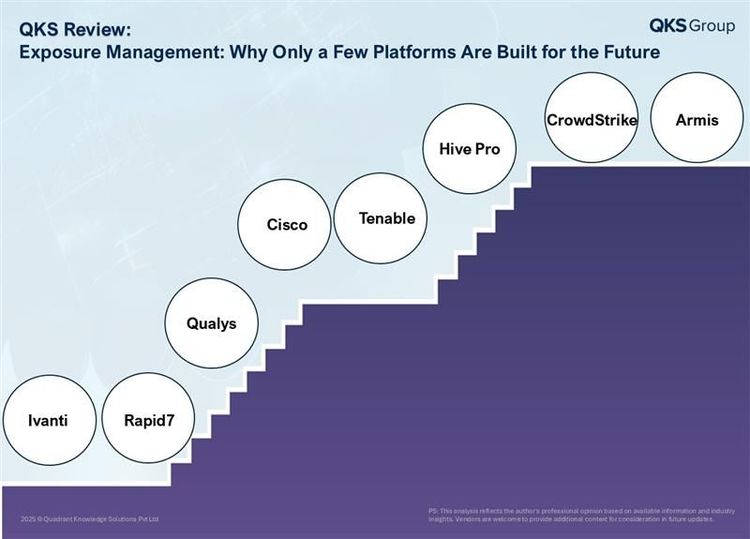
Today, the conversation shifts. Not about what’s broken, but who is building for what’s next. The exposure management market has matured beyond checklists and dashboards. It’s now split into three visible categories leaders, emerging players, and challengers based on one defining axis: intelligence embedded into action.
1. Leaders: Intelligence-First, Outcome-Centric Platforms
Armis
Armis is redefining the boundaries of exposure visibility. It’s one of the few platforms purpose-built for unmanaged and critical infrastructure environments OT, IoT, medical devices, industrial controls where traditional agent-based scanning doesn’t apply. What makes Armis stand out is its behavioural intelligence layer. It doesn’t just discover assets; it understands how each device interacts within its environment, detects anomalies, and maps exposure to operational impact.
Armis acts more like a digital nervous system than a scanner. It connects business operations to cyber exposure in real time something legacy tools can’t replicate.
For organizations struggling with asset unknowns across distributed physical infrastructure, Armis has become the reference standard.
CrowdStrike
CrowdStrike’s Falcon Exposure Management capability is built on top of its real-time telemetry engine one of the most mature threat intelligence networks in the market. It combines endpoint, cloud, and identity signals with dynamic adversary profiles to elevate exposure data beyond CVSS or patch status.
CrowdStrike’s advantage lies in correlation speed. Through its Threat Graph, it can detect how a vulnerability is being actively exploited today, not just theoretically. And with Falcon Fusion workflows, exposure data moves straight into automated remediation pipelines.
The platform doesn’t ask “what’s vulnerable?” It answers, “what’s being targeted right now and how do we stop it?”
This is exposure management fully aligned with threat detection and response a convergence most platforms still haven’t achieved.
Hive Pro
Hive Pro has taken a refreshingly disciplined approach to exposure management: start with precision, then scale. The platform’s strength lies in prioritization accuracy not just flagging vulnerabilities, but measuring exploitability, business importance, and remediation timelines. Its predictive analytics engine provides early warning on emerging threats, while SLA-based workflows turn findings into structured, measurable action.
Hive Pro integrates attack path analysis, contextual prioritization, and ticketing across IT and security teams. It serves as a bridge between vulnerability insights and organizational accountability.
Think of Hive Pro as the air traffic control of exposure management monitoring not just the sky, but the trajectory of each risk, ensuring the right response, at the right time.
It’s a platform that builds resilience through orchestration, not just reporting.
2. Emerging Players: In Transition, Gaining Ground
Tenable
Tenable is perhaps the most transformed of the legacy VM vendors. Its pivot from Nessus-based scanning to Tenable One marks a shift toward a more intelligence-focused platform. Tenable One combines traditional vulnerability data with attack path modelling, asset criticality, and exposure prediction.
Where it still has work to do is in closing the remediation loop turning its insights into automated actions across hybrid environments. But its telemetry depth and growing investment in risk analytics suggest it’s well positioned to evolve into a full-spectrum exposure platform.
Tenable is no longer just a scanner. It’s becoming a contextual risk engine one that understands how attackers move, not just what they see.
Organizations already using Tenable will find its new capabilities additive; those evaluating platforms should watch for how rapidly it operationalizes automation.
Cisco
Cisco has all the pieces: visibility through AppDynamics and ThousandEyes, prioritization via Kenna Security, and cloud-native telemetry from Panoptica and Talos threat intelligence. But its challenge remains integration. Exposure management is still presented as a suite of parts rather than a cohesive platform.
Where Cisco shows strength is in network-centric exposure reduction especially for environments prioritizing lateral movement detection and policy enforcement. As it matures its SecureX and XDR narratives, it could become a unifier in hybrid infrastructure security.
Cisco’s exposure story is promising, but not yet fully written. Its future depends on execution how fast it converges tools into unified decision flows.
Organizations with deep Cisco investments may benefit from incremental exposure capabilities, but standalone buyers will want to wait for architectural simplification.
3. Challengers: Reliable, But Reactive
Qualys
Qualys has arguably the most comprehensive asset inventory and vulnerability scanning infrastructure in the industry. Its TruRisk engine attempts to bring more context to prioritization, combining vulnerability data with asset metadata, patch state, and external threat feeds.
But the platform still feels anchored to its scanning roots. Real-time exploit correlation, attack simulation, and dynamic remediation flows are limited. There’s also a reliance on scheduled scans rather than continuous exposure modeling.
Qualys is strong on “what’s wrong,” but less so on “what matters now.” For organizations prioritizing visibility over actionability, it remains a capable though static choice.
Rapid7
Rapid7 has a powerful stack InsightVM, InsightAppSec, InsightConnect but struggles with platform cohesion. While individual modules are effective, especially in SOAR and SIEM, their exposure management capabilities lack the intelligence fabric needed to turn data into decisions in near real-time.
That said, Rapid7 has made progress in visualizing risk posture across hybrid environments and integrating workflows across IT teams. What holds it back is the lack of real attacker-behaviour modelling in its prioritization and response logic.
It’s a platform that connects tools well but still requires manual effort to connect the right decisions.
Ivanti
Ivanti has leaned into its roots endpoint patching and vulnerability mitigation. It automates patch workflows efficiently and supports compliance requirements. But its scope is narrow. There’s minimal attacker context, limited cloud or OT telemetry, and little in the way of predictive or behavioural analytics.
In today’s distributed and hybrid threat landscape, Ivanti’s exposure view is largely device-centric valuable, but insufficient for enterprise-wide risk reduction.
If the focus is patch compliance, Ivanti delivers. If the goal is end-to-end exposure visibility and response, it falls short.
Closing Perspective: Strategy Must Match the Threat Landscape
The exposure management landscape isn’t just changing it’s dividing.
- Some platforms are built for speed and context, with attacker insights, business alignment, and automation at the core.
- Others remain feature-rich but fragmented, delivering tools without orchestration.
- And a few are stuck in a patch-and-scan mindset, increasingly disconnected from the realities of modern attack surfaces.
The question isn’t who has the most dashboards. It’s who helps you act faster, with greater precision, and measurable impact.
Because in today’s environment, where attack surfaces grow and dwell time shrinks, visibility isn’t power. Intelligence is.
Disclaimer:
This blog is based on independent research and publicly available information. The insights presented reflect the views of QKS Group and are for informational purposes only. While we strive for accuracy, we do not guarantee completeness or absolute correctness. Vendors are welcome to provide clarifications or updates. If any vendor listed in this analysis wishes to provide additional context or clarification, we welcome a briefing call and will consider incorporating relevant updates. This analysis is not intended to disparage any vendor but to provide an informed, balanced perspective. We encourage open and constructive dialogue to foster transparency and a deeper understanding of the industry.
Author: Sujit Dubal, Analyst - Network Security at QKS Group