As the Data Analytics and Artificial Intelligence market faces rising pressure from evolving service demands such as verticalized analytics consulting, enterprise BI transformation, analytics CoE enablement, cloud-native migration services, and KPI-driven governance frameworks, organizations are moving beyond traditional reporting, dashboard migration, and ad hoc analytics support services.
This review blog by QKS Group assesses whether Data Management and Analytics Services (DMAS) vendors are truly innovating to meet these demands or merely making incremental updates.
What Modern DMAS Should Deliver:
Today’s platforms must offer more than core features. Critical next-gen capabilities include: • Analytics Strategy and Maturity Advisory
• End-to-End BI Transformation Programs
• Data Stewardship and Governance Integration
Key Findings:
Modern Data Management and Analytics Services (DMAS) providers are expected to go beyond delivering dashboards and managing data pipelines. Organizations are seeking partners who can guide them through a complete analytics lifecycle—from maturity assessment and roadmap design to governance setup and long-term enablement. Successful vendors embed analytics into business workflows, prioritize CoE-led models, and align with strategic KPIs across domains. The ability to bridge technical implementation with advisory services and organizational change management is becoming a key differentiator. Meanwhile, many traditional providers remain fragmented, offering isolated capabilities without translating them into connected, outcome-driven transformations. Enterprises increasingly demand unified delivery models, modular transformation frameworks, and real-world success evidence before investing in large-scale BI adoption programs.
Vendor Classification:
• Leading Vendors: Tech Mahindra, Accenture
• Capable Vendors: Deloitte, TCS
• Lagging Vendors: Wipro
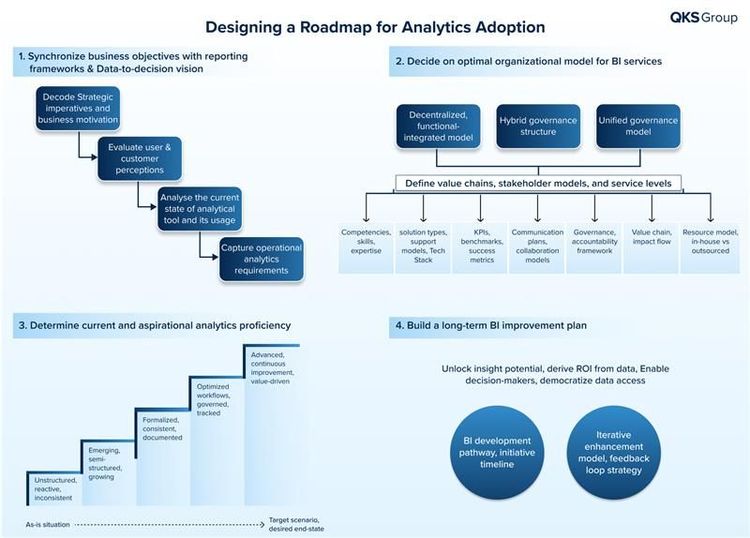
Enterprises looking to become truly insights-leg organizations often follow a four-stage analytics adoption roadmap. Before choosing an optimal BI service organizational model, assessing the current vs aspirational analytics maturity, aligning current analytics strategy to business objectives and finally executing a long-term BI improvement plan is very important. That is why, ensuring the selection of the right consulting and IT services partner who fits the business vision is necessary to scale across the enterprise.
Below is the visual roadmap, designed by QKS Group, which lays a clear framework that businesses can follow to enhance their analytics maturity. Each stage aims at guiding organizations to achieve analytics excellence with strategic insights and operational effectiveness.
Stage 1 focuses on aligning the data and reporting structures to highlight the importance of understanding strategic intent, assessing user perception, evaluating current tool usage, and identifying operational analytics needs. This alignment shows the necessity of having a BI partner wo can not only conduct a thorough diagnostic but also ensure stakeholders engagement.
Stage 2 is the examination of BI service delivery of the different organizational models to asses if they are decentralized, hybrid, or unified, while encouraging companies to clarify their value chains, KPIs, technology stacks, and governance structures. Here, the selected BI service vendor should be able to offer strategic advice and demonstrate effective change management skills.
Stage 3 transfers all the attentions to the comparison of the organizations current and desired analytics capabilities, tracking the journey from ad-hoc and inconsistent analytics practices to value driven and continuously improving systems.
The final and 4th stage is about the development of long-term BI improvement roadmap that includes iterative feedback loops and initiatives aimed at maximizing the ROI, broadening the data access, and enhancing the strategic value.
We have analyzed and evaluated strength and weaknesses of 5 prominent global service vendors – Accenture, Deloitte, TCS, Tech Mahindra, and Wipro – based on their ability to guide enterprises through their end-to-end analytics transformation. Thorough research through the credible evidence of real-world deployment, repeatable methodologies, customer impact, and delivery scale across major industries, a comparative narrative has been derived, from leaders to laggards.
Tech Mahindra – A leader rising in Analytics Transformation
Tech Mahindra has positioned itself as a leader in this market which is dominated by incumbents for over a decade by helping enterprises structure and scale their analytics services, especially the BI adoption initiatives. Tech Mahindra has maintained a consistent, framework driven approach to navigate the analytics lifecycle has helped it acquire big customers in telecom, automotive, and manufacturing industries and maintain them thought its growing credibility in executing measurable BI transformation. Tech Mahindra’s ability to approach analytics as a structured transformation program rather than an isolated technology play sets it apart from its fellow competitors. For Tech Mahindra, client on-boarding begins from assessing current analytics maturity and use-case discovery to define a clear roadmap for clients and align technology and plan termed execution. Unlike others, TechM underlines foundational decisions such as governance structures, data stewardship, and operating models in the early stage and does not rush into tool deployment.
One of the recent telecom projects of TechM in North America states that, TechM helped them draw a BI strategy that reduced operational inefficiencies by over 18% through improved decision visibility shows their emphasis on advisory around setting up analytics Centres of Excellence (CoEs), federated data ownership models, and KPIs linked to specific business workflows. With its in-depth domain alignment and engineering, Tech Mahindra compensates the consulting scale remains in comparison to the Big Four. Its proven strengths in telemetry, sensor data, and IoT-led analytics, makes it a reliable partner for industries with operational data complexities. One of their clients explicitly mentioned, the company’s approach focusing on long-term reusability and data integrity by avoiding oversimplified dashboarding shows its lean toward sustainability. In a landscape where overstated promises are common, Tech Mahindra is quietly leading with precision and executing across the four key stages of analytics adoption.
Accenture – Structured Precision with High-Scale delivery
Accenture’s force in the analytics and BI services has been dominant over years and only few vendors can match the company’s ability to plan and scale the data-led transformation. Accenture’s upper hand lies in its expansive delivery network and disciplined approach to linking analytics strategy with business goal has made it a go-to choice for many clients. Its routine partnerships with executive teams help them to decode strategic imperatives and translate them into analytics priorities. The company brings structured frameworks for use case mapping, data monetization strategy, and analytics governance design with dedicated consulting units across industries. However, Accenture still relies on template-driven execution which can be efficient sometimes but can be rigid in certain contexts, for example, clients in manufacturing or supply chain-heavy industries may require greater adaptability to operational edge cases or legacy integration challenges. In cases such as clients without a clear articulated data strategy, Accenture falls behind because of its high emphasis on scaling and low emphasis on agility.
Accenture analyses many models to benchmark analytics proficiency by integrating diagnostic tools with industry benchmarking data. These models and frameworks are generic used for generalized strategic consulting and are not often domain specific BI maturity models. This might mislead the clients looking for granular guidance on tool usage, data stewardship gaps, or role-based analytics capability with high-level tighter engagement loops lowering the local improvements. Accenture ecosystem of its partnership across cloud, data platforms, and AI solution providers not only removes the client lock-in to vendor-specific tool but also offer a modular architecture that supports interoperability. However, his can result in heavier dependency on alliance workflows occasionally limiting Accenture’s ability to deliver highly differentiated IP in BI reporting and visualization.
Accenture still remains as a benchmark and go-to vendor for structured execution, strategic alignment, and scalable delivery. It has been named as a proven and trusted advisor in analytics-led transformation ability to blend contextual flexibility with structure.
Deloitte - Strategically Sound, But Operationally Misaligned
Deloitte, a BIG4, brings in formidable reputation to the analytics services market with well-established business advisory and strategic consulting while playing a significant role in shaping enterprise data strategies. While, this, there is little debate over the firm’s ability to initiate high-level conversations with senior business leaders and guide them through the conceptualization of data-driven transformation. A common issue with Deloitte is that, while it can create a clear strategy, it may not always follow through with the detailed execution. This problem is seen in many industries and is supported by both secondary reports and customer feedback. Clients often start excited when they work with Deloitte because the firm is good at showing how analytics can improve business outcomes, align stakeholders, and establish clear performance measures.
For Deloitte, the initial enthusiasm may fail as the project moved from planning to implementation stage. The major reason for this is Deloitte’s delivery process which relies on high-level consulting strategies which may not be useful for smaller vendors who want to deeply delve into the practical aspects like deploying platforms, setting up dashboards, or enabling users. Such companies usually do a trial and error method of using varied tools and approaches and relying on only high level consulting may get complicated and can cause inconsistencies in how projects are handled.
In practice, Deloitte often provides a solid foundation for an analytics vision, but clients usually need to complete the work using their own resources or through third-party help.
For companies that need both strategic guidance and full implementation support, Deloitte's approach can feel disconnected, especially when dealing with the ongoing challenges of running a long-term BI program. Deloitte is a trusted advisor, but may not always be the best at turning plans into real results.
TCS – Though Structured, not Sufficiently Adaptive
Tata Consultancy Services is often the go-to choice for large-scale BI transformations because of its disciplined approach, well-established global delivery models, and frameworks like DATOM for assessing analytics maturity.
However, as the expectations for BI evolve to include more business-driven agility and real-time changes, TCS's heavy reliance on structured methods can sometimes limit its effectiveness. While TCS is good at delivering big projects on time and within established frameworks, its approach often prioritizes technology over the business impact or adoption by end-users. DATOM, although comprehensive, is often applied in a uniform way, leading to recommendations that are more theoretical than practical. In fast-changing industries like retail, logistics, and healthcare, this rigidity can be a drawback.
Additionally, TCS's consulting team, while growing, doesn't often offer the same level of strategic insight or alignment with executive leadership as some of its competitors. Clients recognize the precision of TCS's engineering teams, but they also feel that more thought leadership and flexibility are needed, especially when adapting pre-built tools to fit specific needs. Over in all, TCS though offers a reliable delivery, its not always deep in transformation for the companies with unclear vision and have no strong implementation partner. However, the companies who have strong BI strategy or looking to drive change through insights, TCS's method-focused model may be a good fit.
Wipro – Capable Components, But a Fragmented Whole
Wipro has been a master of developing wide range of analytics and BI services ranging from data governance to AI-driven insights. However, the challenge for Wipro is not the lack of capabilities but the cohesive way to approach the issues and apply them in actual client projects. The firm lacks in integrating these capabilities in a modular way to derive a unified value proposition despite of having the right tools and partnerships. One such Wipro's struggles is connecting its technical expertise with broader business strategies.
Many of its BI projects, especially in North America, are seen as more transactional than transformative focused on building dashboards, migrating data, or consolidating reports rather than on how analytics can change decision-making or organizational behavior. Although Wipro has made significant moves like acquiring Capco and investing in AI tools, these efforts are still developing, and their impact on core BI programs is still uneven.
Also, Wipro's internal structure often leads to silos between its advisory, engineering, and change management teams. This can cause problems in projects where a clear strategy needs to be aligned with implementation and stakeholder engagement. Some clients have pointed out missed chances for deeper insight or change management due to this separation. While Wipro has strong technical skills and a broad range of services, its delivery model is missing the consistency, strategic depth, and client-focused iteration that many enterprises now expect from BI transformation partners. For organizations looking for a technically capable but strategically integrated partner to guide them through the entire journey of analytics adoption, Wipro still has work to do to bring its various capabilities together into a more connected and mature offering.
Conclusion
As enterprise analytics moves from being a siloed technical function to a key part of making big business decisions, what BI service providers are expected to do has changed. It's no longer enough for companies to just offer maturity checks, tool connections, or visual dashboards. Today, businesses want a partner who can bring together business understanding, alignment with different stakeholders, technical know-how, and long-term management into a unified transformation plan. This isn't just about creating reports it's about making data-driven actions happen consistently and widely across the organization.
Each of these vendors still plays an important role in the analytics services field, and all have shown they can deliver results when the right conditions are met. However, for businesses looking for a full-service partner one that can adapt to their specific needs, deliver quickly and accurately, and help build long-term BI capability, many providers might still need to improve. The future of BI adoption requires not only strong capabilities, but also a clear vision, consistent execution, and the ability to turn insights into real business impact.
Disclaimer:
This blog is based on independent research and publicly available information. The insights presented reflect the views of QKS Group and are for informational purposes only. While we strive for accuracy, we do not guarantee completeness or absolute correctness. Vendors are welcome to provide clarifications or updates. If any vendor listed in this analysis wishes to provide additional context or clarification, we welcome a briefing call and will consider incorporating relevant updates. This analysis is not intended to disparage any vendor but to provide an informed, balanced perspective. We encourage open and constructive dialogue to foster transparency and a deeper understanding of the industry.