

11.08.2025
QKS Review
QKS Review: ERP’s Multi-Entity Consolidation – Why User Experience Shapes Adoption
Author:
Sujan Thomas Mathew


Executive Summary:
As the enterprise finance market faces rising pressure from global expansion, regulatory complexity, and real-time reporting expectations, organizations are moving beyond traditional general ledger and financial close tools.
This review blog by QKS Group assesses whether leading ERP vendors are truly innovating to meet these demands, or merely making incremental updates.
What Modern Financial Consolidation Should Deliver:
Today’s platforms must offer more than core features. Critical next-gen capabilities include:
- Real-time, embedded multi-entity consolidation across subsidiaries
- Self-service financial reporting with native audit trails
- AI-enabled close automation and intercompany reconciliation
Key Findings
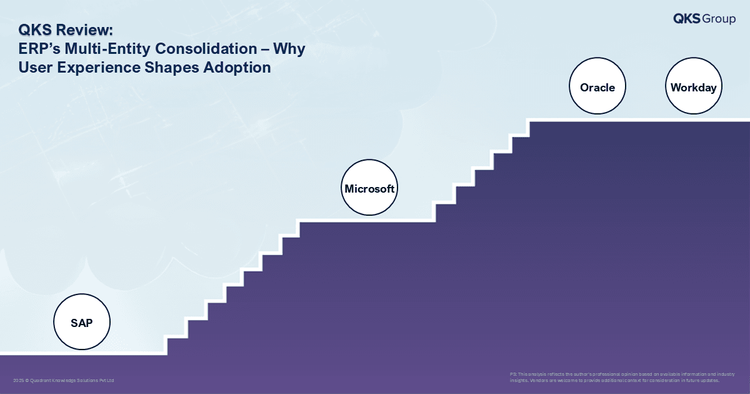
- Leading vendors (Workday, Oracle) stand out with comprehensive, enterprise-grade solutions that streamline consolidation and empower finance teams with intuitive, automation-first experiences.
- Capable vendors (Microsoft Dynamics 365) show promise in configurability and integration strength but require higher IT involvement for effective adoption.
- Lagging vendors (SAP S/4HANA Cloud) remain dependent on fragmented reporting architectures and legacy user experiences, risking adoption barriers in fast-scaling, multi-entity environments.
Platform-Level Reviews
Workday: Built-In Consolidation with Finance at the Core
Workday’s unified data model and embedded consolidation workflows make it a top choice for CFOs managing multi-entity environments. With no need for data movement across modules, users can perform eliminations, adjustments, and intercompany reconciliations natively—often in real-time. The platform’s in-memory architecture and spreadsheet-like planning interface enable finance users to take ownership of the close, reducing dependence on IT or external tools. Workday’s biggest advantage lies in its “business-owned” reporting and ease of audit, enabling faster closes and confident decisions across subsidiaries.
Oracle: Unified Ledger with AI-Augmented Close
Oracle Fusion Cloud ERP handles multi-entity consolidation through its unified ledger and accounting hub—delivering a single source of truth for intercompany balances and adjustments. Its embedded AI capabilities assist in anomaly detection, journal recommendations, and close automation. While implementation requires upfront design clarity, the platform shines in scalability, audit trails, and close orchestration across global subsidiaries. Oracle’s financials also integrate directly with EPM for planning and reconciliation, reducing latency and manual effort.
Microsoft Dynamics 365: Modular Strength, Configuration Heavy
Dynamics 365 offers a capable consolidation engine through its Finance module, with flexibility to manage intercompany setups, eliminations, and currency conversions. However, its configuration demands higher IT involvement during setup, especially for complex entity hierarchies. Users praise the role-based access and Power BI integrations, but non-finance users often require additional training. Overall, Dynamics 365 performs reliably, but the experience is less intuitive than that of Workday or Oracle unless heavily customized.
SAP S/4HANA Cloud: Functional Power, User Experience Lag
SAP’s consolidation power comes from Central Finance and Group Reporting—but the experience is often fragmented, with reliance on external reporting engines like SAC (SAP Analytics Cloud). Users report that navigation between operational data and consolidated reports is unintuitive. Real-time capabilities exist but require specialized configuration, limiting self-service adoption. Finance teams often rely on IT support or external consultants to manage reporting hierarchies, adjustments, and period-end close workflows.
Analyst Perspective and Close
Consolidation in recent times goes beyond just a compliance checklist; it is an experience that impacts close velocity, cross-entity agility, and CFO confidence. Workday has engineered that experience natively for finance teams, while Oracle brings strong architectural unity with AI-led augmentation. Microsoft, though flexible, leans on configuration. SAP despite functional depth, struggle with cohesive execution and intuitive workflows.
Disclaimer:
This blog is based on independent research and publicly available information. The insights presented reflect the views of QKS Group and are for informational purposes only. While we strive for accuracy, we do not guarantee completeness or absolute correctness. Vendors are welcome to provide clarifications or updates. If any vendor listed in this analysis wishes to provide additional context or clarification, we welcome a briefing call and will consider incorporating relevant updates. This analysis is not intended to disparage any vendor but to provide an informed, balanced perspective. We encourage open and constructive dialogue to foster transparency and a deeper understanding of the industry.
Author: Sujan Thomas Mathew, Practice Director, QKS Group
Vendors: