As digital transformation accelerates across every sector, the software engineering function has evolved from a backend utility into a direct driver of competitive differentiation. Yet, despite this elevation of engineering to a board-level concern, most enterprises continue to grapple with a persistent operational and cognitive disconnect between what engineering teams execute and what business stakeholders expect. In most organisations, engineering metrics are siloed, operationally focused, and lack the contextual framing necessary to support high-velocity, data-informed business decision-making. At the same time, product leaders, CIOs, and strategy heads often lack the granularity to trace how their business initiatives translate into developer workloads, technical debt accumulation, or throughput constraints.
Software Engineering Intelligence (SEI) Platforms have emerged as a structural solution to this challenge, not as simple dashboards, but as architectural systems designed to integrate telemetry from across the software delivery lifecycle, correlate it with business priorities, and surface insights that allow engineering execution to be continuously optimized in alignment with strategic objectives. In doing so, these platforms do not just deliver visibility, they enable governance, feedback control, and cross-functional trust, all of which are essential to modern Application Lifecycle Management (ALM).
From Tool Chaos to Strategic Signal: Why Engineering Needs a Unified Intelligence Architecture
In traditional ALM environments, visibility was confined to what planning tools (like Jira) or version control systems (like Git) could offer. These tools captured status, not behaviour; they measured velocity, not value. The modern engineering ecosystem, however, is characterized by polyglot pipelines, tool fragmentation, cross-functional dependency chains, and increasingly hybrid execution models involving cloud-native services, open-source components, and third-party APIs. This has rendered static metrics and manual oversight mechanisms obsolete.
SEI Platforms represent a shift from manual introspection to machine-assisted correlation. By ingesting real-time signals from distributed version control systems (e.g., GitHub, GitLab), issue tracking tools (e.g., Jira, Azure DevOps), CI/CD pipelines (e.g., Jenkins, CircleCI), testing frameworks (e.g., SonarQube, Selenium), incident and observability systems (e.g., PagerDuty, Datadog), and production environments, SEI Platforms construct a living digital twin of the engineering organization. This digital twin is continuously enriched with contextual metadata, time-series behaviour patterns, and interlinkages to business epics, OKRs, and customer journeys, allowing for dynamic mapping between engineering execution and business outcomes.
The ability to capture and model such end-to-end context in real time is foundational to ensuring software teams do not merely operate efficiently but operate strategically.
Translating Code to Commerce: The Semantic Intelligence Layer Powering Strategy Execution
The most critical differentiator of SEI Platforms lies in their ability to serve as a semantic translation layer, reconciling the granularity of engineering data with the abstraction level of business goals. Traditional business intelligence platforms have failed to bridge this divide because they are detached from software development ontologies and lack integration with developer tools. SEI Platforms, on the other hand, are natively embedded into the engineering toolchain and fluent in its semantics.
At their core, Software Engineering Intelligence (SEI) Platforms perform two interdependent functions: engineering observability and business traceability. Engineering observability refers to the platform’s ability to analyze patterns such as pull request duration, code churn, review depth, test coverage, deployment latency, and defect injection rate, surfaced not as isolated metrics but as interlinked indicators of engineering health, delivery risk, and team scalability. Business traceability, on the other hand, maps these indicators to higher-level constructs such as business capabilities, roadmap themes, customer deliverables, and strategic KPIs like cost of delay or feature lead time.
For example, a product executive can observe not just how many Jira stories were closed, but how these stories advance a specific market-critical feature, what proportion of engineering capacity is being consumed by non-functional work (e.g., refactoring or technical debt remediation), and whether the current team structure can meet the release SLA without compromising on quality. This moves the narrative from a superficial “how busy is the team” to a far more strategic “are we delivering business value at the right cadence and cost.”
From Metrics to Foresight: Empowering Executive Decision-Making Through Engineering Intelligence
At an executive level, SEI Platforms are no longer perceived as engineering-side reporting tools. They are increasingly being adopted as decision support systems that power scenario modelling, investment prioritization, and cross-functional alignment. CIOs can now use SEI Platforms to conduct return-on-investment (ROI) analyses for large-scale modernization efforts, quantifying how platform engineering initiatives affect deployment frequency, defect resolution time, or developer throughput over time. CTOs can monitor architectural drift and forecast capability gaps based on telemetry patterns that suggest team overload, tool inefficiency, or unbalanced investment across capabilities.
Product leaders benefit from these platforms by gaining real-time insights into value stream velocity, enabling them to reprioritize epics based on delivery risk, capacity constraints, or customer impact thresholds. Engineering managers are empowered to take corrective actions, ranging from team reallocation and workload balancing to review process refinement, backed by empirical data rather than anecdotal escalation.
More importantly, SEI Platforms facilitate the creation of a shared truth layer across business and engineering. This eliminates second-guessing, reduces micromanagement, and institutionalizes trust-based governance. In a digital economy where engineering is the execution engine of strategy, such a capability is not a luxury; it is a foundational requirement.
Defining Maturity: Architectural and Functional Hallmarks of a Business-Aligned SEI Platform
The maturity and utility of an SEI Platform should not be judged by the quantity of metrics it generates but by its ability to contextualize, correlate, and operationalize insights in a business-relevant manner. Leading platforms today demonstrate the following architectural and functional characteristics:
A truly mature platform demonstrates full-stack telemetry integration, allowing ingestion of structured and unstructured data from source code repositories, project management tools, CI/CD pipelines, QA tools, and production monitoring platforms. More critically, this telemetry is normalized, enriched, and transformed into causal models that identify systemic issues, not just anomalies.
Business alignment is achieved through a contextual tagging engine, where user stories, commits, incidents, and test cases are associated with strategic themes, OKRs, or capability tracks. This creates a bidirectional traceability model, allowing business leaders to trace KPIs back to their engineering roots and vice versa.
Advanced platforms also incorporate predictive analytics, leveraging machine learning to surface latent risk indicators such as delivery delays, team burnout probability, or structural code complexity trends that impact strategic outcomes.
And finally, role-based intelligence delivery ensures that insights are not delivered as raw dashboards but as curated decision assets tailored to product leaders, engineering heads, transformation officers, and executive leadership.
Market Reality Check: Evaluating Leading SEI Vendors on Strategic Alignment and Execution Depth
Jellyfish: Visibility Without Fully Contextualized Business Traceability
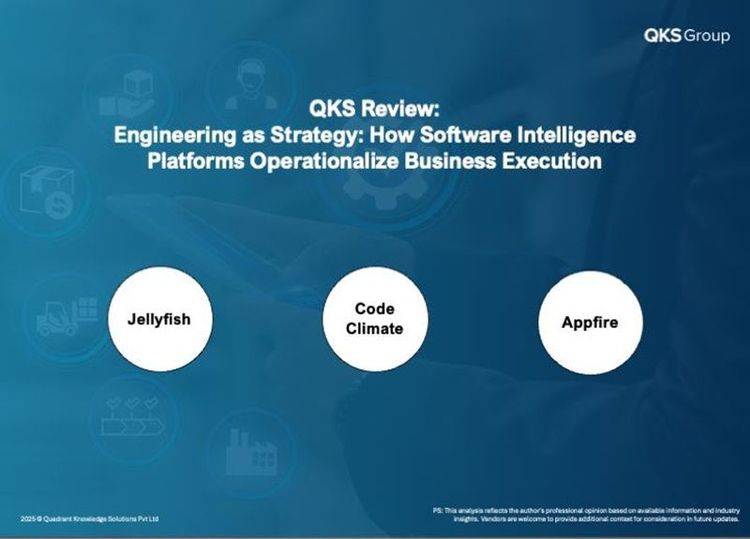
While Jellyfish is often positioned as a frontrunner in the Software Engineering Intelligence landscape due to its robust telemetry ingestion and team-level allocation visualizations, it exhibits fundamental architectural constraints in bridging engineering execution with enterprise-level strategic imperatives. Its data modelling framework, though effective in surfacing operational insights such as engineering throughput, team capacity, and allocation across roadmap themes, lacks a deeply causal linkage between these engineering signals and downstream business value realization. The platform’s mapping between epics, capabilities, and engineering effort remains largely descriptive and retrospective, offering limited predictive modelling or simulation to help product leaders assess trade-offs between competing priorities or investment themes. Moreover, Jellyfish’s instrumentation for cost-of-delay analysis, customer outcome acceleration, or ROI justification remains underdeveloped, making it difficult for CIOs or business stakeholders to quantify engineering performance in financial or customer-centric terms. This positions Jellyfish as a powerful engineering visibility tool, but not yet a comprehensive business-aligned decision platform.
Code Climate : Developer Productivity Insights in Isolation
Code Climate’s Velocity platform is primarily engineered around the philosophy of developer efficiency optimization, with its core strengths anchored in measuring team hygiene, pull request cycle times, review participation rates, and engineering responsiveness. However, the platform fundamentally lacks a semantic overlay that can map these granular engineering activities to higher-order business constructs such as customer journey acceleration, OKR attainment, or business initiative throughput. Its data architecture is inherently tactical, built to surface workflow friction or behavioural inefficiencies at the developer level, but it does not abstract these signals into strategic business narratives. Consequently, while engineering managers may benefit from improved observability into code review patterns or time-to-merge delays, product leaders and executive stakeholders are often left without the contextual frameworks necessary to understand how these signals impact product-market fit, innovation cadence, or competitive differentiation. This disconnect renders the platform effective for local team optimizations but insufficient for cross-functional strategy alignment or enterprise-level governance.
Appfire (Pluralsight Flow): Legacy Engineering Telemetry in a Strategic Vacuum
Appfire’s Flow, formerly GitPrime, remains anchored in its foundational architecture of Git-level analytics and code-centric observability. The platform continues to deliver high-fidelity insights into pull request velocity, code churn, review participation, and other developer productivity indicators. However, it falls short in elevating these signals into a business-aligned decision-making framework. There exists no native capability within Flow to translate engineering effort into customer value realization, strategic initiative acceleration, or cost-of-delay analysis, resulting in a unidirectional flow of information that remains confined within the engineering function. Post-acquisition, while integration with Appfire’s broader DevOps and Atlassian-adjacent ecosystem has improved interoperability, there has been minimal innovation in evolving Flow into a semantic intelligence platform that supports product, strategy, or executive personas. Its inability to correlate technical telemetry with business KPIs renders it increasingly inadequate for organizations seeking a unified, outcome-driven view of their software delivery ecosystem.
Closing Observations
While each of these vendors has contributed meaningfully to the evolution of software engineering observability, they remain at varying degrees of maturity when evaluated against the core requirement of strategic alignment. The inability to model causal relationships between engineering activity and business value realization, the lack of embedded predictive and scenario simulation capabilities, and the absence of pre-built semantic layers for executive interpretation continue to limit their utility as full-fledged platforms for outcome-driven Application Lifecycle Management. Enterprises seeking to institutionalize engineering intelligence as a pillar of strategic governance must carefully evaluate not only the data ingestion capabilities of these platforms but also their capacity to deliver contextual, forward-looking insights that directly inform cross-functional decision-making.
Conclusion: From Engineering Execution to Strategic Command, SEI Platforms as the Control Plane for Modern Software Enterprises
As the velocity and complexity of software delivery continue to scale, the enterprise imperative is no longer limited to achieving developer productivity; it is about embedding engineering into the strategic nervous system of the organization. Software Engineering Intelligence Platforms represent the evolution of this imperative into an operational reality. These platforms are not peripheral reporting layers; they are becoming the analytical and decision-making backbone that connects granular engineering telemetry to enterprise-wide objectives, from customer impact realization to digital revenue enablement.
The emerging class of SEI Platforms defines a new control plane for the software-powered enterprise, one that does not merely monitor pipelines but orchestrates strategic alignment, codifies governance, and institutionalizes data-driven prioritization. The platforms that succeed will be those that deliver semantically rich, role-specific intelligence capable of informing trade-offs, reducing value leakage, and enabling scenario planning at both execution and portfolio levels.
In this context, engineering is no longer a cost centre; it is a strategic asset whose performance, risk posture, and value contribution must be continuously modelled, measured, and managed. Organizations that fail to adopt SEI Platforms will increasingly find themselves operating in a vacuum of insight, reactive, fragmented, and unable to reconcile their delivery outputs with business mandates.
For decision-makers, the takeaway is clear: investing in SEI is not about better dashboards. It is about redefining how strategy is operationalized through engineering, and how engineering, in turn, informs strategic foresight. In the age of software-defined value creation, SEI Platforms are not just enablers; they are indispensable instruments of organizational intelligence and control.
Disclaimer:
This blog is based on independent research and publicly available information. The insights presented reflect the views of QKS Group and are for informational purposes only. While we strive for accuracy, we do not guarantee completeness or absolute correctness. Vendors are welcome to provide clarifications or updates. If any vendor listed in this analysis wishes to provide additional context or clarification, we welcome a briefing call and will consider incorporating relevant updates. This analysis is not intended to disparage any vendor but to provide an informed, balanced perspective. We encourage open and constructive dialogue to foster transparency and a deeper understanding of the industry.
Author: Nikhilesh Naik, Associate Director at QKS Group