Introduction
The practice of investigating cybersecurity incidents has evolved dramatically over the past decade. Traditional forensic approaches relied heavily on manually collected evidence, such as log files, disk images, and memory captures, which analysts examined long after an event had occurred. This method was resource-intensive, slow, and often incomplete. In today’s environment, where adversaries move quickly and make use of advanced tactics to conceal their activities, waiting until after the fact is no longer sufficient. Modern Security Information and Event Management (SIEM) platforms are attempting to bridge this gap by embedding forensic and threat hunting capabilities directly into their architecture. The result is an investigative ecosystem that blends real-time visibility with the structured discipline of digital forensics.
The shift toward integrated forensics within SIEM platforms reflects several operational pressures. Organizations face sprawling attack surfaces that include cloud services, software-as-a-service applications, hybrid data centers, and in some cases operational technology environments. Analysts no longer investigate isolated servers or endpoints but must piece together a continuous chain of activity across distributed infrastructures. This requires SIEM platforms to provide automated evidence capture, contextual enrichment, and correlation across multiple telemetry streams. Equally important, SOC teams require tools that can generate clear timelines, highlight suspicious deviations, and allow analysts to pivot between artifacts without relying on separate point solutions.
The imperative for forensic depth is closely linked to the practice of threat hunting. While forensics traditionally begins after an incident is confirmed, threat hunting operates proactively, searching for indicators of stealthy compromise that may not have triggered alerts. Both functions benefit from high-fidelity data, contextual enrichment, and analyst-friendly investigative workflows. Increasingly, SIEM vendors are positioning their platforms as dual-use tools: equally suited for automated alert detection and for structured forensic investigations. The following sections examine how several vendors are approaching this convergence, highlighting both their strengths and the challenges that remain.
Exabeam
Exabeam has made forensic reconstruction a central part of its SIEM offering. Its Smart Timelines feature attempts to automate what analysts have historically done manually: creating a chronological sequence of events that map a user’s or host’s behavior over time. By correlating activity across users, endpoints, and applications, Smart Timelines aim to reduce the investigative burden and make it easier to understand attack chains. Exabeam operates on its New-Scale SIEM architecture hosted on Google Cloud, which is designed to ingest large volumes of telemetry from an extensive set of integrations and connectors spanning SaaS platforms, on-premises infrastructure, and cloud environments. Forensics is not treated as an isolated module but as a natural outcome of this correlation.
The vendor also integrates multi-agent AI capabilities to assist in risk scoring, triage, and investigation support. However, the platform presents challenges when tailoring data pipelines and custom detections to unique environments. Cost is another consideration, as sustained forensic investigations require significant data storage and retention, which can escalate rapidly at enterprise scale.
Gurucul
Gurucul approaches the issue from a different angle by embedding advanced machine learning and identity analytics into its forensic workflows. Its platform incorporates more than 3,000 machine learning models that align with the MITRE ATT&CK framework, enabling analysts to contextualize events within known adversary tactics. Gurucul does not limit its view to system logs, it extends timelines to include HR data, entitlement records, and access patterns. This approach is particularly useful for insider threat detection, where contextual information about user behavior is as important as technical indicators.
Forensic timelines in Gurucul’s Security Information and Event Management (SIEM) are enriched with identity-centric details, which can illuminate misuse of credentials or subtle privilege escalations. Automation playbooks are available to handle both insider and external threats, allowing forensic investigation to be paired with semi-automated response. Yet challenges remain. The platform requires a significant degree of configuration and tuning to achieve optimal performance. Organizations often report extended onboarding times when integrating niche or proprietary data sources. Additionally, the interface, while powerful for technically skilled analysts, may present difficulties for less technical SOC personnel. Gurucul’s strategy highlights how forensic and hunting workflows increasingly depend on merging technical events with human-centric data.
Imperum
Imperum emphasizes language-driven interaction as a way to reduce the complexity of forensic investigations. The vendor has built a domain-specific large language model that enables analysts to express investigative queries in natural language. The system translates these prompts into structured workflows, effectively acting as an intermediary between human analysts and the underlying data sources. Imperum maintains a library of more than six hundred artifact collectors that span different operating systems, network devices, and operational technology endpoints.
By combining this artifact collection with AI-driven workflow orchestration, Imperum seeks to reduce the time analysts spend switching between tools and scripting ad hoc queries. The platform’s case management system further integrates automation, allowing investigations to proceed with reduced manual overhead. However, Imperum faces the typical challenges of an emerging vendor. Its presence in the market is still relatively young, and organizations adopting the platform often require professional onboarding and customization to align with existing telemetry. Proprietary or legacy data sources may demand additional tuning. Even so, Imperum illustrates how natural language interfaces and AI orchestration are becoming credible features in the forensic dimension of SIEM platforms, though it is worth noting that AI-driven outputs should always be validated during forensic investigations to ensure accuracy and admissibility.
Stellar Cyber
Stellar Cyber positions its platform under the banner of Open XDR, which is designed to unify data from endpoints, networks, and cloud services into a single investigative plane. Forensic workflows in Stellar Cyber rely heavily on graph-based representations. Tools such as the Incident Graph and Alert Analyzer allow analysts to visualize relationships between alerts, entities, and observed behaviors. This graphical approach can accelerate understanding by showing how disparate events connect, rather than forcing analysts to piece them together manually.
The platform is well-suited to mid-sized security teams that value fast deployment and accessible visualization. Nonetheless, Stellar Cyber’s workflow customization and ticketing integration are less mature compared to some larger competitors. Organizations with highly complex investigative processes may find these limitations constraining. Still, the emphasis on visual representation underscores the value of intuitive investigative tools in reducing analyst fatigue and enabling quicker recognition of attack patterns.
Logz.io
Logz.io originates from the open-source ecosystem, building its cloud-native Security Information and Event Management (SIEM) on the foundation of OpenSearch. Its strength lies in large-scale search and correlation capabilities, making it an attractive choice for organizations with significant cloud presence. Forensics within Logz.io is oriented around workflow automation and case tracking, supported by dashboard-driven investigations. Analysts can pivot across telemetry using advanced queries and dashboards, which suits teams with strong search proficiency.
However, the platform’s forensic depth remains limited when compared to vendors that integrate endpoint-level collection or memory analysis through dedicated EDR or DFIR tools. For advanced orchestration, Logz.io often relies on third-party SOAR tools, creating potential dependencies. The focus on cloud scalability and open-source flexibility makes it appealing for organizations that prioritize transparency and customization but also places greater responsibility on SOC teams to shape forensic workflows according to their own needs.
ManageEngine
ManageEngine positions its Log360 as a unified security analytics and threat detection platform, combining comprehensive log ingestion with compliance reporting to address both regulatory and operational requirements. With support for more than 750 log sources, Log360 can process a wide variety of data formats across on-premises, cloud, and hybrid environments. Beyond compliance, the platform incorporates real-time correlation, user and entity behavior analytics, and threat intelligence enrichment to strengthen its threat detection and investigative capabilities. These features allow Log360 to profile normal user behavior, flag anomalies, integrate external threat feeds, and trigger automated workflows that respond to suspicious activity as it is detected.
Forensic investigation is supported through timeline reconstruction, enriched incident data, and exportable reports that assist in both audit and investigative workflows. While the modular architecture provides deployment flexibility, it can also introduce complexity, as different components may need to be deployed and managed separately. ManageEngine continues to expand its integrations across cloud environments, including Microsoft’s ecosystem, reinforcing its applicability in hybrid IT settings. Overall, Log360 balances breadth of log coverage with advanced detection and response features, positioning it as a solution that serves both compliance-driven organizations and security teams focused on hunting and forensic analysis.
Sumo Logic
Sumo Logic emphasizes analytics-driven forensics and cloud-native scalability. The platform leverages entity graph visualizations within its Cloud SIEM Enterprise product to display relationships among users, assets, and events, giving analysts a high-level map of how incidents unfold. Investigations are designed to be data-driven, with search and correlation forming the backbone of forensic workflows. Sumo Logic is well-suited to organizations that already operate with mature cloud strategies and need forensic tools that align with large-scale, elastic data pipelines.
The challenges primarily revolve around the expertise required to use the platform effectively. Analysts must be skilled in crafting complex queries, and cost management becomes an ongoing concern in environments with very high data volumes. These factors highlight that cloud-native forensic workflows, while powerful, require both technical skill and budgetary planning to be sustainable.
Conclusion
Looking forward, the outlook suggests an even greater role for AI in automating forensic tasks, from evidence collection to timeline construction and anomaly detection. Vendors are also exploring new interfaces for investigations, including mobile and augmented reality solutions that could support distributed SOC teams. The balance between automation and analyst expertise will remain critical. While AI can accelerate investigations, human judgment is still required to interpret findings, assess context, and make risk-informed decisions.
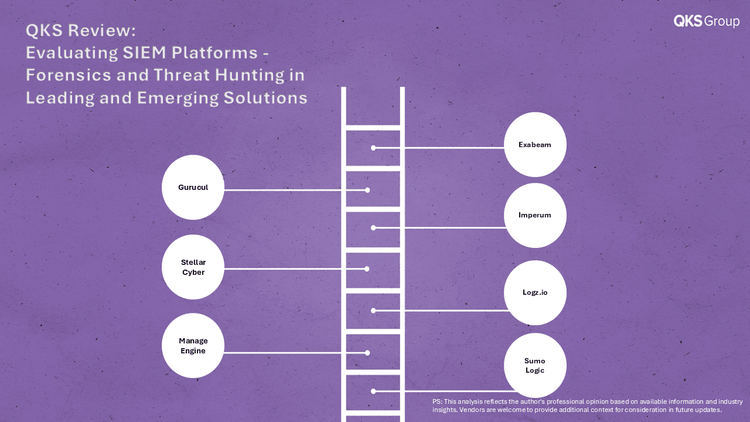
The evolution of Security Information and Event Management (SIEM) platforms toward integrated forensic and threat hunting capabilities represents a significant step in security operations maturity. Vendors such as Exabeam, Gurucul, and Imperum emphasize automation and AI-driven workflows, while others such as Stellar Cyber, Logz.io, ManageEngine, and Sumo Logic focus on visualization, scalability, or compliance alignment. Each approach carries strengths and limitations, but collectively they demonstrate that forensic investigation is no longer peripheral to SIEM. It is becoming a core expectation, one that enables security teams to move beyond alerts toward a deeper understanding of adversary behavior. Organizations selecting a SIEM must therefore consider not only how well the platform detects threats, but also how effectively it supports the investigative processes that follow. The ability to conduct timely and accurate forensics, supported by structured timelines, contextual enrichment, and intuitive workflows, may ultimately determine the difference between containing an incident and suffering its full consequences.
Disclaimer:
This blog is based on independent research and publicly available information. The insights presented reflect the views of QKS Group and are for informational purposes only. While we strive for accuracy, we do not guarantee completeness or absolute correctness. Vendors are welcome to provide clarifications or updates. If any vendor listed in this analysis wishes to provide additional context or clarification, we welcome a briefing call and will consider incorporating relevant updates. This analysis is not intended to disparage any vendor but to provide an informed, balanced perspective. We encourage open and constructive dialogue to foster transparency and a deeper understanding of the industry.
Author: Venkatesh Kopparthi, Principal Analyst - Security Analytics and Automation at QKS Group