

30.10.2025
QKS Review
QKS Review: Democratizing AI: How Connectivity Platforms Are Driving Edge Intelligence
Author:
Kushal Shah


Executive Summary:
Industrial AI is rapidly shifting from the cloud to the edge, driven by the need for faster, more autonomous decision-making in distributed operations. Traditional cloud-centric models often struggle with latency, bandwidth, and reliability challenges, especially in industrial environments spread across multiple sites. Industrial edge connectivity platforms are bridging this gap by enabling real-time data exchange, protocol translation, and contextualization directly at the edge. They form the digital backbone that unifies machines, sensors, and enterprise systems, creating low-latency, event-driven data flows that are foundational for deploying AI closer to operations. Across vendors, distinct approaches define this transformation. EMQ’s NeuronEX focuses on lightweight AI-enabled data hubs, HighByte emphasizes governed Industrial DataOps, and Matrikon delivers secure, standards-based connectivity. Codra prioritizes robust communication middleware for real-time industrial data exchange, while HiveMQ and Softing bring MQTT-first and OPC UA-based architectures that enhance interoperability and reliability. Together, these platforms highlight how industrial connectivity is evolving from simple data movement to intelligent data infrastructure, enabling manufacturers to unlock contextual AI, analytics, and automation directly at the edge.
Artificial Intelligence has long lived in cloud data centers: powerful, centralized, and often expensive. For many industrial operations, especially those spread across factories, plants, or remote sites, that model has struggled to meet the realities of industrial operations. Moving large amounts of data to the cloud and back can be slow, unreliable. But that’s starting to change. As industries push for faster decisions and more autonomy on the ground, AI is now moving closer to where things actually happen, at the edge.
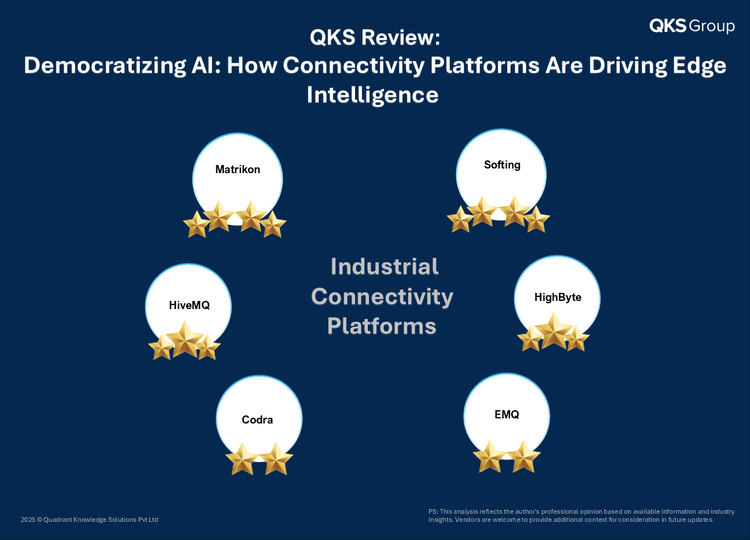
What’s enabling this shift isn’t just smaller, cheaper computers. It’s the rise of industrial edge connectivity platforms. These are the systems that allow machines, sensors, and edge devices to talk to each other and to higher-level systems in real time. They’re built for tough environments, and setups that span multiple locations. Instead of waiting for scheduled updates like traditional systems, these platforms respond to events as they happen, they support a wide range of protocols and device types, enabling seamless communication across distributed industrial systems while managing real-time data streams, translating protocols, and performing data transformation tasks directly at the edge. The following are the vendors I’ve analyzed and my perspective on each of them.
EMQ
EMQ’s NeuronEX is an industrial edge connectivity platform designed to unify OT and IT data across diverse industrial environments. It supports a wide range of industrial protocols to enable real-time data collection from various equipment types. Its core strengths include on-site stream processing capabilities and support for edge-level AI/ML integration, allowing low-latency decision-making. The platform is lightweight and can be deployed flexibly using containers.
However, NeuronEX lacks HMI tools and depends on integration with external platforms for centralized monitoring and management, which may limit its out-of-the-box functionality in more complex deployments.
HighByte’s Intelligence Hub is an edge-native Industrial DataOps platform that unifies, models, and standardizes operational data for distribution across enterprise and cloud systems. It supports key industrial and IT protocols such as OPC UA, MQTT Sparkplug B, REST, and SQL, enabling contextualized data exchange across heterogeneous environments. Its no-code configuration interface, modular pipelines, and support for containerized deployment through Docker or Kubernetes make it suitable for scalable edge-to-cloud architectures that prioritize governed, model-driven data flow.
However, HighByte focuses on data contextualization and orchestration rather than visualization or control, requiring integration with third-party analytics or HMI tools. Large or distributed deployments may depend on external orchestration frameworks for device management and workload scheduling. Additionally, ecosystem maturity in terms of implementation partners and regional support is still expanding, which can influence deployment timelines for enterprise-scale projects.
Matrikon’s portfolio, including Matrikon Data Broker and OPC Server Suite, provides standardized and secure data connectivity across multi-vendor automation environments. It bridges legacy and modern protocols such as Modbus, DNP3, and OPC UA, allowing integration of older assets into contemporary architectures. Its deployment flexibility across physical, virtual, and containerized environments supports diverse industrial topologies.
However, Matrikon’s scope is limited to connectivity and governance, lacking native visualization or orchestration capabilities. Without centralized orchestration, maintaining consistent configurations across multi-site deployments becomes resource intensive.
Codra Panorama COM is Codra’s industrial communication middleware designed to facilitate real-time data exchange between automation systems and enterprise applications. It supports a wide range of industrial protocols and is built for seamless integration with SCADA, MES, and IT environments. A key strength is its modular architecture and reliability in managing high-frequency data across complex infrastructure.
However, Panorama COM lacks native support for integration standards such as MQTT/Sparkplug and REST APIs. This limits its ability to seamlessly connect with contemporary IIoT ecosystems and cloud-based analytics platforms. Additionally, Codra’s market presence remains largely concentrated in France and a few European regions. In other regions beyond its core markets, the platform may face adoption challenges due to limited visibility and ecosystem presence which might hinder long-term support confidence.
HiveMQ Edge is an industrial MQTT gateway available in open-source and commercial editions. It focuses on protocol to MQTT conversion for edge to cloud connectivity and includes a built-in MQTT broker for local publish or bridge use. The commercial edition adds Data Hub for stateful transformation, enrichment, and data combining, along with direct database integrations and offline buffering. Its MQTT-first design suits event-driven architectures and real-time messaging. HiveMQ supports multi-tier broker setups with built-in clustering and bridging, allowing local edge brokers to run independently while staying connected to central systems. This ensures data continues to flow even during network interruptions and keeps message topics and device sessions aligned across all layers for reliable, low-latency communication.
HiveMQ Edge focuses on secure data movement rather than human–machine interaction. Local dashboards or HMI functions are not included natively and typically require third-party integration. Analytics are not yet part of the core platform. HiveMQ Pulse, planned for GA in 2025, will extend capabilities with contextual metrics like OEE and MTBF. HiveMQ’s strongest adoption and partner ecosystem are currently concentrated in North America and Europe. HiveMQ can further strengthen its presence in the APAC region by expanding local partnerships, references, and support coverage to better serve regional industrial markets.
Softing’s edgeConnector is a containerized software solution that bridges industrial controllers with IT systems using OPC UA and MQTT. It supports integration with major PLCs and CNC equipment and enables secure data publishing through modern IT protocols. The product offers flexible deployment on Linux or Windows using Docker and features robust security controls.
Furthermore, while the product is supported by multilingual documentation, the absence of a well-established global consulting and implementation ecosystem may hinder adoption in non-core geographies or in projects requiring extensive customization.
Final Take:
When evaluating industrial edge connectivity platforms, end users should begin by mapping their current automation landscape and identifying integration priorities. A platform’s protocol depth, deployment flexibility, and data modeling capability determine how easily it can unify legacy and modern assets. Equally important is the platform’s approach to security and access control, ensuring governance across distributed operations without adding complexity to day-to-day maintenance.
Beyond technical fit, buyers should assess vendor maturity and ecosystem strength. Factors such as availability of certified system integrators, regional support, and compatibility with enterprise IT or cloud tools can significantly impact rollout success and long-term scalability. Platforms that demonstrate consistent performance in multi-site or hybrid environments offer better risk mitigation and operational continuity.
Looking forward, the industrial edge will move beyond connectivity to become an intelligent control plane for contextual data, analytics, and AI inference. Vendors that blend interoperability with low-latency data processing and governed data pipelines will set the pace, enabling manufacturers to build self-optimizing, autonomous operations powered by data intelligence at the edge.
Disclaimer:
This blog is based on independent research and publicly available information. The insights presented reflect the views of QKS Group and are for informational purposes only. While we strive for accuracy, we do not guarantee completeness or absolute correctness. Vendors are welcome to provide clarifications or updates. If any vendor listed in this analysis wishes to provide additional context or clarification, we welcome a briefing call and will consider incorporating relevant updates. This analysis is not intended to disparage any vendor but to provide an informed, balanced perspective. We encourage open and constructive dialogue to foster transparency and a deeper understanding of the industry.
Author: Kushal Shah, Analyst at QKS Group
Vendors: