

21.07.2025
QKS Review
QKS Review: Cutting Through the Hype: A User-Centric Look at Self-Service in EiPaaS Why We Chose These Vendors and Why This Capability Matters Now
Author:
Ipsita Chakrabarty


Executive Summary:
As the Enterprise Integration Platform as a Service (EiPaaS) market faces rising pressure from business decentralization, digital agility demands, and IT bottlenecks, organizations are moving beyond traditional developer-first integration tools.
This review blog by QKS Group assesses whether EiPaaS vendors are truly innovating to meet these demands, or merely making incremental updates.
What Modern EiPaaS Platforms Should Deliver:
Today’s platforms must offer more than low-code promises. Critical next-gen capabilities include:
- True self-service enablement that empowers business users to build, modify, and manage integrations independently
- AI-guided flow builders and contextual assistance to reduce dependency on IT and shorten time-to-value
- Built-in governance and prebuilt connectors to ensure safe, scalable adoption across departments
Key Findings:
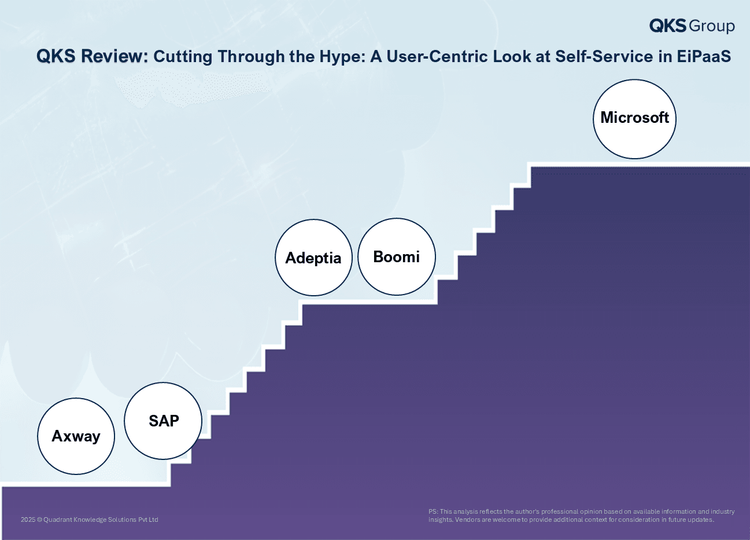
Leading vendors (Microsoft, Boomi) stand out with intuitive user experiences, AI guidance, and strong ecosystem alignment, particularly for productivity-focused use cases.
Capable vendors (Adeptia, SAP) serve specific domains (e.g., B2B onboarding or ERP-centric automation) well but struggle with broader accessibility and low learning curves. Lagging vendors (Axway) emphasize governance and control but fall short in enabling true autonomy for business users, limiting their appeal in decentralized, fast-paced environments.
These five vendors were selected based on their significant presence in the global enterprise integration-platform-as-a-service (EiPaaS) market and the diversity of their strategies toward user empowerment:
- Boomi: Long-time category leader, evolving toward AI-driven, business-friendly experiences.
- Adeptia: Niche player with a strong B2B onboarding focus and a self-service value proposition.
- SAP: Enterprise powerhouse offering integration within its expansive ecosystem.
- Microsoft: Ubiquitous in workplace productivity and extending self-service through Power Platform.
- Axway: API-centric innovator emphasizing governance and hybrid environments.
Self-service integration was chosen as the lens for evaluation because it is no longer optional. As enterprises decentralize decision-making and prioritize agility, business units must be able to build integrations in their own context safely and effectively. Yet, vendors vary widely in how authentically and effectively they enable this.
A Closer Look at How Each Vendor Serves the Business User
Boomi Aims High but Leaves Users in Two Worlds
Boomi has invested heavily in positioning itself as a self-service-friendly platform with capabilities like Boomi GPT and AI-guided flow creation. Business users can build simple automations with its low-code canvas and benefit from AI-assisted data mapping.
However, the experience is inconsistent beyond standard use cases. More complex integrations still expose underlying technical layers, creating friction for non-technical teams. While Boomi’s connector ecosystem and process libraries reduce some effort, the jump from low-code to advanced customization requires technical intervention. Features like process reporting and error handling also demand IT support to configure and troubleshoot.
Analyst Perspective: Boomi has the right vision and architectural foundation for self-service, but the user experience needs to be harmonized across its modules. Suitable for business teams with light IT oversight, but lacks consistency in enabling true end-to-end autonomy.
Adeptia’s B2B Strength Doesn’t Always Translate Beyond Onboarding
Adeptia emphasizes self-service for B2B partner onboarding, and in that niche, it succeeds. Business teams can onboard customers and suppliers through pre-built templates and guided interfaces with minimal IT involvement. Its data transformation engine and schema mapping tools streamline data exchanges, making it particularly effective in EDI and supply chain scenarios.
Outside of this narrow domain, the platform lacks conversational AI, dynamic workflow support, and prebuilt integrations for common enterprise SaaS tools. Internal teams looking to build custom workflows often find themselves constrained by limited orchestration logic and a dated UI.
Analyst Perspective: Adeptia meets business needs well in its B2B sweet spot, but falls short of being a general-purpose self-service integration platform. It’s a strong fit for partner data exchange but not for broader departmental automation.
SAP Offers Depth, if You Can Climb the Learning Curve
SAP’s Integration Suite combines low-code tools, AI-infused assistance, and tight coupling with its ERP ecosystem. It includes tools like Event Mesh, Integration Advisor, and prebuilt content for S/4HANA, SuccessFactors, and other SAP systems. For enterprises with deep SAP roots, this level of integration is invaluable.
However, usability remains a challenge. Business users require training to navigate the complex interfaces, and many features are designed with IT architects in mind. While SAP has made strides with Business Technology Platform (BTP) integration services, self-service remains gated by expertise.
Analyst Perspective: SAP delivers depth but struggles with accessibility for typical business users. Best for structured programs where IT leads the architecture and guides business-led integration initiatives, especially within SAP-centric landscapes.
Microsoft Nails Ease of Use, But Only Inside Its Ecosystem
Microsoft’s Power Automate and Logic Apps offer a genuinely intuitive self-service experience. Business users who are already familiar with Microsoft 365 products can easily connect workflows across Outlook, Excel, Teams, SharePoint, and Dynamics using plain language prompts and prebuilt templates. Copilot functionality further lowers the barrier to entry by generating logic from simple descriptions.
However, integration becomes less seamless when moving beyond the Microsoft universe. Third-party connectors are available, but advanced configurations may require Power Platform admin controls or Azure expertise. Performance tuning and security settings are not always transparent to business users.
Analyst Perspective: Microsoft leads in accessibility and user confidence — as long as you’re operating primarily within the Microsoft ecosystem. It's excellent for productivity-centric use cases but less equipped for cross-stack integration without IT involvement.
Axway Prioritizes Governance, Leaving Little Room for User Autonomy
Axway excels in API lifecycle management, security enforcement, and hybrid integration across cloud and on-premises systems with flexible deployment options. Its Amplify platform supports deep API governance and visibility across distributed environments, making it a top choice for compliance-heavy industries like healthcare and finance. Axway provides a unmatched self-service experience around API ecosystems and adoption for both internal and external users.
The integration layer provides a no-code integration experience for non-technical users, including AI support, but is not optimized for a complete self-service experience for business users for rapid automation. The focus on centralized control is well-suited for enterprise IT, but not for line-of-business users who want to build integrations themselves without the involvement of their integration team.
Analyst Perspective: Axway is ideal for IT-led integration programs where governance, security, and compliance are paramount, particularly in regulated industries like finance and healthcare. While it offers a powerful no-code interface and AI support, its integration layer is better suited for technically proficient users. It lacks the full self-service agility and embedded guidance that business teams need to drive rapid, independent automation at scale.
Closing Thoughts: Self-Service Isn’t a Feature It’s a Design Principle
The rise of self-service in enterprise integration-platform-as-a-service (EiPaaS) is not simply about reducing IT tickets or putting a prettier interface on old workflows. It represents a fundamental shift in how enterprises expect integration to support agility, innovation, and employee productivity. As this comparison shows, some vendors like Microsoft and Boomi are making significant strides toward delivering intuitive, business-friendly experiences, while others remain anchored in governance-heavy or developer-centric models that risk alienating non-technical users.
For business users, the value of self-service integration lies in its ability to transform how work gets done not just in theory, but in day-to-day execution. When delivered effectively through intuitive low-code builders, AI-powered assistance, and robust libraries of prebuilt connectors, these platforms allow business teams to independently build workflows, integrate applications, and automate tasks without having to rely on IT for every change. This accelerates time-to-market for new initiatives, empowers departments like marketing, finance, and operations to tailor processes to their needs, and enables faster experimentation with lower overhead. However, when self-service is poorly implemented, offering limited flexibility, exposing users to overly technical configurations, or failing to include built-in governance, it can just as easily backfire. Users encounter friction, abandon the tools, or turn to unapproved workarounds, leading to inconsistent integrations, compliance risks, and growing distrust in the platform. What was intended as empowerment ends up becoming fragmentation, proving that self-service isn’t just a feature, but a discipline that must be embedded in the product’s design, support, and intent.
Vendors who can strike the right balance, offering guardrails without creating roadblocks, providing intelligence without overcomplication, will define the next wave of leadership in the integration market. Until then, business users must look past the marketing claims and ask hard questions: Does this platform let me build what I need, when I need it, without waiting in line?
Disclaimer:
This blog is based on independent research and publicly available information. The insights presented reflect the views of QKS Group and are for informational purposes only. While we strive for accuracy, we do not guarantee completeness or absolute correctness. Vendors are welcome to provide clarifications or updates. If any vendor listed in this analysis wishes to provide additional context or clarification, we welcome a briefing call and will consider incorporating relevant updates. This analysis is not intended to disparage any vendor but to provide an informed, balanced perspective. We encourage open and constructive dialogue to foster transparency and a deeper understanding of the industry.
Author: Ipsita Chakrabarty, Analyst - Application Deployment at QKS Group
Vendors: