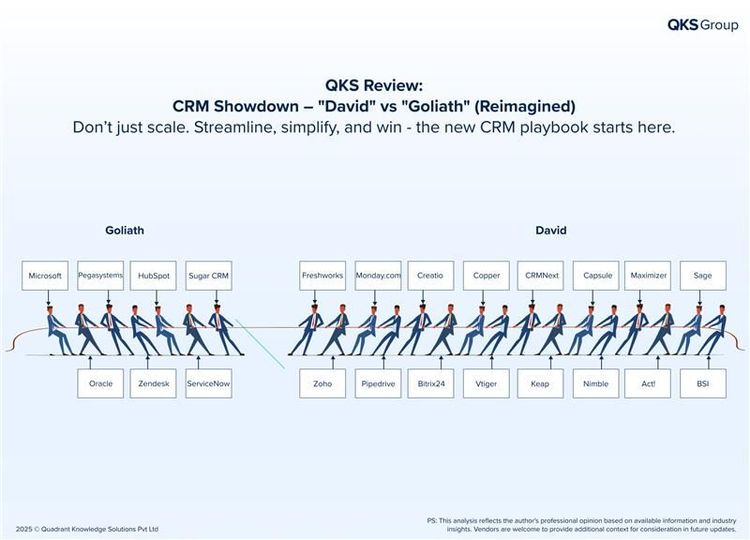
Goliaths: Big Logos, Bigger Luggage
The leading Customer Relationship Management providers offer comprehensive platforms with multi-cloud capabilities, long-term plans, and state-of-the-art AI features. However, managing and putting their solutions into practice can be challenging, often requiring a significant investment in internal knowledge and consulting. The sheer number of features and integrations may lead to information silos and implementation challenges, and not every business will utilize all of the capabilities available.
Businesses should carefully consider the costs of ownership and the trade-offs between complexity and power, even though these platforms are still reliable choices for many businesses. It can be difficult to fully utilize these systems, so it's important to align expectations with business objectives and available resources.
HubSpot – The Friendly Giant with Growing Pains
After transforming from its SMB-focused beginnings into a single platform that encompasses marketing, sales, service, CMS, and operations, HubSpot has made a daring move into the enterprise CRM space. The underlying architecture and feature set still retain the characteristics of its initial focus on small and medium businesses, despite the fact that this evolution is impressive, particularly for a company with strong SMB roots. The audacious move by HubSpot to enter the enterprise CRM market is indicative of its goal of becoming a comprehensive business platform. Large businesses looking for high volume, fine-grained control over their CRM processes may find it difficult to adopt due to its architecture and feature limitations, particularly those related to customization, scalability, and integration, which highlight its SMB heritage.
Microsoft Dynamics 365 – Feature-Rich but Fractured
With the combined strength of CRM and ERP on one cloud platform, Dynamics 365 has the backing of Microsoft. However, the "too-many-modules" syndrome, legacy baggage, and inconsistent user interfaces frequently result in lengthy and cumbersome implementations. Dynamics provides unified identity management and smooth data flow for businesses that have already made investments in Microsoft infrastructure. Microsoft’s strength, however, is also its weakness: although the platform is modular, Configuration can be complex and costly, frequently requiring in-house knowledge or extensive partner engagement. Dynamics is a good option for big businesses with IT resources, but it can easily become a burden if there isn't technical depth.
Oracle – Deep Pockets, Deep Complexity
Oracle’s CX suite offers a comprehensive, AI-enabled CRM platform suited for complex, multinational enterprises. Oracle CX is especially strong in regulated industries like finance, telecom, and healthcare. It excels in personalization, lead scoring, and predictive analytics thanks to its deep data modeling capabilities. However, implementation timelines are long, and total cost of ownership is high. Its user interface is improving, but still lacks the polish of modern competitors, and customization often requires certified developers. Oracle’s marketplace and integration offerings are indeed robust, especially for organizations using other Oracle products (such as ERP or HCM), but they are generally considered smaller or less extensive than those of major competitors like Salesforce.
Pegasystems – The Rules Engine on Steroids
Pega’s Customer Relationship Management platform offers powerful process automation and customization capabilities that appeal to technical teams and developers. However, its logic-driven approach and less intuitive user interface can present challenges for non-technical users. Pega is a process powerhouse known for its dynamic case management and real-time decisioning. With most of its charm buried under the hood, Pega often loses to flashier front-ends. For enterprise IT teams that want full control and customization, it’s a dream but for customer-facing teams, Pega can feel abstract and hard to personalize.
ServiceNow – Ticket to Everything, CRM Included?
ServiceNow has successfully pivoted from IT service management to broader enterprise workflows, and its CRM product is accelerating it’s already strong momentum in the enterprise support and field service space. With the launch of its AI-powered Customer Relationship Management platform and the strategic acquisition of Logik.ai, ServiceNow is actively reshaping what CRM means for the modern enterprise. Built on the ServiceNow AI Platform, ServiceNow CRM unifies front, middle, and back-office operations to deliver seamless, end-to-end customer experiences. It’s particularly valuable for B2B companies managing SLAs, case resolution, or customer service delivery at scale. ServiceNow excels in structured case management, incident tracking, and integration with backend systems via the ServiceNow AI Platform. ServiceNow’s offers Sales and Order Management (SOM) functionalities to be enhanced with the recent acquisition (April 2025) of Logik.ai’s composable, AI-powered CPQ capabilities.
However, ServiceNow’s CRM capabilities lack many native features expected from a traditional CRM, such as marketing automation, or campaign execution, albeit a deep partnership with Tenon provides marketing automation capabilities. As such, it’s best positioned as a having CRM-lite features, not a full CRM replacement for enterprise sales organizations
SugarCRM – The Open Source Underdog That Could
SugarCRM has carved a niche in the mid-market and emerging enterprise segment by offering deployment flexibility (cloud, on-premises, or private cloud) and strong data privacy controls. It provides solid sales, marketing, and service modules, along with AI-assisted insights via SugarPredict. Sugar’s architecture appeals to IT teams seeking control over infrastructure and data residency, especially in heavily regulated regions. However, the platform has struggled to keep up with the user experience and ecosystem breadth offered by giants like Salesforce and Microsoft. Customization often relies on technical users or VARs, and out-of-the-box features may feel thin compared to other enterprise-grade solutions.
Zendesk – From Ticketing Tool to CX Suite
Zendesk’s CRM offering, Zendesk Sell, is positioned as a simple, visually clean sales tool, appealing to businesses that want fast adoption and seamless integration with Zendesk’s support platform. Zendesk nailed simplicity in support but has been trying to stretch into full-blown Customer Relationship Management with mixed success. It’s great for scaling customer service and conversational support, yet struggles in unified data, marketing automation, and sophisticated workflow orchestration. While Zendesk is a dominant force in help desk and service management, Sell lacks the deep customization, marketing automation, and cross-team collaboration features that large enterprise sales organizations require.
My perspective: As the CRM landscape matures in 2025, key questions emerge for each major vendor. HubSpot faces the delicate task of climbing upmarket while keeping its mid-market loyalists. How will it reconcile rising enterprise ambitions with the simplicity and affordability that built its base? Microsoft Dynamics 365, powerful but often complex, must prove it can streamline implementation and reduce reliance on costly consultants. Is it finally solving the “too many modules” problem? Oracle CX, long known for depth and data muscle, now needs to answer: how will it deliver agility without compromising power or demanding a specialist army? Pegasystems, with its rules-driven engine, must find ways to serve non-technical users. Can it surface that power in a more accessible, intuitive way? ServiceNow, expanding from IT workflows to customer experience, must ask itself: can it truly build CRM capabilities that empower sales teams not just support and ops? SugarCRM wins on privacy and deployment flexibility, but to stay competitive, what’s its plan for closing the feature and ecosystem gap with giants like Salesforce and Microsoft? And finally, Zendesk, beloved for support simplicity, faces an uphill climb in sales CRM — how will it evolve Sell into a platform that can support complex global teams and cross-functional collaboration?
Davids: The Underdogs with Bite
Today's David's of agile Customer Relationship Management providers are delivering useful tools made with end users in mind, not just IT departments or procurement checklists, whereas established CRM vendors frequently concentrate their efforts on high-profile conferences and drawn-out enterprise sales cycles. These solutions steer clear of the bureaucracy and complexity that can impede larger organizations in favor of speed, simplicity, and practical usability.
Freshworks' user-friendly interface and Pipedrive's optimized sales pipelines are just two examples of platforms designed to assist teams in swiftly and effectively resolving common business problems. For busy professionals, Capsule, Keap, andNimble provide simple, intuitive user experiences, while Servis.ai smoothly incorporates AI and automation into the workflow.
It would be more accurate to describe these providers as lean, flexible, and intensely customer-focused rather than writing them off as specialized or irrelevant. For instance, Copper seamlessly integrates with Gmail, transforming it from a clumsy add-on to a seamless extension of your inbox. While Act!, Maximizer, and Sage continue to cater to devoted niche markets by adapting to their unique needs, Vtiger and Creatio offer robust open-source and low-code customization options. Monday.com and Bitrix24 offer a variety of adaptable tools for groups that appreciate adaptability, even if it occasionally adds a little organizational complexity.
These "David" CRMs stand out for their dedication to providing value promptly. These providers show that significant business outcomes can be attained without large budgets or protracted implementations in a market that is becoming more and more characterized by the hype surrounding AI and extensive enterprise requirements. Examples of how focused, customer-driven innovation can surpass general enterprise checklists include CRMNEXT's specialized capabilities in the BFSI sector, BSI's regulatory focus, and Zoho's vast ecosystem.
In the end, these agile providers are creating battle-ready solutions in the same amount of time as their larger rivals to create a strategy deck, demonstrating that speed and relevance are crucial in the current CRM environment.
Disclaimer:
This blog is based on independent research and publicly available information. The insights presented reflect the views of QKS Group and are for informational purposes only. While we strive for accuracy, we do not guarantee completeness or absolute correctness. Vendors are welcome to provide clarifications or updates. If any vendor listed in this analysis wishes to provide additional context or clarification, we welcome a briefing call and will consider incorporating relevant updates. This analysis is not intended to disparage any vendor but to provide an informed, balanced perspective. We encourage open and constructive dialogue to foster transparency and a deeper understanding of the industry.
Author: Umang Thakur, Vice President - Research & Consulting at QKS Group