As the Communications Platform as a Service (CPaaS) market faces rising pressure from rapidly shifting enterprise communication preferences, regional fragmentation, and the rise of omnichannel engagement, organizations are moving beyond traditional messaging platforms.
This review blog by QKS Group assesses whether CPaaS vendors are truly innovating to deliver agile, omnichannel-ready communication strategies or merely making incremental updates to legacy portfolios.
What Modern CPaaS Platforms Should Deliver: Today’s platforms must offer more than core messaging features. Critical next-gen capabilities include:
Extensive and regionally adaptive channel mix that balances mature and emerging formats
Enterprise-grade orchestration and API flexibility for scalable use cases
Support for conversational commerce and embedded communications in mobile-first environments
Key Findings:
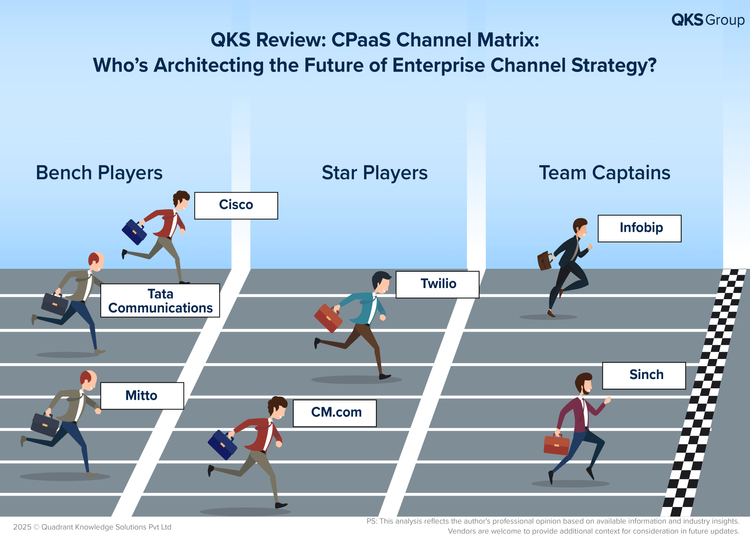
Leading vendors like Sinch and Infobip stand out with expansive, globally responsive portfolios and deep orchestration capabilities, setting a high benchmark for omnichannel maturity.
Capable vendors such as Twilio and CM.com show strong potential, particularly in developer agility and responsiveness to regional trends, but are still evolving their presence across richer engagement channels.
Lagging vendors including Cisco, Tata Communications, and Mitto continue to operate with a narrower channel focus, risking diminished relevance as enterprise needs shift toward immersive, multichannel customer experiences.
Introduction: Within the ever-changing environment of cloud communications, Communications Platform as a Service vendors are spearheading digital transformation, operating at varying levels of technological sophistication and market influence. There are vendors emerging as team captains demonstrating strategic leadership and taking initiative in driving implementation while others resemble bench players, adopting a more reserved posture as they await the right moment to step into the spotlight. The difference among these players is not just in their portfolio of channels but also in the manner in which they utilize their products to address the varied requirements of the global market.
Importance of a Robust Channel Mix for CPaaS Vendors:
An adequately balanced and extensive channel mix is foundational to any CPaaS provider. The channels a vendor is able to support in one of the ways determines the reach and relevance of their solutions. A strong and wide portfolio allows companies to engage with customers across several touchpoints, ensuring that regardless of where the customer is or what their communication preference is, they can be engaged effectively. For a CPaaS provider, the right combination not only enhances the solution's usefulness but also allows customers across various industries and geographies to communicate as effectively as possible. A limited channel combination can hinder a vendor's responsiveness to businesses that have to work in various markets, hence their competitiveness on the global market.
Local preferences largely influence the choice of communication channel that performs well in a particular region. Social media and Over the Top (OTT) channels such as WhatsApp, Facebook Messenger, and WeChat, for example, lead in certain regions. WhatsApp is usually the preferred channel in Latin America and in certain parts of Asia particularly India, whereas WeChat is the main one in China. In North America and Europe, SMS and email still retain significant relevance. On the demand side, Rich Communication Services (RCS) has seen an impressive growth, while platforms like Telegram and Google Business Messages are gaining ground and market traction steadily. By providing a comprehensive set of channels, CPaaS providers are able to more effectively address the unique requirements of businesses that operate across different regions, extending global coverage and local relevance.
As the demand for omnichannel communication grows, Communications Platform as a Service vendors must prioritize the expansion of their channel portfolios to stay competitive. Channels such as SMS, MMS, Email, Voice, RCS, WhatsApp, Meta Messengers both Facebook and Instagram, and WeChat are critical, but businesses today need to engage customers on a variety of channels, including social media, messaging apps, and live chat. Vendors with a broader channel mix can cater to businesses in diverse regions, ensuring that they can engage customers wherever they are and on whichever channel they prefer. By investing in a comprehensive channel strategy, CPaaS providers can not only meet the current needs of businesses but also future proof their offerings as new platforms and technologies emerge.
Channel Matrix Analysis: Revenue Generated Globally vs Global Demand
In the ever-evolving world of CPaaS, providing fundamental channels such as SMS, voice, WhatsApp, email, push, and RCS is essential for providers to be relevant in the enterprise communications market. SMS leads all, respected for its universal coverage and facilitating use cases like OTPs, alert messages, and marketing communications. Voice, though lower in volume, generates higher ARPU (annual revenue per unit) via enterprise grade applications such as IVRs and contact centers. WhatsApp Business continues to accelerate as a result of Meta's conversation-based pricing and leadership in mobile first markets. Email maintains its strategic value for transactional workflows despite lower per message monetization. OTT and social messaging platforms, while presently generating marginal revenues, are poised for growth as enterprise use cases mature. As API capabilities expand and regional adoption grows, these channels are increasingly well suited to facilitate rich, brand driven interactions, especially in mobile first economies. Push notifications remain a critical element of app driven use cases, though they are subject to ongoing monetization issues. On the other hand, Rich Communication Services (RCS), with its vision of its rich media features modernizing SMS, has experienced a significant increase in demand. However, its wider deployment is being inhibited by a fragmented operator market. Where the ecosystem is better aligned in markets like Germany vendors experience much more efficient onboarding processes and more seamless deployment of rich messaging experiences. Secondary but regionally important channels like MMS, video, fax, and in-app messaging add to the depth of CPaaS offerings even though they hold a small share. MMS experiences niche but significant traction mainly in the U.S. market. Video is increasing in importance for embedded communication in apps, particularly in telehealth and online collaboration but encounters infrastructure and compliance challenges. Fax while extremely niche is requested by legacy-dependent companies, which is provided by a few CPaaS providers. In-app messaging, traditionally under-leveraged beyond mobile-native verticals, has gained traction in finance, healthcare, and urban personal transport apps, based on its real-time quality and context-aware communication.
Analyzing the global CPaaS channel revenue landscape, SMS accounts for approximately 40 to 45% of the revenue, underscoring its maturity, reliability, and continued use across critical sectors such as BFSI, healthcare, and e-commerce. Voice channel offerings, which account for roughly 25 to 30% of the total channel revenue, continue to hold strong due to their widespread use in enterprise scenarios, especially for customer support and identity verification. The programmable aspect of voice, coupled with higher value per-interaction contributes to its high revenue generation.
WhatsApp Business, representing a 10 to 15% share, which is increasing dramatically due to its role in conversational commerce and customer support use cases, especially in developing markets where WhatsApp is often a key consumer touchpoint. Email accounts for a steady 8 to 12% share fueled by its critical role in system notifications but the revenue is limited by low per unit pricing despite high volumes.
Push notifications (3 to 5%), RCS (1 to 3%), and OTT & Social messaging channels (1 to 3%) marginally support the revenue from CPaaS channels overall. Push notifications are beneficial for in-app interactions but have no significant monetization models. RCS uptake is limited by carrier fragmentation and device constraints, limiting monetization though it has technological potential. OTT and social messaging platforms, regionally popular and deep in features, have not yet reached enterprise grade standardization or scale of WhatsApp. Inadequate platform openness, absence of good APIs, and heterogeneity of user behavior patterns constrain monetization, keeping their contribution to revenues small despite increasing interest in diversified messaging approaches. Their future will depend on wider enterprise uptake, better tooling, and integration with business workflows in the long term.
As enterprise communication becomes increasingly complex, the role of a well-orchestrated channel strategy has shifted from being a market differentiator to a foundational requirement. While SMS, email, and voice continue to anchor enterprise workflows, the accelerated adoption of richer, real-time formats such as WhatsApp, video, push notifications, and RCS, has redefined what qualifies as an enterprise ready CPaaS solution. Players such as Sinch and Infobip have also shifted their channel strategies, closely following global user behavior and industry specific requirements to provide flexible, scalable, and future proof communication platforms.
Sinch has become an undisputed leader in Communications Platform as a Service channel strategy with one of the richest and most globally responsive portfolios available. From SMS, MMS, voice, and email to video, push notifications, WhatsApp, and RCS, and many more, Sinch puts together depth with deployment maturity. Its strength in balancing carrier grade reliability with developer focused flexibility, rendering it as preferred choice for regions and industries. The company’s focus on conversation driven commerce and embedded communications, backed by strategic acquisitions and organic growth, reinforces its ability to support mission critical enterprise interactions at scale.
Infobip, another leader in the channel strategy, delivers a robust, end-to-end CPaaS architecture tailored to evolving customer journeys. The company’s omnichannel stack spans core and advanced messaging channels, including newer formats like chat apps and rich media messaging, enabling contextual engagement across touchpoints. Infobip’s global infrastructure footprint, emphasis on orchestration and automation, and deep integrations with marketing, service, and commerce platforms position it as a strategic partner for enterprises pursuing unified communication flows. Its agility in expanding channel capabilities reflects a clear understanding of dynamic user behaviors and market fragmentation.
Sinch and Infobip illustrate what it is to lead with an advanced and end-to-end channel strategy. Their coverage depth, alignment with enterprise priorities, and focus on ongoing innovation set a new benchmark in the CPaaS space. With omnichannel engagement becoming the foundation for customer experience, their foresight in anticipating market changes and modifying offerings in response positions them as key enablers for the future of enterprise communications.
With enterprise communication needs evolving beyond the traditional channels, vendors are now offering a balanced blend of old and new messaging styles. Twilio and CM.com have become star players with strong roadmaps. Both are refining their portfolios to cater to regional differences and growing enterprise aspirations, indicating a definite intention to sync with the future of omnichannel engagement. Their adaptability and strategic foresight underscore their readiness to compete effectively in an increasingly mature CPaaS landscape.
Twilio, with its well-known developer centric philosophy, melds a tightly coupled set of core channels like SMS, voice, and WhatsApp with an API design that is continuing to draw enterprises looking for scalability and agility. Twilio recently announced Data Residency for Email in the EU (GA in July), providing confidence that data and privacy needs are being supported in the region. Their adaptability and strategic foresight underscore their readiness to compete effectively in an increasingly mature CPaaS landscape. Its platform stability and execution focus have made it a go-to provider of global communication infrastructure among organizations looking for technical simplicity and reliable performance.
CM.com, on the other hand, stands out because of its quick response to changing enterprise requirements. With a diversified portfolio that includes legacy and next gen messaging channels, CM.com is positioned as an ideal choice for addressing both high volume transactional use cases and interactive conversational experiences. It excels because of its flexibility, which is its capacity to fit regional needs, accommodate newer use cases, and integrate customized communication workflows for customers across sectors. This responsiveness not only enhances its enterprise appeal but also signals the company’s readiness to scale into a more expansive role within the CPaaS hierarchy.
Both Twilio and CM.com reflect a strong alignment with the core principles of CPaaS maturity that are modular architecture, reliable channel performance, and user centric customization. As they continue to invest in portfolio expansion and regional coverage, these vendors are well placed to elevate their standing and shape the future of omnichannel enterprise engagement.
Cisco, Tata Communications, and Mitto are a group of CPaaS players who, although providing critical services, have an immediate need to expand their channel strategies because of it being foundational. With more and more enterprises putting omnichannel engagement at the forefront in order to address customer demands, a narrow channel mix can limit market reach and responsiveness, particularly in geographies where digital-first communication has become the new standard.
Cisco, known globally for its strength in enterprise communications and networking, has taken measured steps into the CPaaS space. However, its focus continues to lean more toward its core UCaaS and CCaaS offerings. While it supports a range of channels such as SMS, MMS, RCS, Apple Business Messaging, WhatsApp, Meta Messengers, email and more, its CPaaS portfolio is still evolving to meet the demands of more dynamic engagement models and conversational commerce. Its portfolio is relatively narrower than some of the leading peers. The absence of certain digital channels may limit its reach in specific market segments where those capabilities are essential for customer engagement.
Tata Communications maintains a more traditionalist orientation, characterized by a relatively limited set of native CPaaS channels, with the acquisition of Kaleyra serving as a strategic move to broaden and strengthen its portfolio. While such acquisitions offer a degree of flexibility, they do not substitute for a fully integrated, expansive channel portfolio. For Tata Communications to maintain competitiveness and expand its Communications Platform as a Service relevance beyond core telecom capabilities, a more deliberate focus on next-generation and region-specific communication channels is necessary.
Mitto, while nimbler as a result of its smaller size, is still equally hampered by a limited channel set. Focusing on core channels such as SMS and WhatsApp, the vendor has made its place in the transactional and customer authentication use cases. Even so, lack of rich media channels such as video, email, live chats and OTTs & social messaging channels restricts it from supporting richer customer experiences. As business users seek platforms that can support sophisticated, multichannel workflows, Mitto needs to scale up its channel portfolio to capture increasing demand and move beyond niche implementations.
In an increasingly competitive CPaaS market, being able to provide a complete and dynamic channel approach is no longer a choice, it is becoming a basic requirement. For Mitto, Tata Communications, and Cisco, widening their channel depth is of paramount not just for global relevance but also for maintaining long term platform viability in an environment that rewards omnichannel innovation.
Conclusion:
In conclusion, Communications Platform as a Service providers offering an extensive and varied channel portfolio like Infobip, Sinch, CM.com and Twilio clearly stand out in the market. The ability to provide users with an extensive number of channels positions them better in the market, enabling companies to acquire the flexibility and coverage they need to connect with customers through various touchpoints. Alternatively, vendors such as Cisco, Tata Communications, and Mitto, with their limited channel portfolios, can find it difficult to serve businesses that conduct operations in areas where there are disparate communication needs. As the CPaaS industry expands, vendors need to evolve and widen their channel strategies in order to sustain a competitive advantage and support changing business and customer demands.
Disclaimer:
This blog is based on independent research and publicly available information. The insights presented reflect the views of QKS Group and are for informational purposes only. While we strive for accuracy, we do not guarantee completeness or absolute correctness. Vendors are welcome to provide clarifications or updates. If any vendor listed in this analysis wishes to provide additional context or clarification, we welcome a briefing call and will consider incorporating relevant updates. This analysis is not intended to disparage any vendor but to provide an informed, balanced perspective. We encourage open and constructive dialogue to foster transparency and a deeper understanding of the industry.
Author: Abhishek Ghosh, Senior Analyst - WEM & UCaaS at QKS Group