

13.08.2025
QKS Review
QKS Review: Correlation Is Not Enough – Can These Vendors Truly Prioritize What Matters?
Author:
Arpita Dash


Executive Summary:
As the security analytics and automation market faces rising pressure from escalating threat complexity, identity-centric attack patterns, and analyst resource constraints, organizations are moving beyond traditional SIEM tools.
This review blog by QKS Group assesses whether modern security analytics platforms are truly innovating to meet these demands or merely applying incremental updates to legacy correlation engines.
What Modern Security Analytics Platforms Should Deliver:
Today’s platforms must move beyond log ingestion and event correlation. Critical next-generation capabilities include:
- Intelligent Triage: Automated prioritization of incidents using entity-level context, risk scoring, and behavioral deviation analysis.
- Integrated UEBA: Identity-first detection that stitches activity across users, devices, and accounts without dependence on static rules.
- Adaptive Risk Modeling: Continuous recalibration of incident severity based on asset criticality, threat model alignment, and temporal patterns.
Key Findings:
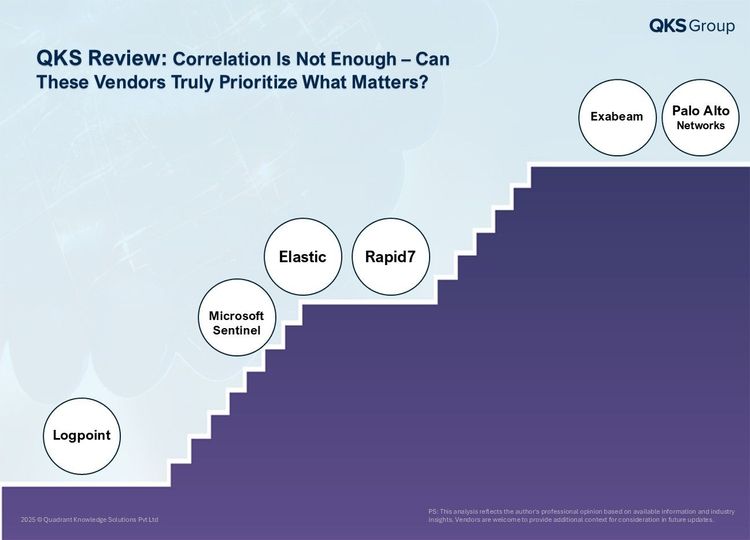
- Leading Vendors: Palo Alto Networks and Exabeam stand out for embedding adaptive, behavior-driven prioritization into their core analytics engines.
- Capable Vendors: Rapid7 (Incident Command), Elastic Security, and Microsoft Sentinel demonstrate strength in specific areas but rely on significant customization or analyst intervention to achieve full contextual prioritization.
- Lagging Vendors: Logpoint offers compliance-aligned capabilities but remains anchored to static rule-based scoring without default dynamic risk adaptation.
Introduction
In the current security operations environment, correlation alone no longer defines effectiveness. SOC teams operate under a continuous influx of alerts where many of them false positives and while managing siloed detection tools, disjointed workflows, and increasing resource constraints. Expanding log collection or normalizing additional events does little to improve threat management outcomes. The defining capability has become the transformation of raw telemetry into actionable, prioritized intelligence.
The operational question has shifted from “Can a SIEM detect threats?” to “Can it determine which threats represent the greatest risk, and why?”. Achieving this requires context-aware prioritization, integrating UEBA, dynamic risk scoring, and entity correlation to elevate incidents that carry genuine operational impact. Platforms without this capability maintain a reactive triage posture; platforms with it enable higher-confidence, context-rich decision-making.
This review assesses six platforms through the lens of intelligent triage and adaptive risk modeling: Palo Alto Networks, Exabeam, Rapid7, Elastic, Microsoft, and Logpoint. Some are evolving toward entity-centric decision-making, while others remain constrained by noise-heavy correlation models.
Cortex XSIAM applies a signal-first approach, consolidating endpoint, cloud, network, and third-party telemetry into a unified processing pipeline. It combines SmartScore machine learning models with configurable rule-based scoring to assess incidents based on behavioral deviation, threat intelligence, and historical activity.
UEBA is integrated at the core of the architecture. Identity stitching across SSO providers, EDR deployments, and cloud accounts enables detection of lateral movement without prebuilt rule chains. The platform merges related alerts into scored incidents, enriched with entity profiles and supporting evidence.
The scoring process, while effective, retains a level of opacity within the machine learning pipeline that can challenge transparency requirements in regulated environments. The system prioritizes automation speed and coverage, setting a high standard for integrated prioritization.
Exabeam New-Scale SIEM
Exabeam’s New-Scale SIEM operates from a behavior- and identity-first perspective. It constructs detailed timelines for users and devices, mapping deviations from established baselines. UEBA forms the foundation of the analytics engine rather than functioning as an auxiliary feature.
Incident prioritization is directly tied to behavioral drift and correlation with recognized threat models. Risk scores adapt dynamically as entity behaviors evolve, providing a continuously updated assessment of compromise likelihood.
This approach allows the platform to deliver not only an account of events but also a contextualized understanding of risk distribution and affected entities. While the automation layer is functionally capable, interface design lags behind newer SOAR platforms in visual refinement.
Rapid7 Incident Command
Rapid7’s transition from InsightIDR to Incident Command reflects a shift from detection-centric to response-oriented operations. The platform integrates attack surface context, detection, and automation into a single SOC environment, with investigative workflows aligned to enriched SOAR capabilities that can execute automated remediation.
Prioritization logic remains primarily manual, relying on analyst-defined thresholds and rules. UEBA coverage includes anomalies such as atypical logins and lateral movement, though these operate in relative isolation. Linking disparate behaviors into a coherent risk narrative still requires substantial manual configuration.
The investigation interface offers a structured analyst experience, with clear timelines and asset views, but underlying triage remains static and rule dependent. Alerts are effectively correlated, though contextual understanding is still in development.
Elastic Security
Elastic Security is engineered for operational environments that require precise control over detection logic. It supports extensive detection engineering, metadata enrichment, customizable dashboards, and flexible schema definitions.
Entity Risk Scoring is available natively, but full contextual prioritization often benefits from additional modeling and tuning tailored to specific operational requirements. UEBA functionality remains in a growth stage, with an emphasis on statistical anomaly detection rather than identity-centric behavioral baselining. Triage processes largely depend on static severity assignments and predefined rules.
Elastic provides a capable framework for teams with advanced detection engineering resources but can impose significant overhead in environments without the capacity for extensive configuration.
Microsoft Sentinel
Microsoft Sentinel serves as the analytics hub of the Microsoft security ecosystem. It integrates telemetry from Defender, Azure AD, Entra ID, Purview, and other sources, combining them through the Fusion engine to produce enriched incidents.
The prioritization model is hybrid in nature: some scoring and enrichment are provided by default through entity insights, but deeper contextual modeling incorporating factors such as asset criticality and business impact requires custom rule development. UEBA is available within the Defender portal experience but often requires deliberate integration to break down siloed analytics.
Sentinel delivers significant telemetry breadth and maturing SOAR capabilities. The quality of prioritization depends heavily on the degree of customization and integration effort applied.
Logpoint Cyber Defense Platform
Logpoint’s architecture combines traditional SIEM functions with native SOAR and UEBA modules. UEBA models target compliance-driven scenarios such as privilege misuse, anomalous access, and insider threat detection, aligning closely with European regulatory contexts.
The UEBA engine generates entity risk scores and the SOAR layer supports automated triage and enrichment. However, the adaptability of entity-first prioritization is contingent on available content packs and the extent of tuning applied. Default scoring models are more static than dynamic in nature.
Logpoint demonstrates strength in compliance alignment and integrated workflows but remains anchored to a rule-centric model that limits progression toward continuous, behavior-driven prioritization.
Final Reflection
Correlation in isolation is insufficient for sustaining effective security operations in modern threat environments. The increasing complexity of attack chains, the rise of identity-based threats, and the sheer volume of telemetry require platforms to progress beyond static rules and event matching. The operational imperative is now context-driven, adaptive prioritization the ability to fuse behavioral analytics, entity correlation, and dynamic risk scoring into a system that continuously identifies, ranks, and contextualizes the threats most likely to cause impact. Such a shift not only reduces analyst fatigue but also enables more efficient allocation of investigative resources, ultimately lowering mean time to detect (MTTD) and mean time to respond (MTTR).
Exabeam distinguishes itself through a behavioral-first prioritization model that interprets risk in terms of identity, deviation, and temporal sequencing. By continuously evolving risk scores and aligning them with known threat models, it reduces alert noise and elevates incidents that are operationally relevant and context-rich. This approach positions Exabeam as one of the few platforms where prioritization is not an afterthought but a core analytic function.
Palo Alto Networks’ Cortex XSIAM demonstrates one of the most mature implementations of unified prioritization, blending machine learning–based SmartScore with configurable rule logic. This enables coverage across varied attack surfaces, yet portions of the machine learning pipeline remain opaque, which may pose limitations for audit-heavy or transparency-critical environments.
Rapid7’s Incident Command improves investigation and remediation workflows through integrated context and automation, but prioritization logic is still heavily dependent on static, human-defined parameters. While this provides flexibility, it can limit adaptability against novel attack patterns without significant analyst intervention.
Elastic Security delivers granular control and customization options that appeal to technically mature SOC teams. However, the need for engineering resources to design and maintain contextual models can slow adoption in environments seeking faster time-to-value.
Microsoft Sentinel brings unmatched telemetry breadth through its native ecosystem integrations and Fusion-driven incident correlation. Its ability to deliver precise prioritization is largely contingent on custom rule development and integration efforts, positioning it as a powerful but customization-dependent platform.
Logpoint merges compliance alignment with automated enrichment and triage, but the depth of entity-first prioritization depends on tuning and the availability of advanced content packs. In its default state, scoring remains more static than adaptive, making it better suited to regulated environments than to rapidly evolving threat scenarios.
Disclaimer:
This blog is based on independent research and publicly available information. The insights presented reflect the views of QKS Group and are for informational purposes only. While we strive for accuracy, we do not guarantee completeness or absolute correctness. Vendors are welcome to provide clarifications or updates. If any vendor listed in this analysis wishes to provide additional context or clarification, we welcome a briefing call and will consider incorporating relevant updates. This analysis is not intended to disparage any vendor but to provide an informed, balanced perspective. We encourage open and constructive dialogue to foster transparency and a deeper understanding of the industry.
Author: Arpita Dash, Analyst - Security Analytics and Automation at QKS Group
Vendors: