Introduction
In an era where digital infrastructures are complex, distributed, and ever-evolving, regulatory compliance and policy enforcement are no longer back-office concerns but they’re front-line priorities. Whether it's HIPAA in healthcare, PCI-DSS in retail, GDPR in data-sensitive industries, or internal cybersecurity mandates, compliance failures can trigger fines, reputational damage, or even legal action.
Network observability tools, traditionally deployed for performance and availability monitoring, are now being retooled to tackle this critical compliance burden. They are being repurposed to automate compliance tracking, generate audit evidence, and alert proactively on policy violations or unauthorized access, aligning with real-time operational goals.
But not all tools are created equal and many still fall short of offering the intelligence, automation, or visibility required to meet compliance demands at scale.
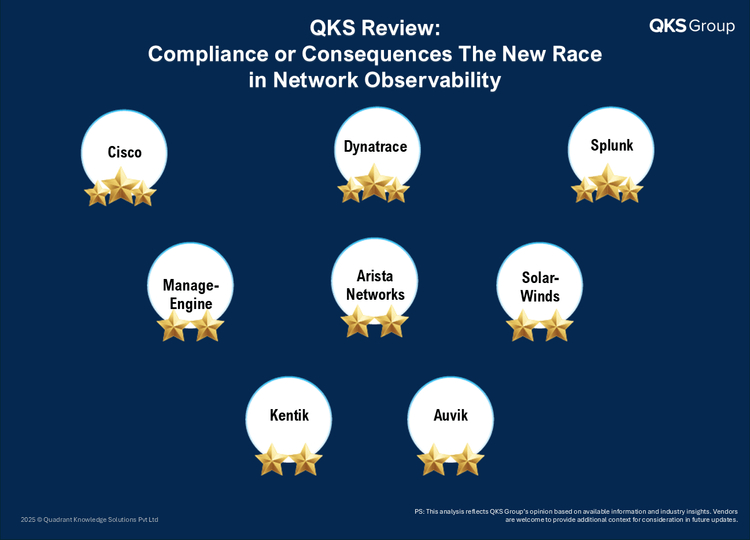
Leading Vendors: The Compliance Disruptors
These vendors are setting a new standard for how observability platforms intersect with compliance and policy enforcement.
- Cisco Digital Experience:
Cisco’s network intelligence and visibility platform allows businesses to transform the way network troubleshooting is performed and ensures digital experience throughout the operations.
The platform complies to standards by meeting the local data residency and sovereignty requirements. Also, its global and regional compliance standards include ISO/IEC 27001, SOC 2 Type II, GDPR.
Role-based access control and granular permissions are available for secure user governance and supports enterprise governance frameworks through integration with identity providers, SIEM tools, and compliance reporting systems helping businesses maintain consistent oversight across distributed environments.
To further support data sovereignty and regulatory adherence, Cisco ThousandEyes has achieved certifications such as C5 Type 2 attestation in Germany, aligning with the BSI's rigorous cloud security standards. This includes capabilities for continuous monitoring, logging, access governance, and policy enforcement, enabling organizations to map compliance against frameworks like C5, ISO, and ENS using integrated telemetry and audit evidence collection.
The platform actively measures network paths, application performance and user experience through software-based agents called the software-vantage points which act as monitoring probes that simulate and monitor traffic from branch offices, data centres, user devices and cloud regions to provide visibility across the entire delivery chain of digital services. This reduces the operational footprint on network endpoints as software agents are natively embedded into cisco hardware like Catalyst 9000, ISR and Meraki eliminating the need for additional infrastructure while generating detailed audit trails.
The platform further empowers users with fine-grained configuration control across cloud, enterprise, and edge environments by combining network & application insight from cisco infrastructure to provide internet and cloud visibility at scale.
To support large-scale testing and continuous monitoring across diverse third-party ecosystems, ThousandEyes integrates with DORA (Digital Operational Resilience Act) frameworks, offering visibility into ICT vendor performance and enabling enterprises to validate resilience and governance across their digital supply chains.
Cisco’s network intelligence and visibility platform transforms traditional network troubleshooting by delivering actionable insights that ensure optimal digital experiences across operational workflows.
The platform is architected to support global compliance by adhering to local data residency and sovereignty requirements, while also aligning with widely recognized frameworks such as ISO/IEC 27001, SOC 2 Type II, and GDPR.
To enable secure and scalable governance, it features role-based access control (RBAC) and granular user permissions, integrating with identity providers, SIEM tools, and compliance reporting systems. These capabilities allow enterprises to maintain consistent oversight and policy enforcement across distributed IT environments.
Strengthening its commitment to regulatory adherence, Cisco ThousandEyes has obtained C5 Type 2 attestation in Germany, aligning with the BSI’s stringent cloud security standards. The platform supports continuous monitoring, access governance, logging, and automated compliance mapping, enabling organizations to align with frameworks like C5, ISO, and ENS through integrated telemetry and evidence collection.
Central to its observability capabilities, ThousandEyes deploys software vantage points which are lightweight, software-based agents that simulate and monitor traffic across branch offices, data centers, cloud regions, and end-user devices. These agents deliver end-to-end visibility into network paths, application performance, and user experience. By embedding these agents natively within Cisco infrastructure including Catalyst 9000, ISR routers, and Meraki hardware the solution minimizes additional operational footprint while generating rich, auditable telemetry without the need for extra infrastructure.
Additionally, the platform provides fine-grained configuration control across cloud, enterprise, and edge environments. It fuses deep network and application insights derived from Cisco infrastructure to deliver internet-scale and cloud-native observability.
To support compliance in highly regulated industries, ThousandEyes integrates with DORA (Digital Operational Resilience Act) frameworks, enabling organizations to monitor and validate the performance and governance of their ICT supply chain. This empowers enterprises to continuously assess resilience and regulatory alignment across third-party ecosystems.
While Cisco digital experience platform is not a full-fledged IT Risk management platform and does not interpret regulatory mandates or offer legal guidance, it has evolved beyond traditional performance monitoring into a compliance-aware observability solution, delivering policy-centric visibility and agent-level governance at scale.
Dynatrace delivers compliance-centric observability to address the evolving regulatory landscape particularly in preparation for the EU’s Digital Operational Resilience Act (DORA), taking effect in January 2025. Designed for highly regulated sectors such as financial services, insurance, and public institutions, Dynatrace enables continuous conformance with stringent ICT risk and security standards.
The platform automates technical control validation against DORA mandates through ongoing ICT risk management, ensuring system integrity, availability, and resilience. The Compliance Assistant app provides regulation-specific workflows tailored to EU mandates, offering the ability to capture, contextualize, and resolve anomalies in real time while generating structured evidence to support audits and incident investigations.
Dynatrace enhances audit readiness by producing comprehensive compliance artifacts such as topology maps, real-time alerts, incident logs, and configuration snapshots that offer deep visibility into the compliance posture of ICT service providers and their digital supply chains.
By consolidating observability, application security, and AIOps into a single unified platform, Dynatrace minimizes tool sprawl and streamlines compliance reporting. Custom dashboards and AI-powered insights deliver actionable remediation guidance and real-time compliance visibility to executive stakeholders.
While Dynatrace does not function as a full IT Risk management solution capable of interpreting legal frameworks, it effectively validates technical adherence to regulatory standards and automates compliance workflows reducing the operational burden of manual oversight and accelerating alignment with policy and audit expectations in regulated environments.
Splunk delivers a compliance-centric full-stack observability platform that combines visibility and security offered at scale to troubleshoot any type of business problems across digital environment.
Splunk’s business service monitoring accelerates mean-time to resolution with intelligent incident management capabilities for cloud-native, hybrid and 3-tier environments. Splunk’s observability features provide AI applications & LLM monitoring features that monitor compliance, cost and performance of Gen AI and Large Language Model (LLM) applications used to optimize IT performance and its related business outcomes.
With increased application of LLM use cases across various production environments, businesses are vulnerable to sophisticated attacks such as black-box adversarial attacks and indirect prompt injection. Splunk’s platform is often aligned with frameworks like SOC2, ISO 27001, and NIST, supporting enterprise compliance through centralized visibility and AI-driven anomaly detection. Splunk supports local LLM security monitoring through its observability & AI-powered analytics platform with a focus on LLM observability that enables secure, auditable data collection, threat detection, and compliance reporting across IT infrastructure.
Splunk offers a compliance-centric, full-stack observability platform that integrates visibility with security capabilities that are scalable to help organizations rapidly diagnose and resolve complex business issues across digital environments.
Its Business Service Monitoring accelerates mean time to resolution (MTTR) through intelligent incident management, delivering actionable insights across cloud-native, hybrid, and traditional 3-tier architectures.
Splunk also extends its observability capabilities to modern AI workloads, providing advanced monitoring for generative AI and Large Language Model (LLM) applications. This includes tracking compliance, cost efficiency, and performance to ensure optimized IT operations and measurable business outcomes.
As LLM adoption grows across production environments, organizations face emerging threats such as black-box adversarial attacks and indirect prompt injections. Splunk addresses these risks with centralized visibility and AI-powered anomaly detection, aligned with leading compliance frameworks such as SOC 2, ISO/IEC 27001, and NIST.
The platform supports localized LLM security monitoring through secure, auditable data collection, real-time threat detection, and automated compliance reporting empowering enterprises to manage AI-driven innovation without compromising trust or regulatory adherence.
While Splunk’s IT service intelligence is not a full IT Risk management platform and does not interpret or author regulatory requirements, it serves as a telemetry and analytics engine. It empowers users to identify compliance drift, generate evidence, and respond to violations though responsibility for corrective enforcement remains with operational and compliance teams.
Followers: The Fast Movers with Enterprise Readiness
These players are not dominant disruptors but offer strong compliance-focused features and are rapidly maturing.
- ManageEngine
ManageEngine’s IT operations monitoring suite delivers compliance-oriented capabilities across complex IT environments, offering comprehensive visibility and control across critical infrastructure layers including storage, applications, network performance, configuration management, and IP address allocation.
ManageEngine aligns its monitoring solutions with a wide array of compliance certifications and global data privacy frameworks, including HIPAA, AICPA SOC 2, GDPR, ISO/IEC 27001, ISO/IEC 27701, and ISO/IEC 27017. Its tools are built to support enterprises in achieving audit readiness, strengthening security oversight, enforcing policies, and safeguarding sensitive data. By leveraging built-in compliance reports, granular access controls, and configurable settings tailored to regulatory requirements, organizations benefit from enhanced accountability and reduced compliance risk across their monitoring and IT operations stack.
While not a full-scale Risk management platform, its monitoring tools functions as a reliable compliance enabling monitoring solution. It empowers IT teams manage configurations of various IT infrastructure devices through real-time change and configuration management. The tools offer network configuration analysis, user activity tracking and remote firmware upgrade through standard regulatory practices such as automated backup, and role-based access control.
SolarWinds enables compliance ready observability through flexible deployment options and proactive capabilities allowing IT teams to select data center locations that align with customer data residency requirements. This also provides IT teams with the flexibility to select a preferred regional deployment that aligns with local compliance requirements, while simultaneously reducing latency and optimizing load distribution to ensure improved application performance and responsiveness.
It also equips users with the ability to monitor real-time application performance, Kubernetes environments, database health, CPU and memory utilization, log activity, and popular Java-based applications enabling comprehensive visibility across diverse use cases spanning networks, infrastructure, databases, applications, and end-user experience.
While the SaaS-delivered observability features do not serve as a complete Risk management platform, it functions as a technical enforcement engine, capable of detecting violations, initiating automated responses, and supporting compliance workflows. It provides a pragmatic, security-focused foundation for organizations seeking resilience and regulatory alignment.
Arista Networks embeds multi-tenant observability, forensic visibility, and enterprise-grade access control to deliver in-depth visibility into network and application performance. It provides insights and dashboards that correlate traffic behavior across network layer 4-7 with security and performance metrics. This level of visibility creates a verifiable audit trail of historical network activity, accelerating forensic investigations and ensuring alignment with compliance mandates such as PCI-DSS, HIPAA, and SOX. Arista’s monitoring platform enables multi-tenant environments by logically segmenting monitoring infrastructures for business units. This logical partitioning and role delegation align with GDPR, SOC 2, and FedRAMP controls that demand clear separation of roles and responsibilities. It further provides granular behavioural insights to improve threat detection and response times, supporting standards like ISO/IEC 27001 and NIST 800-53.
Further, its management platform orchestrates global visibility and lifecycle management across multiple observability deployments, streamlining operations from provisioning to upgrades. It ensures consistent enforcement of security and compliance policies across hybrid and multi-cloud environments, while providing real-time health monitoring, version control, and capacity insights.
While Arista does not offer full-spectrum IT risk management platform capabilities, it delivers a network-centric compliance support platform through its advanced monitoring and management capabilities. Arista bridges observability and governance by combining flow-aware visibility, policy-driven multi-tenancy, and centralized orchestration, enabling organizations to enforce compliance with precision and consistency.
Aspirants: The Visionaries in the Making
These emerging players aim to reimagine compliance observability, offering innovative but still-developing solutions.
- Kentik
Kentik delivers observability through enriched network telemetry, policy validation, and compliance centred on forensic intelligence across hybrid environments. By collecting high-volume flow data (NetFlow, sFlow, IPFIX), cloud access logs, and BGP/SNMP metadata, Kentik provides users with real-time insights into policy adherence and traffic behaviors, helping organizations to enforce security baselines and detect violations across cloud and on-prem infrastructure.
Its anomaly detection capabilities such as identifying DDoS attacks, traffic to embargoed regions, or RPKI validation failures allow security teams to proactively surface risks that could lead to non-compliance. Kentik’s dynamic policy auditing highlights deviations in ACLs, security group rules, and misconfigured routes, while its telemetry enrichment ties user and asset context to network events for deeper investigation.
Through forensic-grade data retention and alerting integrations with SIEMs, ticketing systems, and mitigation tools (e.g., Radware, RTBH, Cloudflare), Kentik supports evidence-backed auditing and rapid incident response. It also provides visibility into network vulnerabilities and supports audit traceability without introducing polling-based latency, thanks to its streaming-first architecture.
While Kentik does not offer full-spectrum IT Risk management solution, it functions as a network-centric compliance enforcement and validation platform. It bridges observability and governance by delivering high-fidelity visibility, policy intelligence, and actionable analytics, supporting organizations in meeting regulatory obligations with agility and precision.
Auvik provides a cloud-native network observability solution that helps IT teams and Managed Service Providers (MSPs) through deep, real-time visibility into network infrastructure. To strengthen its customer’s compliance posture and regulatory governance capabilities Auvik offers continuous monitoring through network topology, device configurations, and traffic behavior to surface anomalies and misconfigurations that could lead to non-compliance. By capturing configuration changes, backup states, and historical network data, Auvik helps organizations maintain a defensible audit trail aligned with standards such as SOC 2 and ISO 27001.
Through automated alerting and configuration monitoring, Auvik detects unauthorized modifications or protocol deviations, notifying teams to act on potential policy breaches. Its centralized dashboards and reports offer actionable insights, enabling fast identification of compliance gaps and system drift across distributed environments. The platform also supports secure data retention, change tracking, and role-based access control to support audit readiness and reduce manual compliance efforts.
While Auvik is not a full-fledged IT risk management platform and does not interpret regulations or manage legal risk frameworks, it acts as a critical observability layer empowering IT operation with the tools to validate network integrity, enforce configuration standards, and streamline compliance workflows. It serves as a foundational layer for operational governance, accelerating audit preparedness and regulatory alignment without the overhead of manual checks.
Final Thoughts:
Organizations seeking to stay compliant in real-time, reduce audit fatigue, and enforce policy with precision should view observability platforms not just as monitoring tools, but as compliance accelerators that support governance operations at scale.
These platforms now offer centralized log aggregation, real-time policy enforcement, automated compliance reporting, and advanced telemetry correlation to support audit readiness and regulatory alignment. Features such as configuration drift detection, prebuilt regulatory templates, AI-driven anomaly detection, and forensic-grade data retention help organizations to detect violations proactively, streamline incident response, and maintain continuous compliance across hybrid environments. While they are not substitutes for risk management solutions, these platforms serve as tactical engines for operational governance bridging visibility, security, and compliance in a complex and digital infrastructure.
Disclaimer:
This blog is based on independent research and publicly available information. The insights presented reflect the views of QKS Group and are for informational purposes only. While we strive for accuracy, we do not guarantee completeness or absolute correctness. Vendors are welcome to provide clarifications or updates. If any vendor listed in this analysis wishes to provide additional context or clarification, we welcome a briefing call and will consider incorporating relevant updates. This analysis is not intended to disparage any vendor but to provide an informed, balanced perspective. We encourage open and constructive dialogue to foster transparency and a deeper understanding of the industry.
Author: Harsha K, Senior Analyst - IT Infrastructure Management at QKS Group
Co-Author: Kaushik V, Analyst - Enterprise Networking at QKS Group