

25.06.2025
QKS Review
QKS Review: Cloud Security Posture Management Integrations - Are Vendors Enabling Security or Entangling It?
Author:
Aiyaz Ahmed


Executive Summary:
As hybrid and multi-cloud environments grow in complexity, effective Cloud Security Posture Management (CSPM) depends not just on detecting misconfigurations, but on how well platforms integrate into the broader security and DevOps ecosystem.
This QKS Group review assesses whether CSPM vendors are enabling smooth security operations through meaningful integrations or are complicating them with fragmented, manual setups that undermine response speed and reliability.
What Modern CSPM Platforms Should Deliver:
To support real-time security in cloud-native environments, integration-ready CSPM platforms must offer:
• Deep, bidirectional connectors with SIEM, SOAR, ITSM, and IaC tools
• Cross-cloud compatibility across AWS, Azure, GCP, and Kubernetes
• Support for CI/CD pipeline enforcement and alert automation with minimal manual tuning
Key Findings:
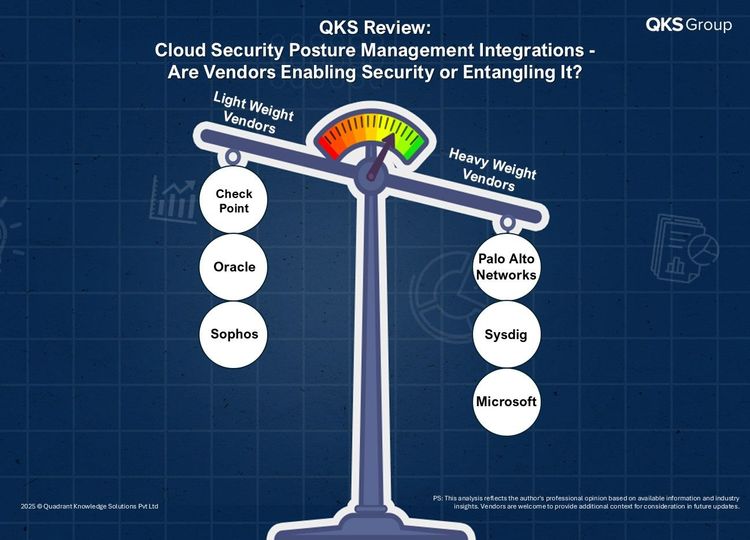
• Sysdig, Microsoft, Palo Alto Networks provide broad, mature integrations across runtime, ticketing, SIEM, and DevOps systems enabling automated, context-rich workflows.
• Check Point, Oracle, Sophos support essential connectors but rely heavily on scripting, webhooks, or manual configurations slowing down automation and increasing operational effort.
Standards for Effective CSPM Integration
Effective Cloud Security Posture Management (CSPM) integrations hinge on both depth and breadth, depth in terms of the richness of each connector (e.g., telemetry fidelity, bidirectional actions, policy as code enforcement) and breadth in terms of cross platform support (across Azure, AWS, GCP, on-prem, and container environments). Poorly architected integrations can introduce alert duplication, maintenance issues, and ambiguous vendor support undermining the very security posture the tool was designed to improve. Conversely, tightly woven integrations can drive measurable reductions in mean time to detection and resolution by automating end to end workflows.
This review evaluates six leading Cloud Security Posture Management (CSPM) platforms, organized into two integration maturity tiers: Advanced Integration Frameworks and Core Integration Frameworks. These classifications reflect the platforms’ ability to support end-to-end workflows or, conversely, their reliance on manual processes and custom configurations.
Advanced Integration Frameworks
Sysdig Secure stands out in containerized and Kubernetes environments, offering strong visibility through its eBPF-based agent and Falco integration. It supports log exports to SIEM platforms such as Splunk, Elastic, QRadar, and Sumo Logic, and enables automated ticket creation in ITSM tools like Jira and ServiceNow. Security policies can be enforced across CI/CD workflows through integrations with GitLab, Jenkins, and Terraform. Additionally, telemetry can be forwarded to Open Telemetry pipelines through custom configuration.However, making full use of these integrations often requires strong DevOps expertise and iterative tuning of workflows.
Designed with deep alignment to Azure, Defender for Cloud provides integrated policy management and telemetry, reporting violations to Azure Sentinel and creating incidents in ServiceNow. Its built-in connectors extend posture management across AWS Security Hub and GCP Security Command Center, supporting enterprises with hybrid or multi-cloud strategies. Integration with Entra ID and GitHub Actions enables policy enforcement from development through deployment. Infrastructure-as-code scanning through ARM, Terraform, and CloudFormation templates supports early-stage compliance checks. Even so, extending this level of integration to AWS or GCP often involves manual mapping and configuration, which can increase operational overhead.
Palo Alto Networks Cortex Cloud
Cortex Cloud delivers consolidated posture management, threat detection, and workload protection through a single, integrated platform. It offers mature connectors for Splunk, QRadar, ServiceNow, and Okta, minimizing the need for custom integration work. When combined with Cortex XSOAR, it supports automated incident response through standardized playbooks. The platform also enables infrastructure policy enforcement through Terraform and CloudFormation scanning across CI/CD pipelines. However, deploying Cortex Cloud in environments outside the Palo Alto ecosystem may require additional field mappings or API customization, and certain features are only available under premium licensing tiers.
Core Integration Frameworks
CloudGuard collects its own vulnerability data and can also pull findings from tools like Qualys, Tenable, or Rapid7, depending on licensing. It correlates risks with cloud assets across AWS, Azure, and GCP, and strengthens posture using native firewall controls. Basic integration with ticketing systems is achievable through CLI scripting or webhook-based connections.
Nonetheless, building a fully automated incident response flow typically demands custom playbooks, which can slow down implementation and responsiveness.
Oracle Cloud Guard integrates with key OCI services such as Logging, Events, and Identity Cloud Service. It provides predefined templates aligned with standards like PCI-DSS, SOC 2, and ISO 27001. A Cloud Bridge template is available to support event ingestion from AWS and GCP. Still, expanding to broader multi-cloud environments generally involves building and maintaining custom event bridges or Lambda functions, making it less practical for teams seeking low-maintenance cross-cloud security posture management.
Sophos Cloud Optix enables deployment and early visibility into misconfigurations through a lightweight agent that sends alerts to Sophos Central or Jira. It supports identity integration through Azure AD and Okta and allows for webhook-based connections to external SOAR tools.Also, Terraform template scanning is included in the Professional tier. Despite these features, the absence of native SOAR playbooks and built-in threat intelligence limits its scalability, often requiring enterprises to introduce additional orchestration layers to achieve full automation.
Final Insights: Integration-Driven CSPM Selection
Sysdig stands out for container-native integrations and CI/CD alignment, though it requires strong DevOps capabilities. Microsoft Defender for Cloud is ideal for Azure-centric teams, offering solid multi-cloud support with manageable complexity. Prisma Cloud delivers ecosystem-wide integration and automation but works best within Palo Alto’s stack. Check Point CloudGuard provides rich vulnerability insights but depends on manual workflows. Oracle Cloud Guard focuses on compliance within OCI, while Sophos Cloud Optix is better suited for lightweight environments with limited orchestration needs. Ultimately, the true value of a Cloud Security Posture Management (CSPM) solution lies not just in integration checklists, but in its ability to drive fast, automated, and context-rich remediation. Organizations should evaluate platforms based on how well they unify detection, response, and risk prioritization across cloud environments ensuring scalable, cohesive defense in an increasingly complex threat landscape.
Disclaimer:
This blog is based on independent research and publicly available information. The insights presented reflect the views of QKS Group and are for informational purposes only. While we strive for accuracy, we do not guarantee completeness or absolute correctness. Vendors are welcome to provide clarifications or updates. If any vendor listed in this analysis wishes to provide additional context or clarification, we welcome a briefing call and will consider incorporating relevant updates. This analysis is not intended to disparage any vendor but to provide an informed, balanced perspective. We encourage open and constructive dialogue to foster transparency and a deeper understanding of the industry.
Author: Aiyaz Ahmed, Analyst at QKS Group
Vendors: